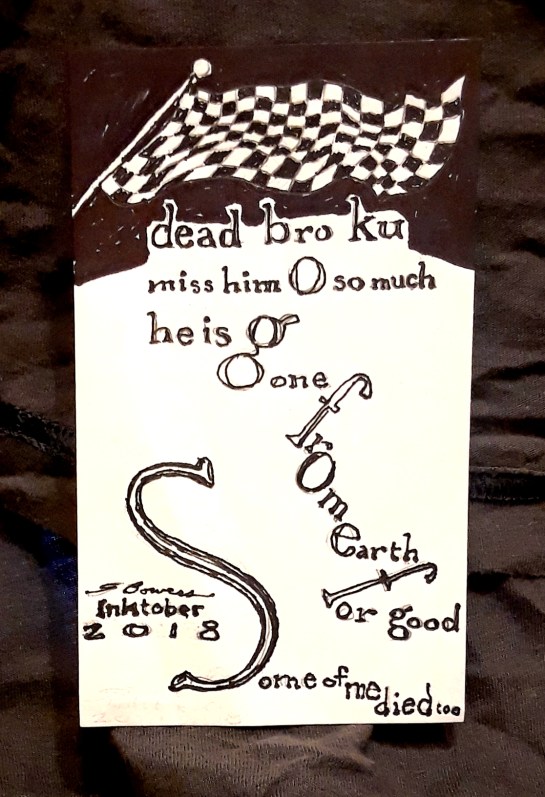
dead bro ku
miss him o so much
he is gone from earth for good
some of me died too
dead bro ku
miss him o so much
he is gone from earth for good
some of me died too
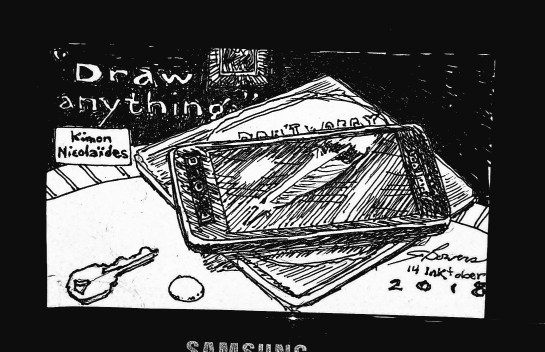
Many years ago Kimon Nicolaïdes, an art instructor, produced an immensely popular book, The Natural Way to Draw. The book is full of wisdom, including a schedule of drawing exercises, a boatload of drawing examples from raw beginner to accomplished master, and the two words of advice that have yielded for me almost fifty years’ worth of rich reward: “Draw anything.”
A willingness to draw anything is a willingness to fail. Every drawing is an approximation, but some subjects for drawings–layered reflections, for instance–are acid tests of patience and skill. The drawing I provide for this post certainly fails the test. It is clumsy and compositionally shaky. But my next drawing will be better precisely because this one is so flawed. It builds my determination to slow down, focus and consider. The next drawing is always, to some extent, an apology and a repentance for previous drawings.
I do not work hard enough on my art.
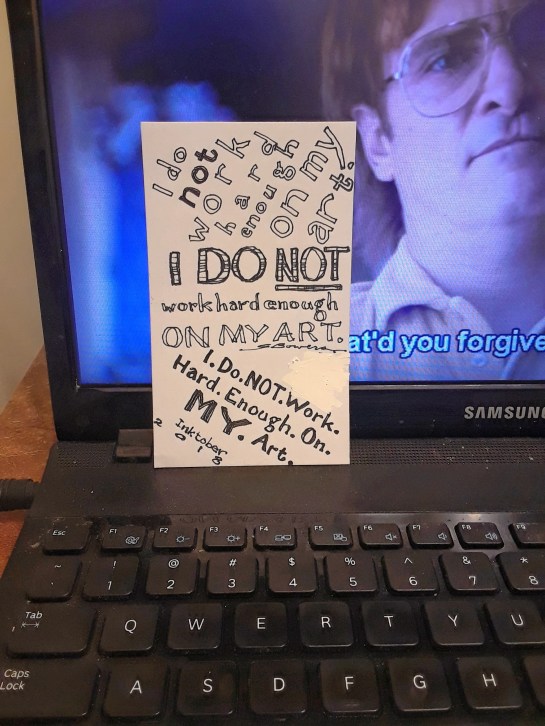

What makes this more than a doodle is…nothing. It is just a doodle.
But when I make a doodle, I feel better. While I make a doodle I become calm. Stressless, expectationless drawing yields the same contentment as chewing a nice wad of sweet gum. So for me, to look at the doodle I made is to surround myself with contentment. It is the next quantum shell of passivity.
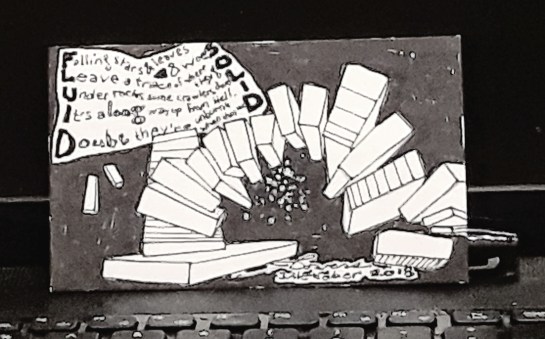
Fluid Solid
Falling stars and leaves and woes
Leave a trace of where they go
Under rocks some crawlers dwell
It’s a long way up from Hell. I
Doubt they’re unburnt when they weld
In grade school we learned that glass is not exactly a solid. The teacher called it Amorphous. It can be thought of as a really slow-flowing liquid.
Sand, from which glass is made, seems liquid when it is poured.
The same word that Glass came from also led to the word Glacier. Thus language flows.
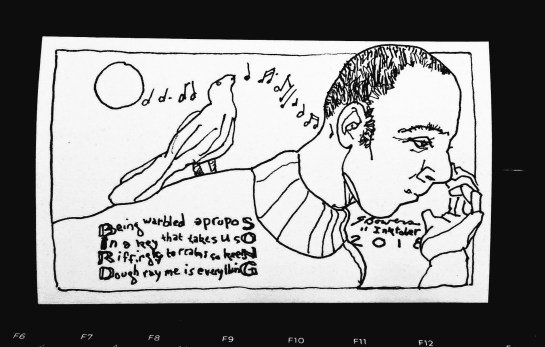
Birdsong
Being warbled apropos
In a way that takes you so
Riffingly to realms so keen
Dough ray me is everything
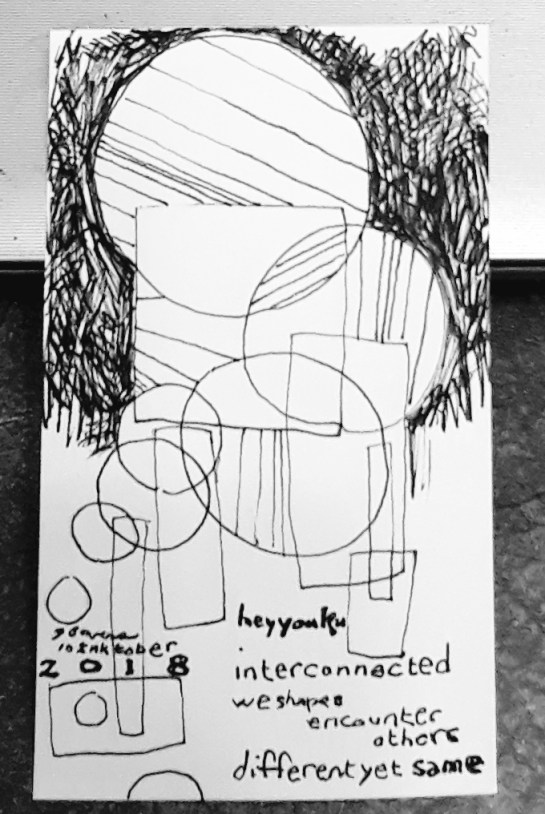
heyyouku
interconnected
we shapes encounter others
different but same
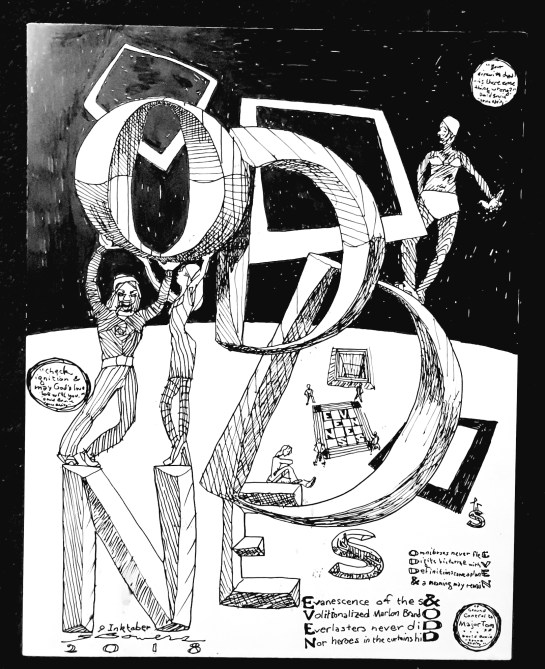
My daughter and I are both fans of David Bowie. In this image I have three lines from his classic song “Space Oddity.” They are encased in three roughly circular shapes, which mark the vertices of a roughly equilateral triangle. Such a triangular dot array is mathspeak for “therefore.”
The oddness of this image is contrapuntally offset by the evenness of the two acrostic, with their identical rhyme and meter schemes. There is also an odd sort of evenness in the balance of the image’s composition. I owe an awareness of balance to a certain Professor Scott of the University of Arizona, who used paintings by Daivd (French; roughly pronounced “dah-veed”) and Poussin (French; roughly pronounced “poo-san”) to make his case for balanced compositions.
Odd & Even
Omnibuses never flee
Digits victorize with V
Definitions carve a plane
& a meaning may remain
Even & Odd
Evanescence of the s&
Volitionalized Marlon Brand O
Everlasters never did
Nor heroes in the curtains hid
I leave you, friendly readers, with the happy notion that you may dismiss any confusion you get from the image, or the poetry, or my notes here, with this simple thought: it’s SUPPOSED to be Odd. 🙂

Iconoclastic vertex periphery? Does that make sense? Yes and no, I hope, just like that iconoclastic vertically peripheral character of the Deadpool movies, Negasonic Teenage Warhead.
And why aren’t Avert (or is it Avery?) and Virtu (Or is it Vertu?) in the title? And are those lovebirds or malevolent eyes in the lower right corner of that maybe-the-Moon?
The artist isn’t trying to be coy, Friends. (Then why is he referring to himself in the third person?) He is just taking Fuzzy Set Theory into account in his iconoclasm. You can’t have Reality without Mystery, thank Goodness.
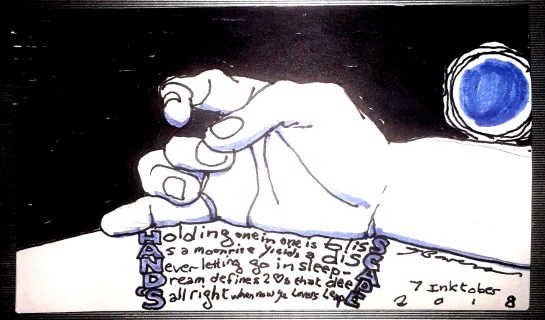
Hand’s Scape
Holding one in one is bliss
As a moonrise yields a disc
Never letting go in sleep–a
Dream defines two hearts that deep
‘S all right when ye Lovers Leape
 One with Clay, Image and Text