
Archive

Monthly Archives: July 2023

Here is the review I posted on Goodreads. I intend to post it on Amazon as well but this far there are technical difficulties…

Special thanks to my Israeli friend Davida Chazan, who as The Chocolate Lady is a book reviewer herself. I asked for her advice and she gave me good counsel.

Note/Warning: The police violence explicitly described in this review may be triggering to some.

Susan Vespoli lost her son Adam on March 12, 2022. Donnell Lindo, who at the time was a police officer for the City of Phoenix, saw Adam get into the police cruiser that Lindo had left unlocked, and he drew his gun while running toward the vehicle and fired three shots through the window. The cruiser ended up crashing against a tree. Adam was pulled from the car, and CPR was administered, but in vain.

Vespoli is on record as claiming that her writing is necessary to her sanity. It is no surprise, then, that this most tragic and wrenching of life events spurred a flurry of writing; and that’s how this book came to be.

As it happens, Vespoli has been trained to be a teacher in a timed-prompt writing process called Wild Writing. This new book of hers contains some of the wildest, most primal writing she has ever done, an improbable mesh of open-wound emotion and the precise, crystalline structure and word choice available to a poet who has been working hard on her craft for years.

In her poem “After I Read Poems About Addiction in My Family,” she tells of a woman who attended her reading and then demanded, “What makes you think it’s okay to write and share these kinds of poems?” She riposted the woman’s aggression with

“Because I believe in telling the truth
with love and I believe we’re as sick as our secrets
and I believe burying your story can kill
you and I believe that writing it out can heal.”

Those four lines, so elegantly different as conversation versus poetry, even though the words are the same, exemplify Vespoli’s wild/quiet skill. The first line ends with “telling the truth” and line 2 begins “with love.” A lesser poet would have ended the first line with “telling the truth with love.” But Vespoli knows that her reader will microscopically pause between lines. She uses that pause for a crucial emphasis on the telling of truth. Lest we imagine that is coincidental, she ends line 3 with “burying your story can kill” instead of “burying your story can kill you.” She achieves deeper meaning with that well-chosen line break, one that is eerily apt to the police violence we have had unearthed more and more in recent times. Had the bus cam not recorded that crucial few seconds between Adam’s approach and entry into the police cruiser and then-Officer Lindo’s discharging his firearm at point blank range, the account Lindo gave, claiming he felt his life was in imminent danger, and the absurdity of the description given to media by the police that Adam was trying to steal the cruiser, might have been the accepted narrative of record. But Adam’s death viewed from the impartiality of the bus cam gives such a depth to the pair of text messages Adam had sent to his mother, the first a mere matter of weeks before his death, and the second in 2021:

“I think god has another plan for my life.”
“I want to share it with the world someday
and I believe that is part of my purpose.”

Consequences related to Adam’s death by violence include the ending of Donnell Lindo’s career as a police officer; the Phoenix Police Department soliciting public input on their policy related to the use of deadly force; and the creation of this astonishing volume that is excellent poetry, but so much more. Vespoli has made a portrait of her beloved son that reveals him as a caring, struggling, vulnerable human being with love in his heart and a journey that we see was derailed tragically. Vespoli takes the book’s title from this that she said in an author’s statement:

“Every homeless person you pass on the street or in the park is someone’s beloved kid. One of them was mine.”

Please add this valuable book to your library. Vespoli is donating any profits it accrues to The National Coalition for the Homeless, Mothers Against Police Brutality, and other advocacy groups. And reading the gripping poems will break your heart in the best possible way.
Today is my two-month anniversary as a prep cook at the SSP Commissary. (SSP America is Select Service Professionals, “The Food Travel Experts,” one of two restaurant-management firms that run most of the restaurants, bars and food kiosks of Phoenix Sky Harbor International Airport. Our Commissary prepares foodstuffs for well over a dozen major restaurants at the airport.) The short version of my workday is that after walking to work, I diced and portioned eleven sheet trays of cooked chicken, and also procured for Chef Adam one gallon of mushroom gravy, prior to cleaning up my work area and heading for home. I worked almost exactly seven and a half hours today, for which I expect to net about a hundred dollars, after deductions for union dues, Social Security, Medicare, health insurance, and federal and state income taxes are taken.

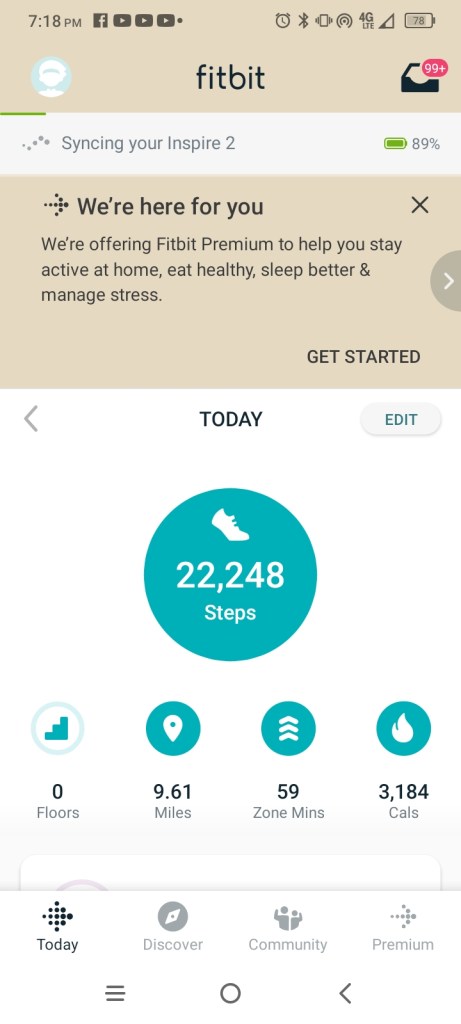
Now for some detail to help me remember in my old(er) age. My alarm went off at 2:10am. I took some medication, flossed and brushed my teeth, shaved, made my bed and laid out my work clothing, showered, dressed, fiddled around on my phone a few minutes, put my cut glove in my left rear pocket, an inkpen in my right rear pocket, my SSP cap on my head, my wallet and keys in my left front pocket, my phone in my right front pocket, and opened my front door at precisely 3am. The walk to work was 5.15 miles today, taking 11,478 steps, which is about half the steps I’ve walked today so far:

In the break room at work I drank water and a Diet Pepsi and fiddled around on my phone prior to using the bathroom and clocking in at 4:59am. I washed my hands, put on some vinyl gloves, got an apron and two squares of cloth from the community pile, put on an apron, got a little red bucket of sani solution from the dish pit, and reported to Chef Adam, asking him what he’d like me to do today. He took me to walk-in cooler C-2 and showed me a rack filled with sheet trays (“cookie sheets” in layman’s terms) of cooked chicken. “Dice. Just two sheets at a time. Keep everything on ice.”

My Mize En Place (workspace preparation; it’s a French phrase common in restaurant kitchens, and means approximately “putting things in place”) included preparing ice beds for sheet trays and diced chicken, procuring a white cutting board and a sharp chef’s knife, putting my cut glove over my guiding hand (my right hand; I’m left-handed), and putting another vinyl glove over the cut glove. I got a loaded sheet tray from C-2 and placed it on its ice bed, then got a second tray, hand-picked the chicken from it and placed all of it atop the chicken on the first tray, and took the second tray to the dish pit for washing.

Then I diced. Some weeks ago, my first attempt at dicing chicken was regarded by my boss Chef Don with baffled disbelief and a blurted “What the ####??” It was a mess, owing partly to my clumsy nervousness and partly to the use of an extremely dull knife. Now, many hours of practice later, my chicken dicing is fast and good. I’ll usually use a sort of rolling pressdown for a lengthwise cut, cleaving the meat cleanly and following it in a split-second with the next cut. After the lengthwise cuts are made, I’ll either leave the meat in place and make widthwise cuts with the knife 90° to the lengthwise, or with bigger pieces, take four rows or so at a time and rotate them at right-angle relative. There are other things I do, depending on size and skin toughness, but let’s keep it brief.

When I’ve got the piece completely diced, I usually gather it into the knife flat with my right hand and give it a two-handed flip/toss into the iced mixing bowl. I don’t always get all the dice in one gather, though. My hands (and feet) are as squat as my body is. C’est la vie.

So it went, two trays at a time, filling a mixing bowl with dice, then covering it with plastic wrap, putting a label on the wrap, and conveying the filled bowl back to C-2. (In the interest of getting the bowl back in the cooler as quickly as possible, to await later portioning into five-pound bags, I used a template that correctly identified the chicken but incorrectly identified the restaurant for which it was intended; that restaurant had plenty of room on its bottom shelf for this temporary storage, and everything going into the cooler is supposed to be labeled. I knew I would do the portioning before the end of my shift.)

Ultimately I filled three large mixing bowls, and a super-large mixing bowl, with dice. About three hours in I told Chef Adam I wanted to take my Fifteen, meaning the fifteen-minute break specified in the Union’s Collective Bargaining Agreement, and after my assurances that all the chicken was on ice, he said OK. I used the time to use the bathroom, hydrate, check my phone for e-mails and other items of interest, and flex and relax my slightly arthritic hands. After my break and before lunch, all four bowls were ensconced in the cooler, and I told Chef I was done dicing. He then asked me to check the blast cooler (a super-duper deep freeze in the approximate center of the Commissary workspace, where hot items are quickly and safely reduced in temperature) for gravy, and to bring him a gallon of it. I found several trays in there, one with its temperature being taken, and reading out below 73 degrees, so after sani-cleaning the thermometer I took out two trays that I knew would together yield at least a gallon. I got a gallon container with lid and a large metal spoon from the utensils racks, used the spoon to stir the goopy gravy in the tray, and carefully-but-quickly ladled gravy into the container until it was full. Though I was careful, some gravy ended up sliding down the outside of the container, so I sani-wiped the container after securing the lid.

Chef thanked me, and when I said I’d like to go to lunch, smiled and said, “NOW you can go have your lunch.” Lunch is prepared and provided free to us, every shift. (I forgot to mention the 6am morning meeting, where we all gather and Chef has a few words with us. This morning he mostly thanked us, because our shelves were well stocked and we were keeping things cleaned and working hard. He also told us lunch would be chicken sandwiches, tenders or patties, and French fries. There was also an ice bed full of salad fixings and sauces.)

When I got back from lunch I retrieved, one at a time, the mixing bowls from C-2; did a new Mize En Place with a digital scale, plastic bags, and blue zip-ties; and portioned the dice into the bags, which we do a bit of quasi-origami with so that they retain an open-container shape on the scale while we fill them with product. In the case of chicken dice the best conveyance from bowl to bag is with gloved hands. When the readout is close to five pounds you’ll add a few dice at a time till it gets to 5.00 or a bit over. I like it exact.

Long story just a little longer: The dice filled 13 bags, and partially filled a 14th. The bags were properly labeled and put on the appropriate shelf of the restaurant for which they were designated. (Note: chicken and other poultry must be stored below every other type of meat; everyone with a Food Handler’s certification learns that.) The total chicken dice yield was therefore just shy of 70 pounds. After I’d finished portioning and conveying, I took all washables except the knife to the dish pit, sharpened and sani’d the knife and returned it to where I had originally found it; sani’d my work counter, swept the floor around my workspace, filled a mop bucket with floor-cleaning solution, mopped my area, took mop and bucket back to the back and dumped the mop water, and leaned the wrung-out mop upside down in the utility room to dry. With my workspace having no trace of my previous presence, I felt free to go, so I removed my apron and placed it in the to-be-washed bag. I clocked out at precisely 1:00pm.

For a guy who started two months ago, the work described above is a fairly decent shift’s worth of justified existence; but I intend to get much faster, more efficient–defter. Acquisition of Deftness is one of Life’s great joys.