20190512_082958

I think I owe some of how this turned out to Fernand Léger. I wasn’t thinking of his stuff when I did it but the light-to-dark value transitions sure look familiar. I gratefully acknowledge whatever influence he has had.

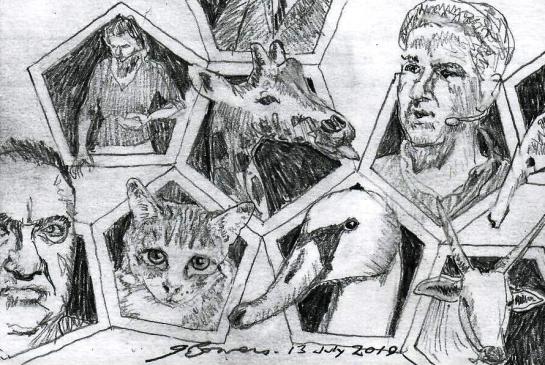
Forces! Innumerable photonic wavicles either strike us or go through us constantly. Alter our sensoria and our view of our personal space is much more dazzling, and confusing. Concentrate on certain wavelengths and we learn more. Let them all register at once and Chaos reigns.

2019 0510 here

Here is a loose interpretation of a photo I took of myself earlier this morning. I drew this to distract myself from the injured knee that is keeping me home from work today. It worked so well I forgot to take my pain medication.

As with most of my drawings, I end up feeling that this drawing is not an end in itself but a stepping-stone to the next drawing. “The next one will be better” has been my mantra for many years.

Here are the final two pieces of the portraiture puzzle I set out to resolve.

First was a value study. This was not an end in itself, but a means of informing the final version of the portrait.

2019 0507 kf 4

Lastly, full circle with pencil, not crayon. This is the best likeness and mood-capture of my friend that I am capable of doing right now.

2019 0507 kf 5

I did my best, but (of course!) I am still dissatisfied. I will show my friend tomorrow. I hope she will like what I have done.

2019 0506 about to happen

Continuing to explore the possibilities of crayon, on a hunch I blocked out a simple pre-death scene, using a couple of widely-understood symbols. The crayon does seem to enhance spookiness.

There are more “suspects” in this Who’s Gonna Die mystery than meet the eye. Some viewers will come up with a far more interesting story than I ever could, and I would love to hear them…

Here is what happened when I Tried Tried Again.

2019 0505 kf 2

Still too harsh, and Kelly’s eyes have a dreamy quality that I have not gotten right yet. There will be two more tries up the road a bit, another in crayon and the final one in pencil, coming full circle.

2019 0505 kelly felicia

Here is another try at capturing the inimitable Kelly Felicia. It is Conté Crayon on Canson Black Drawing paper. I went this route this time around because I thought it would reveal facial planes of light better. It does, but my relative inexperience with white Conté compared to regular pencil is making me wrestle and strain, and it shows. I would call this attempt neither failure nor success. I will try again.

2019 0501kelly felicia

Here is a sketch of my co-worker from the African country Liberia. Some of our colleagues call her Kelly and some call her Felicia. I call her Kelly Felicia, which amuses her.

I admire her immensely. She can do many things well. On the job she is versatile and a consummate professional. She can cook tirelessly, ring a cash register speedily, and break up a logjam in the Dish Pit expeditiously. And she does not complain; she is almost always cheerful.

Attempting her portrait, I am running into the quicksand of trying too hard, because getting this lovely and depth-revealing face just right is a fearsome responsibility. So the compromise I made with my artistic integrity was to do enough sketching of Kelly Felicia to learn how to make a reasonably recognizable face. This portrait was good enough to show her, and she smiled and said, “Oh. That is me.”

But something that is beyond Good is demanded of this remarkable subject. Back to the Drawing Board, then!


2019 0429 danseuse

This is an unconventional study of balance. The posed dancer, the closeup profile, and the date and signature provide one kind of balance. The sketchiness with some detail is a balance of spontaneity and nuance.

2019 0429 cat bag void

I like drawing paper bags, so I started a sketch of one. While sketching the phrase “letting the cat out of the bag” occurred, and I like drawing cats, so I put one on top of the bag. Bag and cat seemed to need a context. “Void” filled that void.

But this seems to be only a step. I know if I threw a few hours of hard observational work and trial&error at this concept it would yield a more satisfying, interesting result. But I am as always in a hurry, and so this is set aside for now.

2019 0428 go away STAY HOME

When I was a freshman college student in the early 70s I took a class called CRITICAL AND EVALUATIVE READING. The class required the reading of five books of our choice, and our assessments of those books on 3″ x 5″ cards. I only remember four of the five books I chose. They were Goldfinger by Ian Fleming, To Kill a Mockingbird by Harper Lee, A Patch of Blue by Elizabeth Kata, and A Portrait of the Artist as a Young Man by James Joyce. The last was far and away the densest, most difficult of the books, and I struggled to get through it. Midway I thought I needed some help and so I bought the Cliffs Notes (or it may have been a different study guide; the bookstore had two) plot summary/analysis of Portrait. But I quickly became skeptical of the analytical integrity of the thing. Near the very beginning Joyce writes

When you wet the bed first it is hot then it gets cold.

According to the “analysis” this occurs because Joyce is riffing on the dichotomy of Heat and Cold as a theme for the book.

I didn’t buy it. I think Joyce was reporting a tiny child’s experience, one I remembered myself. It’s true, especially in winter, that the blood-temp urine starts hot and cools quickly. And the “analyst” also didn’t pick up on the growth of the sophistication of the language of the book from the very beginning, which if memory serves is

Once upon a time and a very good time it was there was a moocow coming down the road…

to the very end, which I think is

Old friend, old artificer, serve me now and in good stead.

So I ditched the Notes and struggled the rest of the way through the book solo. I can say with confidence that I did not fully understand the book and was often baffled by what was being described, or emphasized, or driving the behavior of the principal characters. My assessment was fudgy and deliberately vague so as not to be wrong. C’est la vie.

More than 40 years later, on a different index card, I’ve brought something into existence which would baffle almost anyone, and I don’t exclude myself. A person looking like a blend of Charles Laughton and Eleanor Roosevelt stares over the right shoulder of the viewer, not quite stupidly. He or she is flanked by two dichotomous (perhaps) acrostic poems, transcribed below:

go away

got a pair? well ha ha ha
get a REAL life–it’s the law
only when it’s time for tea
one might stir things gracefully

STAY HOME

Soothing makes a baby Oooooh
Touching when unwelcome: shoo
Adding moisture gains a gleam
Yawning oft subverts the theme

The good news is these are two poems in trochaic tetrameter, with perhaps perfect rhyme and rhythm. The “go away” poem does seem go-awayish, and the “STAY HOME” poem seems to have the lulling comfort of home.

The bad news is it’s hard to tell what has been accomplished here. Some meaning had to take a back seat to the puzzle-solving of the acrosticization. As Chief Dan George says in Little Big Man, “Sometimes the magic works, and sometimes it doesn’t.”

I conclude that its entertainment value is chiefly in the niftiness of the acrostic construction, and may be enjoyed in a similar way that a Lego sculpture might, when all the pieces fit together just right. But, dear Reader and friend, please don’t struggle overmuch with the extraction of meaning from the content. It may remind you of little life moments, or it may seem off the wall. With Acrostics, a perfect blend of content and form is sometimes unattainable.