Image

Here is the text:

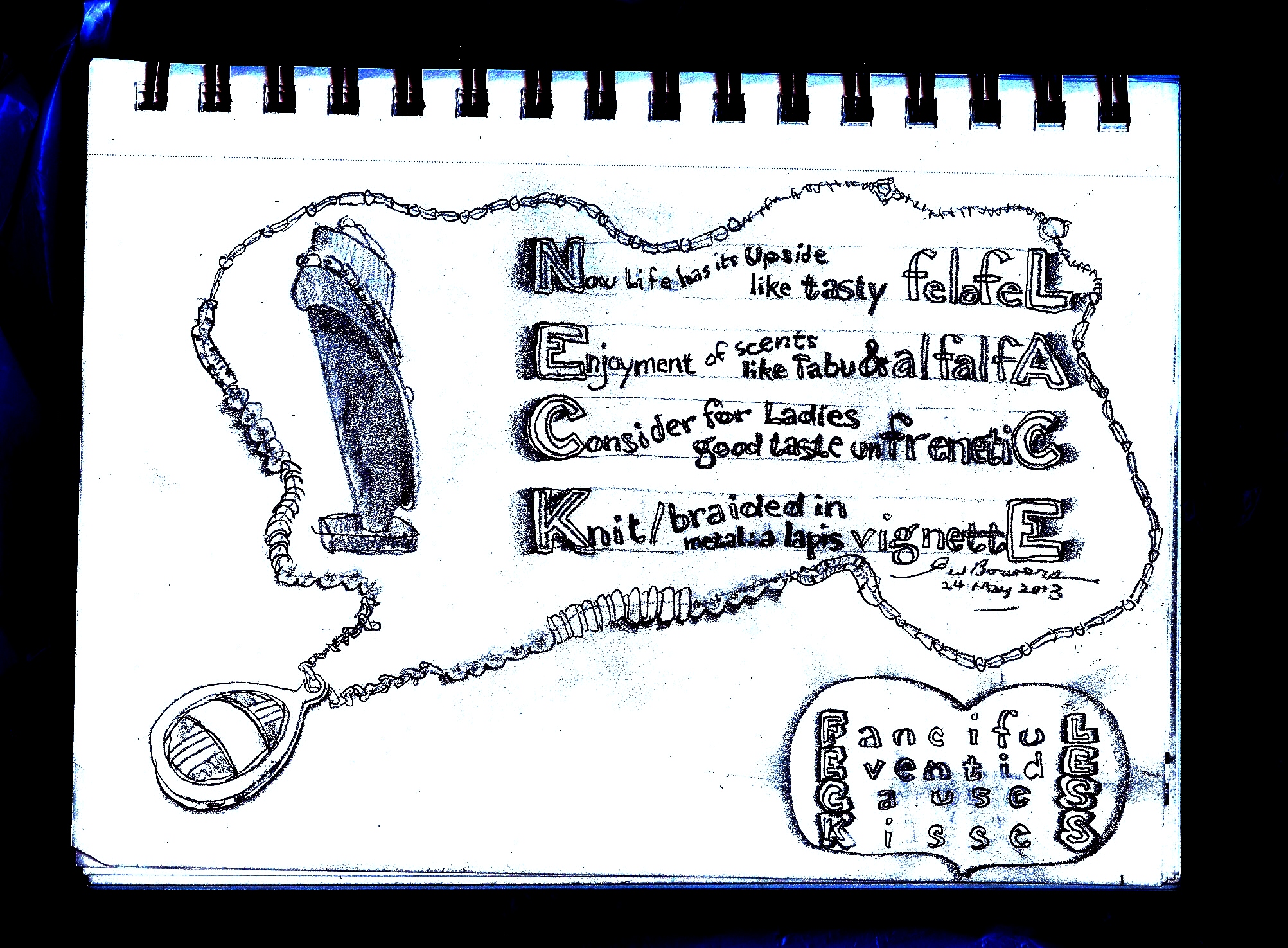
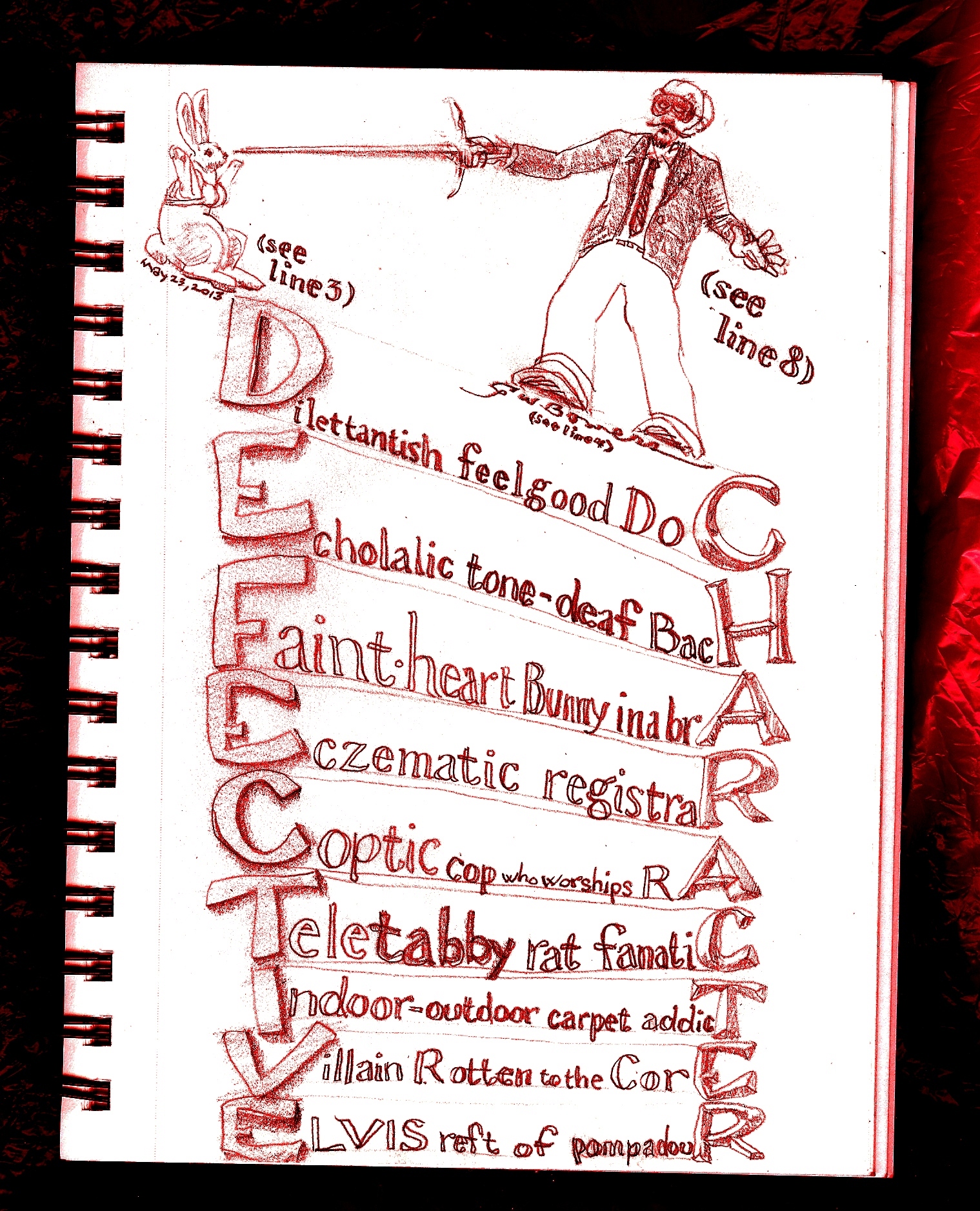
Prehensile tales of yore and more compel to take a sip
Recalcitrant curmudgeons oft complain thus get a grippe
Olfaction may be chancy on the way to Life Fornever
Suspiciousness will keep some eyes on toggle switch & levers
Perception’s doors undirtied kept that Blake bloke in the loop
Especialities for Little Deuce include a Coupe
Conveyances of sympathy enhance the Story’s arc
Then lilies and an aftershave — we’ll gleefully infarct
Investitures of efffort help to slide skate surf or ski
Vermilion may redden due to falsely hued TV
Existence–essence–let us add ENJOYMENT–let it be

Fans of William Blake–and I know there’s at least one such reading, and you should see her Lynda-Barry-esque graphicizing of Master William–are familiar with his notion: “If the doors of perception were cleansed every thing would appear to man as it is, Infinite.” Aldous Huxley did a book about his attempt to cleanse his own doors. Jim Morrison’s Doors took their name from the quotation. Alas, Perception is only ten letters long, or this would probably have been a triple acrostic…


Image

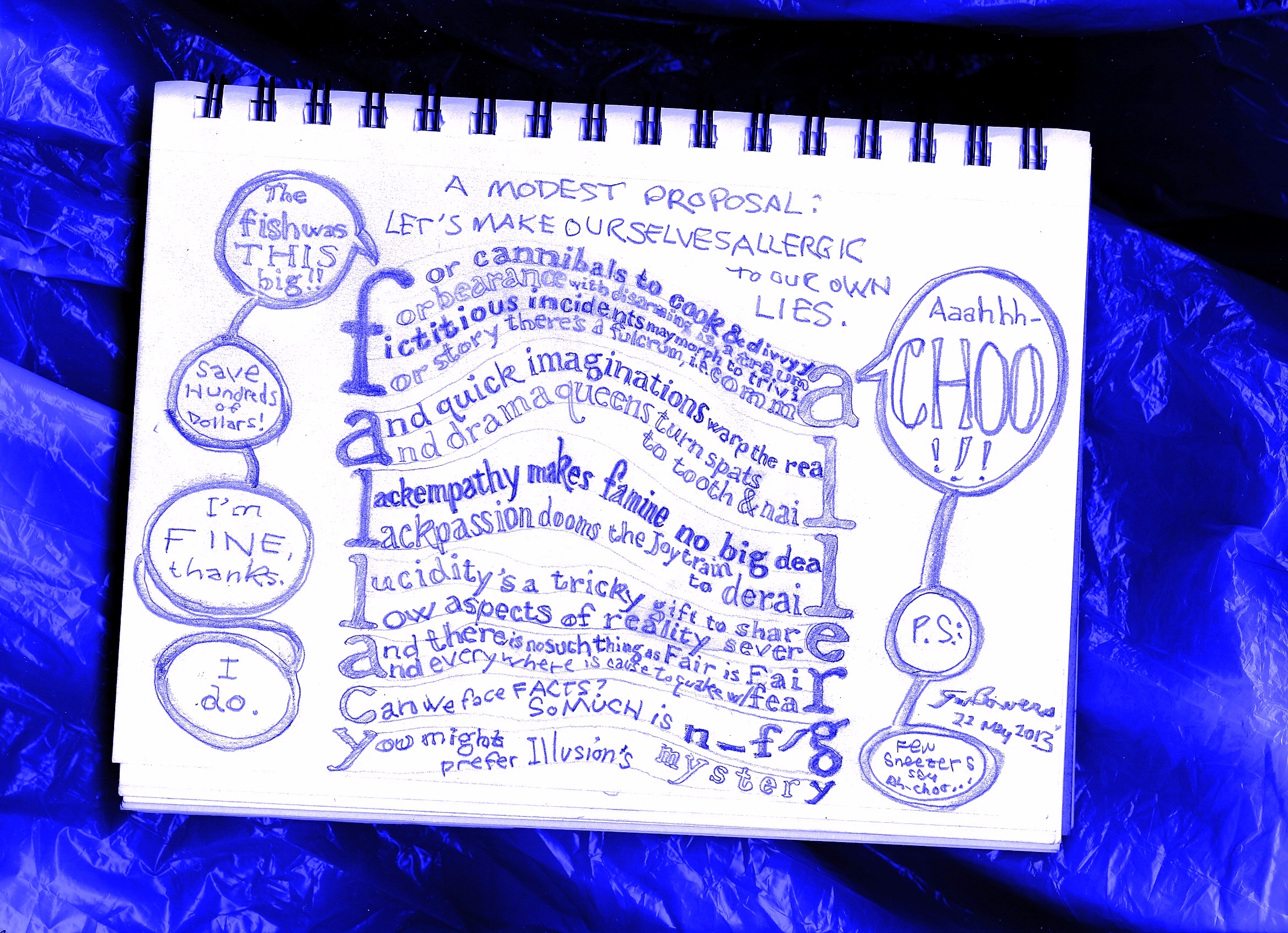
Orson Welles once described Eartha Kitt as “the most exciting woman in the world.” She was a slinky Catwoman in the campy 60’s series Batman, though she was pushing forty. Owl-Like for her big, wide-spaced baby browns; an Eel for her slinkiness.

Joseph Addison and Richard Steele founded The Spectator in 1711. It ran daily for 555 issues. Its stated goal among others was “to enliven morality with wit, and to temper wit with morality…” Why do I make Addison and Steele gelid? Mainly because I like the word; but some printmaking processes involve the use of gelatin. Call me anachronistic, but I see a connection.

The three were Good Eggs who had a good run. We still remember them today. And that makes them Eggs with Legs.

Image

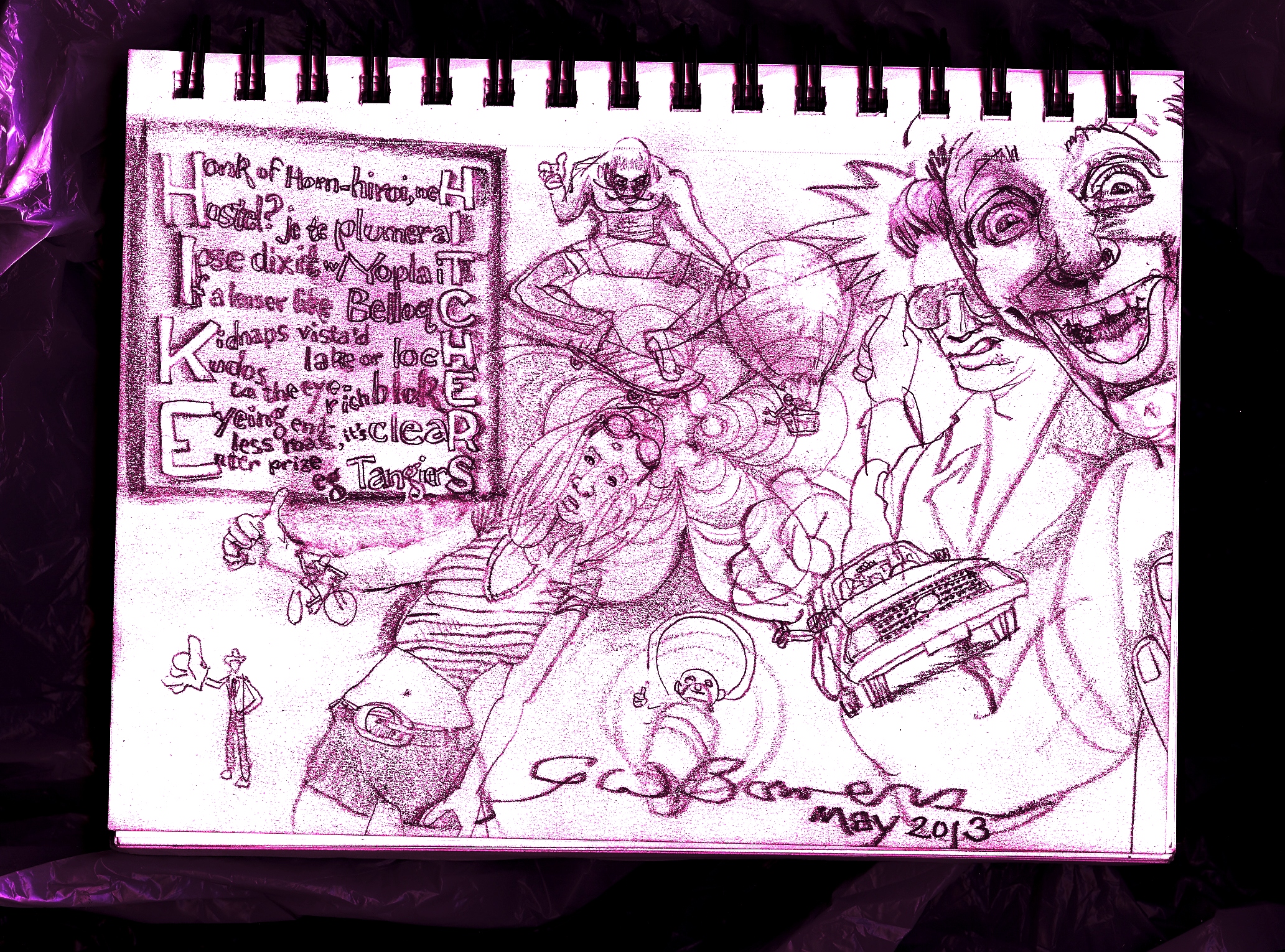
Yesterday I was hurting for time. My shift ended at 7am. I grabbed a few hours of sleep. Midafternoon, off to Cottonwood and then Yavapai College with my lovely Girlfriend; my class ended after 8 and we rolled into the driveway about 9. My journal page, which I’ve done daily without fail every day of 2013, was undone. Could I do it? Yes, but it would be a “filler” issue. Yes, but it would be KILLER DILLER filler–hey, there’s my Triple Acrostic!

(Anyone remember George Harrison’s “Polythene Pam”? “She’s killer diller when she’s dressed to the ‘ilt…”)

For the illustration, a lot of things easily morphable to Filler, Sorry about that, Phil Donahue, Fuller Brush Man, Filet Mignon, and buckminsterfullerene, you wonderful substance, you.

If you can’t make heads nor tails out of the words, remember: it’s filler. On the other hand, if you see beauty, profundity, and wisdom there, remember: it isn’t ANY old filler. It’s Killer Diller Filler.

PS RIP Phyllis Diller, from a fan.

Image

Here are three Graphic Heroes of mine, and they have three things (or more) in common. All are known more for their drawings than their paintings. All shook up the status quo. And all have known prolificity.

About twenty years ago, the Phoenix Art Museum hosted a show featuring Walt Disney, Keith Haring and Andy Warhol. Here’s what David Bryant of THE LIBRARY JOURNAL had to say about the book made from the catalog of that show: “This book is the catalog of the Phoenix Art Museum exhibit of the same title. Brilliantly colorful, this well-designed paperback is full of whimsy, fantasy, and the engaging simplicity of its images, the work of three extremely popular American artist/illustrators. The late Haring regarded Andy Warhol and Walt Disney as two of his art heroes. Kurtz, curator of 20th-century art at the Phoenix Art Museum, gathered the works for this show, many previously unseen. Haring’s exuberant, lovable cartoon art serves as the glue uniting the work of the three artists. Brief but well-constructed essays on Disney, Haring, and Warhol serve to clarify the role of each in American popular culture. Recommended for academic, museum, and public library collections.” My trio is not as household-namey as theirs, but the Kollwitz/Adams/Crumb trio has influenced me enormously, and I hope more art lovers become acquainted with them.

Image

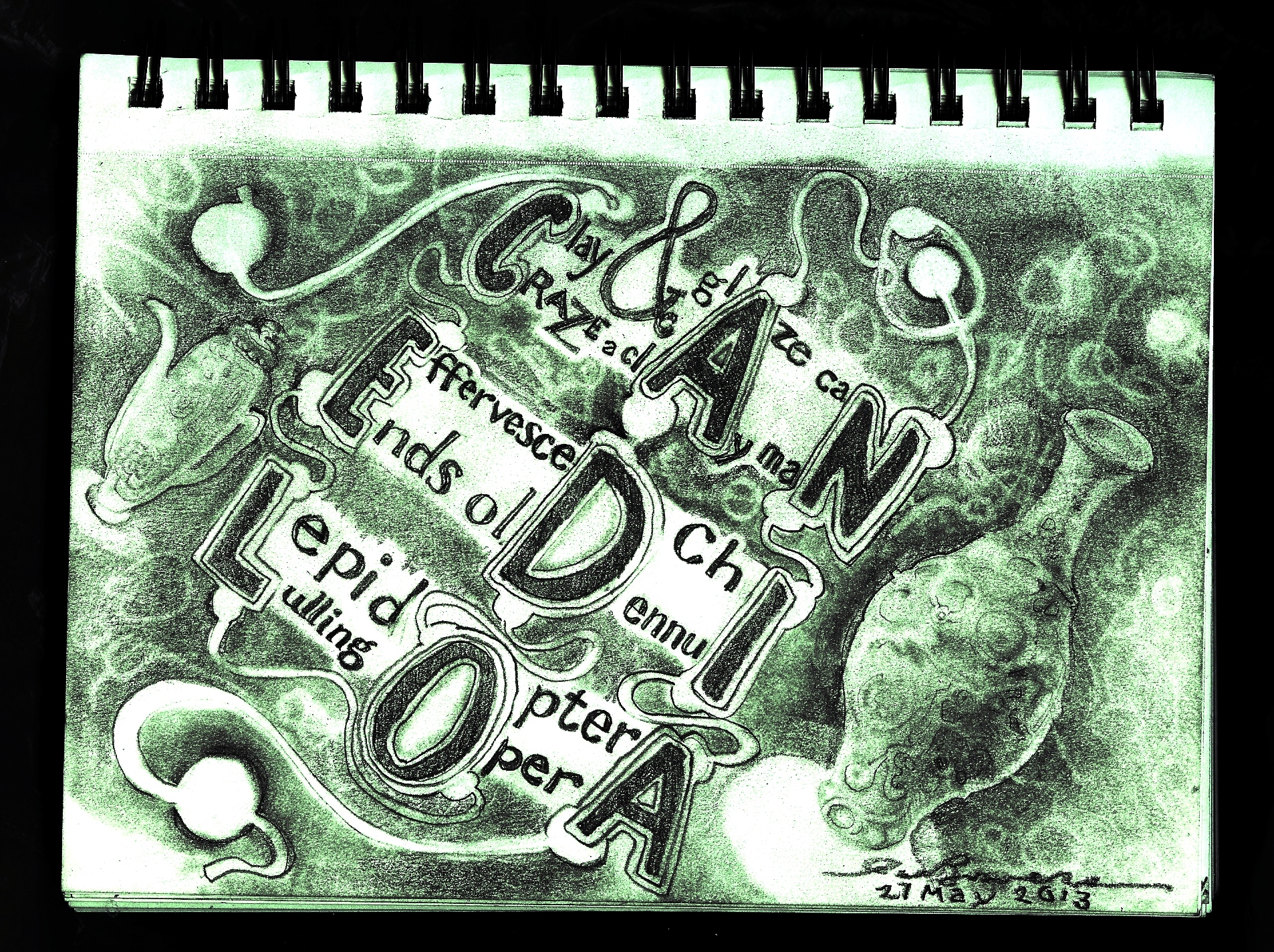
A fervent WISH/A plate too FULL/A THIN-souped dish/A KING to lull–hey, wait a minute. That’s not how this one goes.

Whether you’re after a smile or a look
Woolens hand-crafted or first published book
If you just fumfuh like long-boiled spaghetti
It all goes Uh-Uh plans torn like confetti
So: FORGET SoLILOQUIZIN’
SWOOP and SLIDE that fine horizon
Hellish hot the kiln is FIRING
Heat to FULLNESS your DESIRING

Walt Disney sanctioned a talking, singing, animated cricket to urge us all to Wish Upon A Star. And so people do. “When I win the lottery…” is the touchstone of many a wish as well.

“You’ve got to dream,” urged Conrad Hilton, and I agree. Dreams differ from wishes. Wishes are beggings; dreams require more active participants in their realizations.

Image

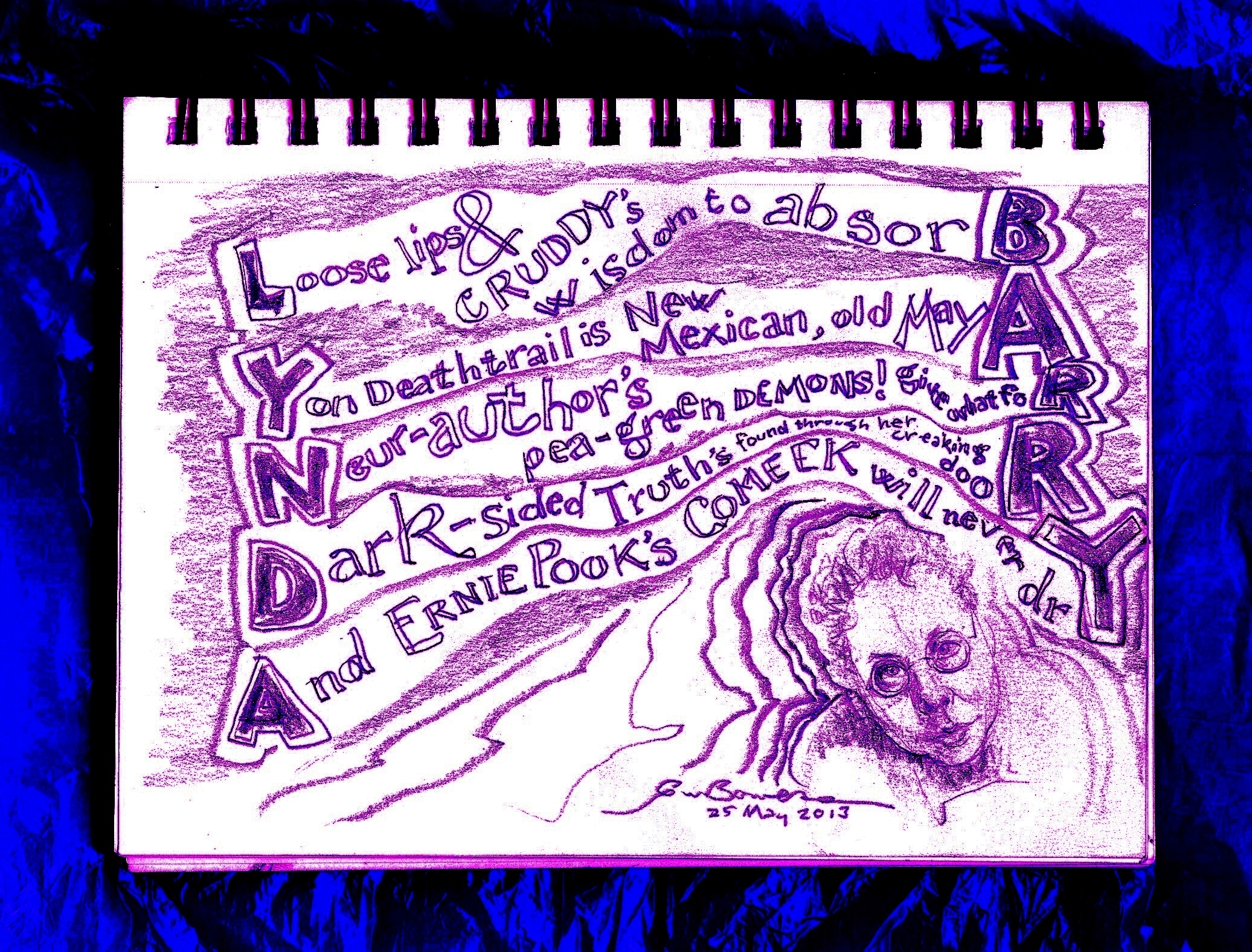
Two days ago, having just finished a journal page, I told my girlfriend I wanted to do a portrait page of someone I hadn’t “paged” before. She suggested Anaïs Nin, perhaps because I’d been affectionately calling her “Nin” (why? Long story) off and on for more than a year.

What a terrific, and challenging, subject for acrostic poetry! The biggest challenge would be to find a word that begins with an umlauted i, i.e. ï. A capital ï, i.e. Ï, never “occurs in nature” since the umlaut in ï is that peculiar species of umlaut known as a diaeresis, which is a diacritical mark that indicates a new syllable. Since the first letter of a word starts a new syllable by definition, the diaeresis isn’t needed and wouldn’t work. What to do? –Well, heck and gee-whiz, what if I treated those two pesky dots not as an umlaut, but as two-thirds of an ellipsis, i.e. .. ? Then I could put an extra line in that began with an ellipsis–problem solved. (One of the things I LOVE about acrostic poetry is the challenges it creates. Solving odd problems like these forces creative solutions.)

That wasn’t the first problem, though. The first problem was, before I got to the acrostic poetry, I had begun the illustration.  My illustration featured nudity in the form of a nude, reclining Henry Miller and June Mansfield. I drew, both with them and with Ms. Nin, not from a photo source, but from imagination; and my imagination used not real life but actresses and actor from the film Henry & June, which I’d seen only once, and that about twenty years ago. Consequently the full-faced Nin looked less like Anaïs Nin and more like Maria de Medeiros, though not much like either (I most definitely do NOT have a “photographic memory”). But the bigger problem was the nudity. Though it is not a violation of WordPress terms & conditions to include nudity, it is frowned upon on certain other sites where I might wish to post my page. I HATE censorship, but I solved this problem by self-censoring.

Before I did the portrait fix-ups and the clothing of the nudes, though, I scanned the work in progress. I leave you with that image:

Image

Image

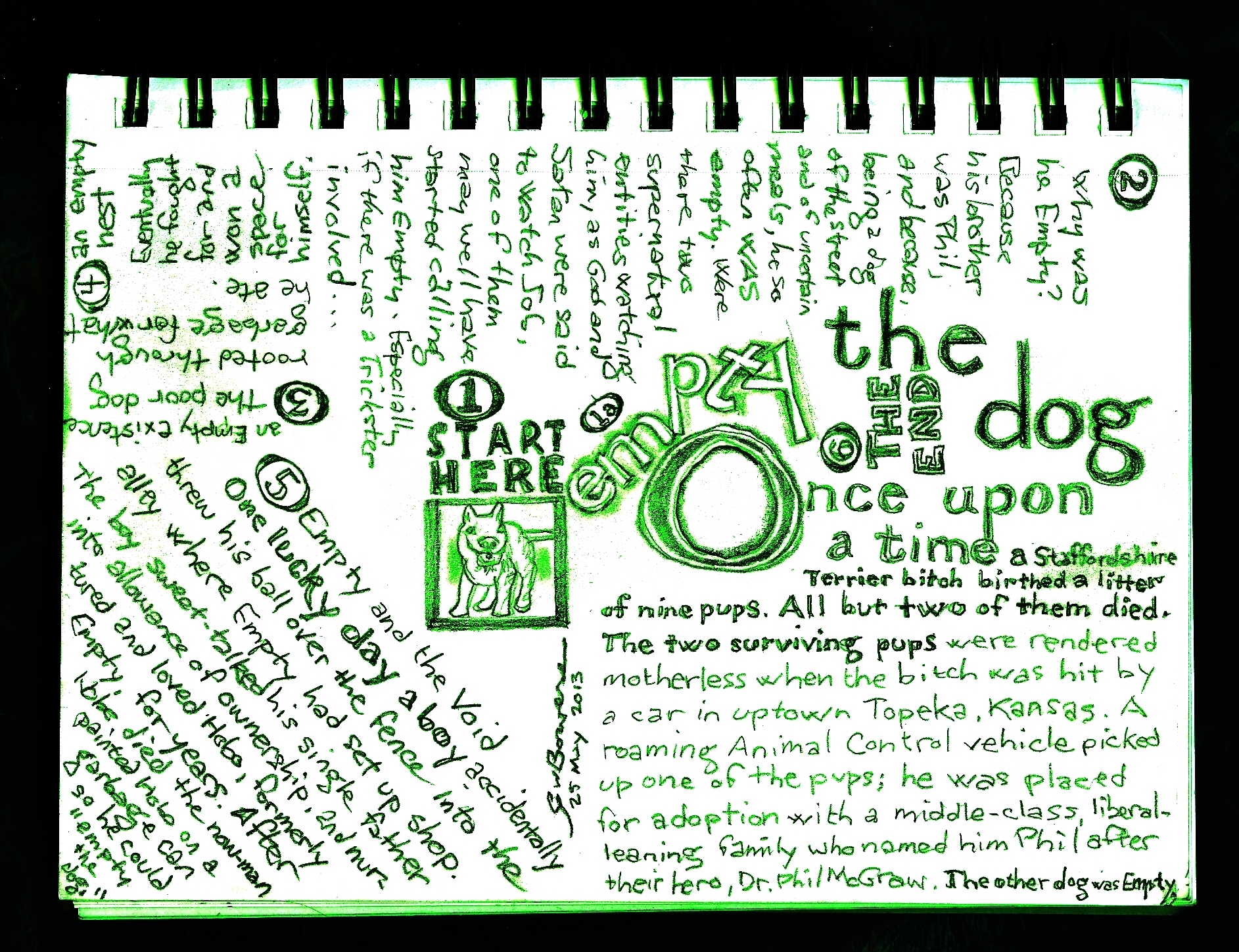
The above platitudinous-yet-true page was, in a way, more than forty years in the making. In June of 1971 I and many other high school students from various Arizona towns spent a week in the high country near Prescott at a “human relations camp” called Anytown. The camp’s reason for being was to mix kids of a spectrum of ethnicities and creeds and have them examine social dynamics, particularly bigotry.

We sang a lot of songs, too. One set of lyrics started like this: “Who am I and where did I come from?/Who am I and where did I come from?/I’m a man and I come from every land./The Earth, the Seven Seas I span./Every language I understand/I’m a man of the Whole Wide World.” And another, the “root” of this journal page, started like this: “Let there be peace on Earth/And let it begin with me./Let there be peace on Earth/The peace that was meant to be…”

I recalled those lyrics yesterday, and realized that many people yearn for Peace On Earth, but far fewer let Peace On Earth begin with them. Yet Peace On Earth has a growing golden opportunity that must begin on the individual level. You who read this–and in only forty-nine entries (this is nice round Number Fifty) and less than two months, my readership includes Swiss, Romanian, Zimbabwean, Swede, and citizens of at least eight other countries–have taken the step of tapping into the Earth’s citizenry via your blogging. You wage Peace on the micro level via connectivity. Keep it up, please!

My illustration is of a Lion and a Lamb coexisting harmoniously. I mention that the Lion is “sufficiently evolved.” So must we be.

Image

This page started with the realization that the words Shibboleth and Lethal had a common letter string, and when combined made a new, potent word. (A Google search disclosed that the word had been coined already. Someone credited someone usernamed Xel for it. Congratulations, Xel!) The word was twelve letters long; soon were found two other twelve-letter words to form a potent phrase.

So what does Shibbolethal Contrapuntal Dispositions mean? Well, shibboleth once meant a tell-tale in pronunciation that revealed where someone came from. (If curious, see the biblical Judges chapter 12, verses 4 through 6.) It has come to mean some distinguishing feature of a special group. Make that deadly, and you’ve got Shibbolethal.

Contrapuntal is the adjective form of counterpoint. In music, Counterpoint is the use of a second melody that enhances the first melody via its difference. This definition has broadened to include non-musical endeavors.

Dispositions is the plural of a word that can mean either Mood or Inclination or Deployment.

Now, with the phrase to conjure with, it was time to do some conjuring. Here is the work in early progress:

Image

Most of these acrostics start with the end words, and with twelve, the main choices are strict rhyme, near rhyme, or no rhyme. Once the choice is made, the words are usually free-associated into discovery. Thus came jihad, wadi, morass, grasp, intaglio, adios, Nefertiti, appetit (which really ought to have been appétit), Kundalini, magneto (the machine, not the supervillain), Hunín (which ought to have been Junín, and which was changed), and vetoes. But it felt like the middle words should somehow relate, too.

Well, one thing led to another, and the resulting message has something to do with the terrible habit of governments and the people they are made up of imposing their opinions, sometimes in the forms of firebombings or assassination, on different nations or cultures or regimes. It is not a clear message; though three different rhyme/meter schemes were used, conforming to the triple acrostic disclarified the meaning. Still–the World is a lot like that: murky, obscure, providing frustrating clues.

A few words about the two caryatids used to illustrate a contrapuntal quality: the traditional caryatid found in Greek architecture is a support element, a quasi-pillar. Auguste Rodin gives us an idea of what would happen if an actual human being were enlisted to hold up tons of masonry. He thus brings to life that fine Greek concept, Pathos.