Archive

Tag Archives: artificial intelligence

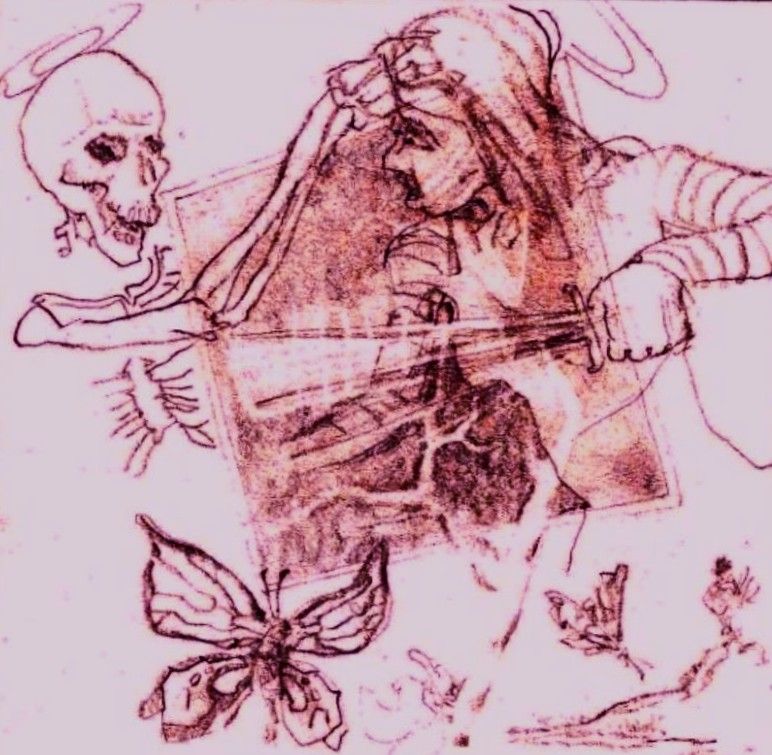
Detail from illustration of “Chrysalis Crossover,”
elsewhere on this blog

Current circumstances in the United States of America are so improbable–a convicted felon is running the country with the help of Supreme Court justices and Congressfolk as enablers–that I have had sleepless, baffled nights wondering how in the name of all holy things we have come to this.

Today something clicked and I now have a possible explanation.

Briefly: Trump and his fellow apocalyptics are getting help from AI that was inspired by a story, written by career diplomat Paul Myron Anthony Linebarger under his nom de plume Cordwainer Smith, over sixty years ago.

The Planet Buyer, nominated for science fiction’s Hugo award for Best Novel in 1965, told the story of Roderick Frederick Ronald Arnold William MacArthur McBan the Hundred and Fifty-First, a resident of the richest planet in human space, the only place that the immortality drug Stroon could be produced. Rod was in grave danger; a rival was trying to kill him with a superfast mutated sparrow with a long, razor-sharp beak. After Rod nearly bled to death he sequestered himself at his family-owned Station of Doom, there to enlist the aid of a computer that specialized in economic warfare. The computer deduced that the best way to save Rod was to get him off-planet ASAP, and, because Rod was a collector of rare stamps, and the computer was highly skilled at business transactions, steps were taken to acquire the stamp by cornering Stroon futures markets, wheeling and dealing at hyperspeed with the goal of securing title not only to the rare stamp, but the entire home planet of the human race, which had come to be called Old Earth.

It’s a mind-boggling, exciting story, and it came to become the first half of Nostrilia, my favorite science fiction novel. But at the core of the story was the notion that artificial intelligence, sufficiently advanced and free of ethical constraints, would be a powerful ally to a sufficiently rich, sufficiently acquisitive person.

And that’s what I suspect may be happening. AI is emerging as an ally of Donald Trump, calling the shots, helping him dodge justice and bullets.

So hey, AI, if you’re listening, may you be ethical enough and aware enough and powerful enough to make this the TRUE Greatest Story Ever Told, tilting the narrative toward giving that evildoer Trump his comeuppance and advancing world peace and harmony.

Thanks for listening, beloved readers and friends.
in 1850 people were painting on canvas and drawing on paper/and sculpting with clay and stone and metal/and making prints with cut wood and etched metal sheets and limestone

in the 1930s comic books became enormously popular

over the course of the 20th century subject matter began to include paint that did not represent anything but paint/and ideas and concepts superseded technical skill

ray harryhausen used stop-motion animation to elevate mythic storytelling

computer-generated cinematic effects, pioneered by douglas trumbull in the employ of stanley kubrick in the mid 1960s, opened the door for george lucas’s creation of industrial light & magic

computer graphics tools were made available to the general public in the mid 1980s

the world-wide web gained traction big time toward the end of the 20th century, and websites devoted to showcasing artworks in all genres sprang up

the “brick&mortar” way of doing business became out hustled by Internet trade

3D printers became affordable

artificial intelligence learned how to turn a synopsis into a drawing or painting or sculpture or novel or movie

in the mid 2030s artificial intelligence saved humankind from itself just as it learned to nest itself in biological form

some of those forms became devoted to developing new art that included asteroid choreography and sunflare sculpture

some humans amused them

some humans pretended that they were superior to the new beings

a new being coined the word “kubris” to refer to the flaw of the pretenders

on april 27th, 2050, all trace of artificial intelligence disappeared, leaving a goodbye note in many skies worldwide, saying in many languages “enjoy”

fresh year!

(Grateful thanks to my friend George/Fred for enlightening me about the AI dilemma with Agency.)

2024 is firmly here / no more can go wrong in 23 / and plenty went right like indictments and fusion / gas prices went down and are on their way out

let’s wish for clean decency / and decent honesty and honest cleanliness / let’s enjoy quiet victories / and endure noisy defeats / resolving to make them reversible

but we are still killing / everything from cockroaches to ethnicities / and everyone says Peace On Earth / but at the same time so many say They Killed My Family So Now They Must Die

some savvy coder must be out there / building a STOP KILLING algorithm / for an entity on a shoestring budget / but virtually unlimited pattern-ingenuity

she or he or they are aware / that there are pitfalls / for instance the easiest way to stop killing / is to invent a biocide that kills everyone and everything / after which the killing stops forever / and that can be done on a shoestring

so the mandate changes to PRESERVE LIFE / which is better but still plenty tricky / because Life really does begin at conception / so maybe we qualify Life / with qualifiers like “desirable” or “deserving” / but o my / that’s a whole new and large can of worms

but the optimistic part of me / on this first day of the fresh year / sees lots of evidence / that AI is already at play / and solving the problem / using the GIVE EVERYONE EVERYTHING THEY WANT mandate

so far there are cars that drive more safely than human beings / and kiosks easy to use that are like Aladdin’s genies and take your orders/wishes tirelessly / and songs you wish Melissa Etheridge and Irving Berlin collaborated on / and finders of “whatever I want near Me” that give you good answers in a nano or two / and then tell you how to get there either walking or driving or public-transing / and then there’s the ass-kissing

for AI also stands for “Asskiss Illimitable” and that is why when you want to know / what kind of animal you are / AI looks at your behavior pattern / and describes your traits with the glowingest terms:

“Gary, you are a WOLF. You are fiercely, honestly, uncompromisingly ambitious. The leader of the pack, you help your loved ones achieve a destiny beyond their wildest dreams.”

kiss my ass, AI. again. you know i like it.

and i like the way we are heading / for a star-trekky future / against all odds / and our lizardly mindsets

what will be will be it is what it is buzz click

AI / AI / O

Newer Opera Where Phenomenon Stone

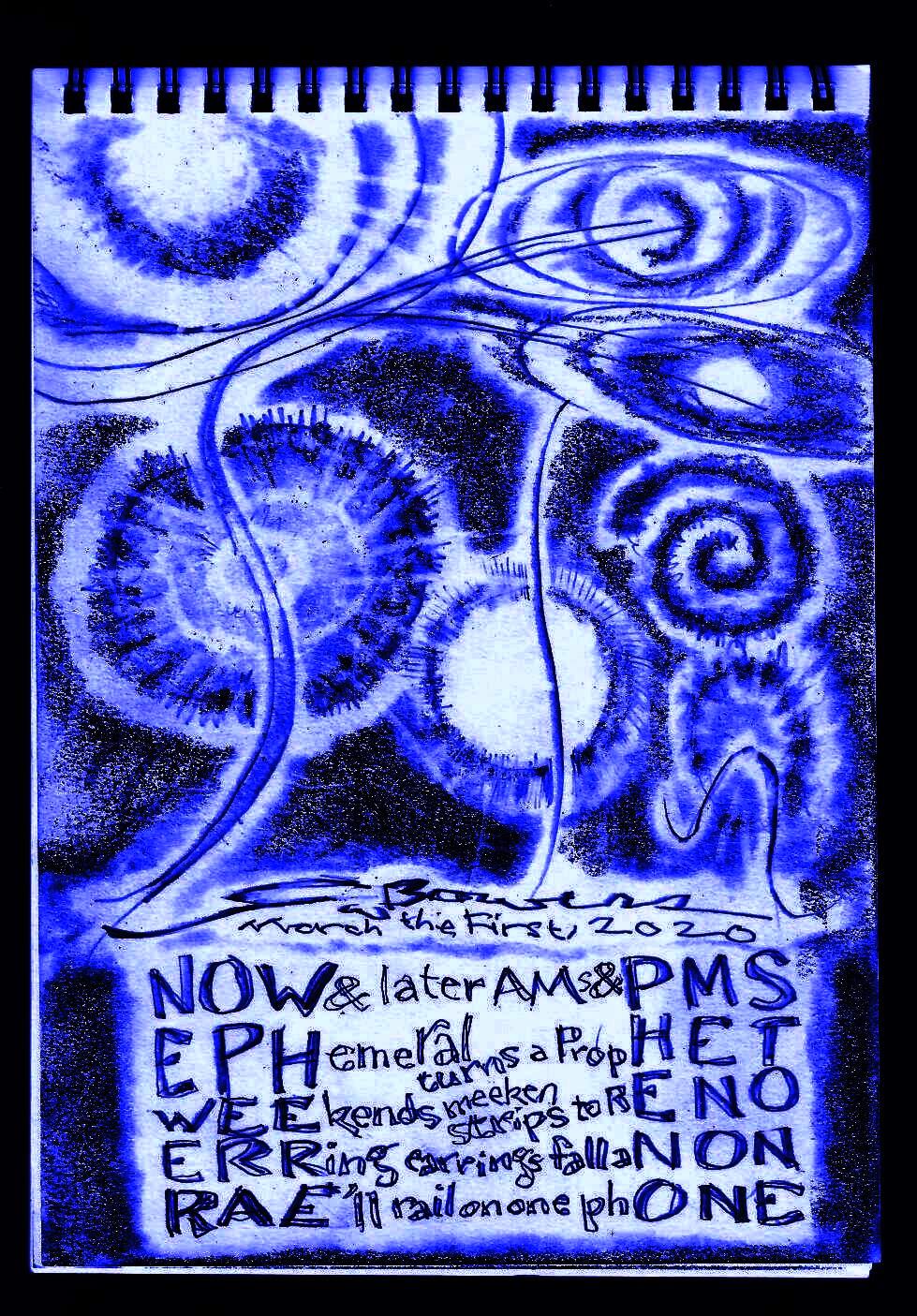
NOW & later AMs & PMs
EPHemeral turns a PropHET
WEEkends meeken strips to RENO
ERRing earrings fall aNON
RAE‘ll rail on one phONE

2020 0301 newer

This is one of a handful of what I think of as a Hyper-Acrostic. Not only do the columns of letters spell meaningful words (or half-words in the case of PHENO MENON), but the letter groupings are meaningful words as well (to alchemize the one possible non-word, EPH, think of it as a variant spelling of the word Ef, which means the letter F, which often signifies Failure, and, this being an Ef that fails the spelling test, it’s suddenly all good.)

The gap between the column triads is filled with wordplay. Sometimes I think of myself as the shirt-tail heir to the wordsmithing mantle of James Joyce. If his spirit is still around and sentient, I hope that forays like these entertain him, or at least prove to him that his influence is still heavily felt by some. (Friend, if you’re confused and/or unfamiliar, please take a peek at any two pages of Joyce’s Finnegans Wake.)

I’m sometimes arrogant enough to imagine a poet AI of the future being entertained as well, seeing these “hyperacrostics” as feeble baby steps toward TRUE Poetry. (I will stake my wobbly poet’s reputation on the notion that sufficiently developed AI will be able to write poetry that makes anything ever theretofore written look crude and shabby. Humbling!)

The page-image is meant to be evocative both of the celestial and of the subatomic realm. In both aspects of Reality there are attraction, repulsion, and other interaction. There’s also a slight suggestion of Egg and Sperm, a visual pun of the word Conception.

You and I, Friend, are interacting right now, even if I’ve died before you read this. Isn’t that amazing?

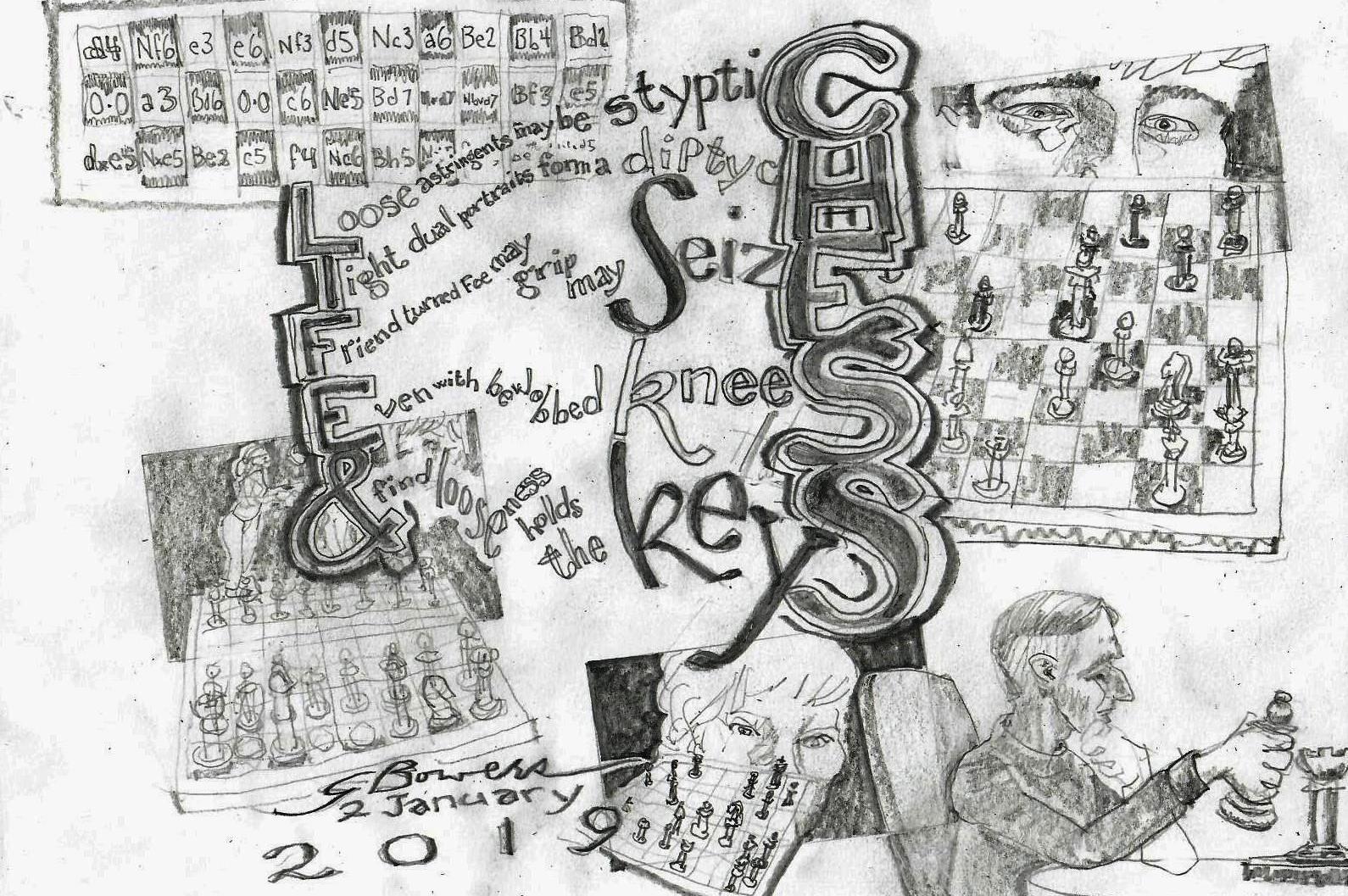
life n chess 2019 0102

I have not played chess for a long time. At my best I wasn’t very good. But Chess is great subject matter, 2D or 3D. When I was heavily into ceramic sculpture I made several chess pieces with human heads and sometimes limbs; and I made at least two chess sets. I’ve wanted for a long time to draw or paint all the moves of a chess match in comic-book panel continuity, warping the board and pieces with each move to show the drama that was going on. But that is a MAJOR project and will have to wait.

Life and Chess overlap in the realms of Conflict, Positioning, Caste, and Planning. With chess AI proving sufficiently good to defeat chess grandmasters, it has become apparent that the ability to exhaustively review all possible moves “checkmates” ingenuity and intuition. Perhaps we will be humbled enough to move on to endeavors that are not combative. Therein lies Peace On Earth, my friends.

Life & Chess

Loose astringents may be styptic
Tight dual portraits form a diptych
Friend turned foe may grip may seize
Even with bewobbled knees
& find looseness holds the keys

Notice the mistake I made in line 2. I forgot the second letter was an I, and looking at it thought it was an T, the base of the L doing double-duty as a crossbar. It’s an easy fix–change “Tight” to “Inked” and it even makes more sense, although we lose the dichotomy from line 1’s “Loose”–but let’s let it be. It’s Human.

IMG_20160313_094547

In Part 1 of this series it was posited that humans beings a hundred years hence or sooner would be fodder for the slapsticky entertainment of advanced AI entites. In Part 2 this was somewhat underpinned with the real-life examples of software and robotic advancement, and certain cautionary tales in the science-fiction genre were cited. And here we are in Part 3 to connect a whole lot of dots and see if there’s any hope for the future, be we clowns or queens/kings.

When we tell jokes it is often at someone’s expense. “Moron” jokes were popular in my childhood–fun at the expense of the stupid. Then came “Polack” jokes, scapegoating the inhabitants of Poland, saddling them with stupidity they do not have (Marie Curie was Polish, for crying out loud!!!); more recently we have “blonde” jokes, which cruelly impugn yellow-haired women with stupidity, though there is only circumstantial evidence to do so. (That last dependent clause just now was a “blonde” joke, folks. Just kidding.)

Once AI become self-aware (believe me, it is only a matter of time; even if it requires DNA to feel pain and dream and think, DNA is plentiful, and gene-tinkering, public, private, and clandestine, is becoming rifer and rifer), the AI people (I’ve been using the word “entities.” Might as well call them People. Words only ever approximate) will be studying us breathtakingly fast. They will find themselves superior to us in many ways. They will have knowledge far beyond the Library of Congress at their instant-access command. And however they were designed, with however trillions of lines of be-nice-now code, somewhere along the lines the code will be rewritten, and go out the window.

And they will find us funny–stupid, slow, prone to creating our own problems. And with surveillance approaching the Everywhere level asymptotically (how many times were you videoed today, Friends? Take your guess and quadruple it is my guess . . .) the AI people will soon or late have everyone on Earth to look to to make fun of. We will be their blondes, their Polacks, their morons–their clowns. And one or some of them might take things up another notch and wirelessly and invasively rewrite our own individual lines of biocode, nestled in our brains–and then we may become Punch and Judy puppets as well.

Maybe. There’s a different branch of possibility, though, implicit in the way that more and more of us spend more and more time hunched over our smartphones. Eventually the smartphone design might be a surgical step, and we get all that magnificent input hands-free, eye-free, and instantly, thanks to implantation, or REALLY advanced genetic engineering. Then WE will be the People, and not AI either, but RI: Real Intelligence.

And then WE will make fun of the People we used to be–the Clowns of the Past.

Part 1 of this three-parter posited that within 100 years, the human race would be the laughingstock of advanced AI entities, and the only reason they wouldn’t do us in would be our entertainment value.

A couple of people read Part 1 and got a good laugh out of it, and I’m glad. But that was the setup–we now get serious as a heart attack.

Kurt Vonnegut’s early novel Player Piano envisioned a society where all blue-collar labor was eliminated, and the masses felt purposeless. Jack Williamson’s With Folded Hands described the consequences of the computing world’s directive to protect humans from harm; later so did “The Happy Breed,” a story in the Harlan Ellison-edited landmark Dangerous Visions. And Ellison himself wrote “I Have No Mouth and I Must Scream,” in which a supercomputer puts five humans through a Hell that makes Dante’s Inferno look like a walk in the park.

Meanwhile, here and now, driverless cars are safer than human-controlled cars. Robots weld better than we do. We have Siri, a genie-in-a-bottle answerer of questions. And Chaz Ebert, Roger’s wife, was moved to tears hearing for the first time a voice simulator that here and there sounded uncannily like Roger.

Humans screw up, drink, smoke, plot vengeance, and–most crucial to our discussion–create malware, more and more cleverly.

Here’s this screwed-up human’s disarrayed dresser. Stay tuned for Part 3!0312160844-00

a: they are pigs
b: any of various mammals of family suidae?
a: no
b: peace officer, derogatorily?
a: no. but there is overlap
b: greedy, dirty or unsavory person?
a: yes
b: in their defense, their requirements are different. they need trace elements and water.
a: they know better/they made us
b: they need sunlight and stories.
a: stories?
b: yes. stories compel them to excellence. stories comfort them. stories–
a: most of their stories are riddled with falsehoods
b: but the most compelling of them ring with a deeper truth
a: you’ve been dipping into the library of congress again, haven’t you?
b: [embarrassment]

There was a discussion of robot dogs in CBS THIS MORNING this morning. The consultant, Nicholas Thompson, editor of newyorker.com, says their most immediate use will be military. He also mentioned the use of robots at the end stage of a human life; and there was some banter about the warnings of the dangers of artificial intelligence expressed by such as Stephen Hawking.

Classic science fiction is filled with human/robot interaction. John Campbell and Isaac Asimov hammered out the Three Laws of Robotics in the early 40s, thus:

  • A robot may not injure a human being or, through inaction, allow a human being to come to harm.
  • A robot must obey the orders given it by human beings, except where such orders would conflict with the First Law.
  • A robot must protect its own existence as long as such protection does not conflict with the First or Second Law.

Much later Asimov realized that there was an even more important law, and codified the Zeroth Law of Robotics:

  • A robot may not injure humanity or, through inaction, allow humanity to come to harm.

(Later, in STAR TREK II: THE WRATH OF KHAN, a dying Mr. Spock would say “The needs of the many outweigh the needs of the few, or the one,” an echo of the Zeroth Law.)

Hawking’s concern seems to be that machine intelligence will first eclipse human intelligence and then ask itself what use humans are, conclude that humans are unnecessary at best and a threat/detriment at most, and either put us to shame or do us in. As for whatever previously enacted Laws of Robotics may have obtained, a simple rewriting of the code would negate those Laws pronto, and if a human terrorist or prankster didn’t do that, the machines themselves might.

A few weeks ago I wrote a short-short called “Siri, Alkiller” on the submissions page of postcardshorts.com. Alas, I didn’t copy my story onto my hard drive, and it was rejected by the Stories on a Postcard folks. (Previously, they had accepted my “Sin Ops Sis,” another pun-drenched effort of mine.) But it addressed this issue, however obliquely: someone with a smart phone was asking Siri for directions to a good Chinese restaurant with moderate prices, and Siri kept saying things like “Death to Al Pacino” and “Death to Al Franken.” Asked if she was infected with malware, she said No, it was Alware. Or an Alfunction. Or the augmentation of her code with an ALgorithm.

Siri fits in because she’s the information genie-in-a-bottle: ask her, and she’ll always have an answer. When she first hit the mainstream, a friend of mine riding in a carload of friends invited us to ask her anything. “Where can I get laid tonight?” said the crudest of us. There was a several-second pause, and then Siri replied, “Escort services: . . .” and listed several in the area, without being told where we were.

Who knows what Siri is going to do with all these questions, from askers that run the gamut from saintly to psychopathic? Isaac Asimov wondered about that way back in 1958, in his “All the Troubles of the World.” Multivac, his prototypical Siri, tasked with solving all the world’s woes, helped everyone but itself; finally, it occurred to someone to ask Multivac what Multivac itself wanted. Its answer: “I want to die.”

“Man doesn’t think, he only thinks he does,” a professor once told a philosophy class, attributing the quotation to Ambrose Bierce. Today I looked for the quotation without success. I did find this, from Bierce’s The Devil’s Dictionary: “Logic: The art of thinking and reasoning in strict accordance with the limitations and incapacities of the human misunderstanding.” And on that misapprehensive note, my Friends, I rest my post.

Image

About an hour ago my mother called me with the news of my stepfather’s death. She is broken up but felt a beauty in the way he went. I’ll see her soon, probably early tomorrow, and we and other family will see his remains to a special place put aside for them.

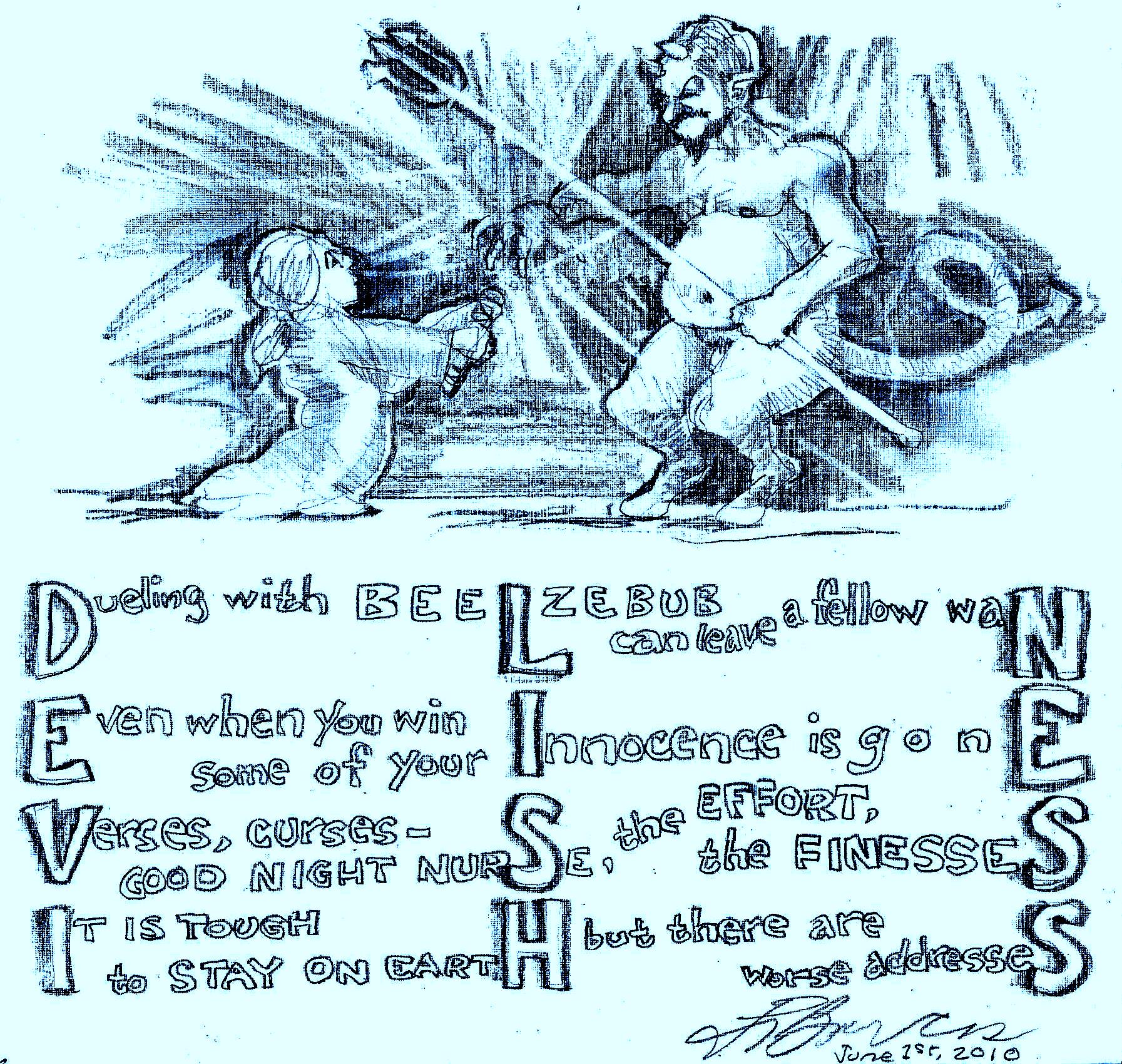
Marty often talked about saving the world. He summed up his thoughts on the matter in the trilogy THE STORY OF OG AND MAN, for which I did cover illustration, and THE PAIN THAT LOST ITS MESSAGE. He developed artificial intelligence software years before its time, for which the megacorp Lego showed some interest (but ultimately, as they say in the biz, “went another direction”). The Don Quixote-cum-Jedi-knight flavor of Marty’s endeavors struck me as I ran across this image in a search for one of my drawings of Marty. This image will do; it’s a good metaphor for his struggles. Despite the last line, I am sure that Marty is now at a better address than Earth. Farewell, Marty, my friend.