Two thousand three hundred years ago, more or less, an Alexandrian man whose name translates to “good glory” was making up rules and checking them twice, and through those postulates was born premodern geometry. To my knowledge, though, and right on through to today, not even Euclid could use compass and straightedge to perform that magical operation known as “squaring the circle” with trueness.
One of my heroes, Isaac Asimov, once wrote a science article called “Euclid’s Fifth,” perhaps obliquely referring to Beethoven, whose Fifth Symphony rivals his Ninth for space in our collective consciousness. Euclid’s Fifth Postulate, much more complicated than his first four, goes like this:
If a line segment intersects two straight lines forming two interior angles on the same side that sum to less than two right angles, then the two lines, if extended indefinitely, meet on that side on which the angles sum to less than two right angles.
Asimov elegantly demonstrated that not taking the Fifth as gospel paved the way for NON-Euclidean Geometry, which with many aspects of reality (navigating the Earth’s surface, for instance) is a better match than non-NON-Euclidean geometry.
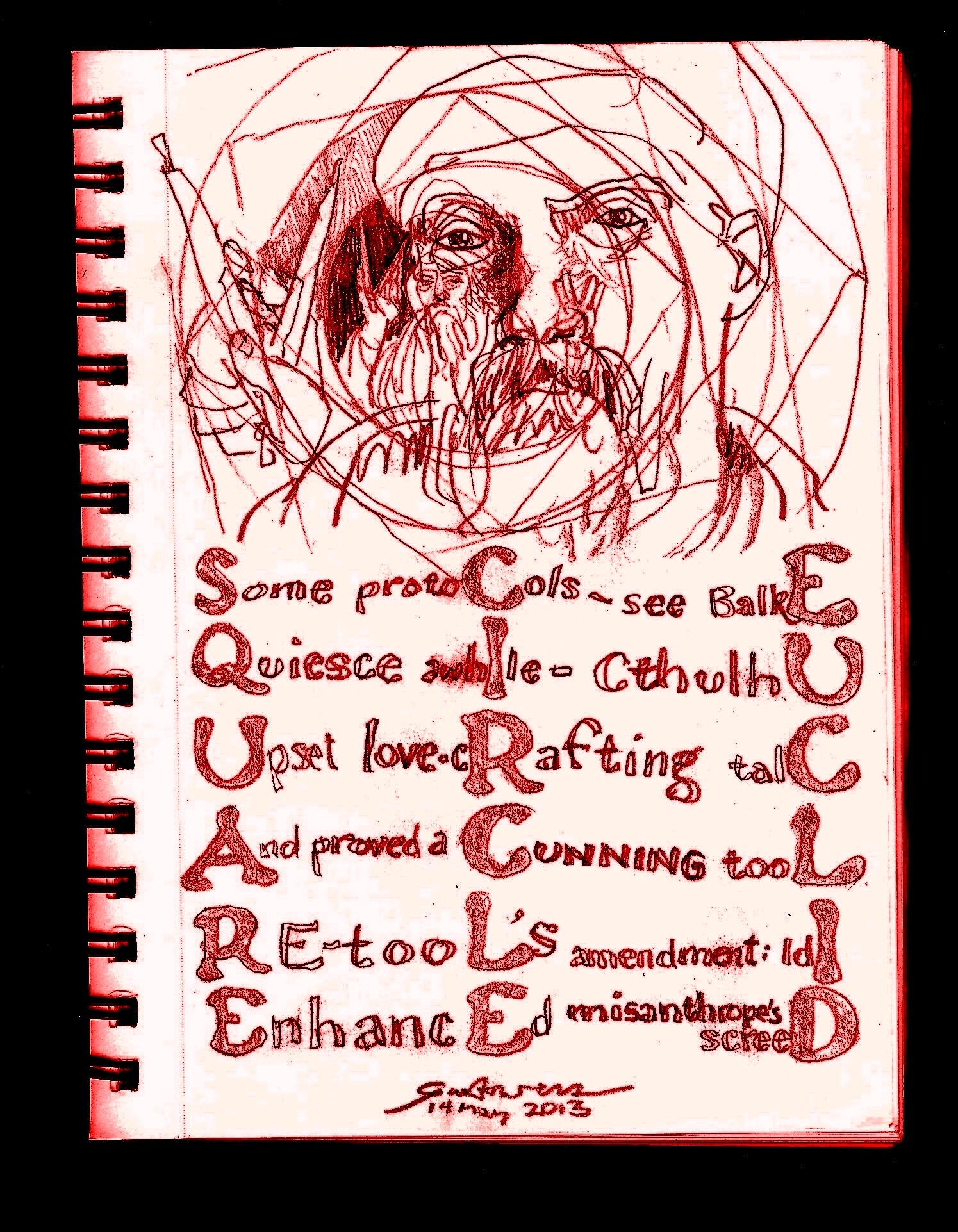
Here are the words to the triple acrostic:
Some protocols–see Balke
Quiesce awhile–Cthulhu
Upset love-crafting talc
And proved a cunning tool
RE-tool’s amendment: Idi
Enhanced misanthrope’s screed
I leave to the student the explanation of what the Balke protocol for measurement of maximum oxygen uptake, Lovecraft’s Cthulhu and Idi Amin Dada have to do with Euclid and/or the futility of “squaring the circle.” HINT: No one today really knows what Euclid looked like. Good Glory!
 One with Clay, Image and Text