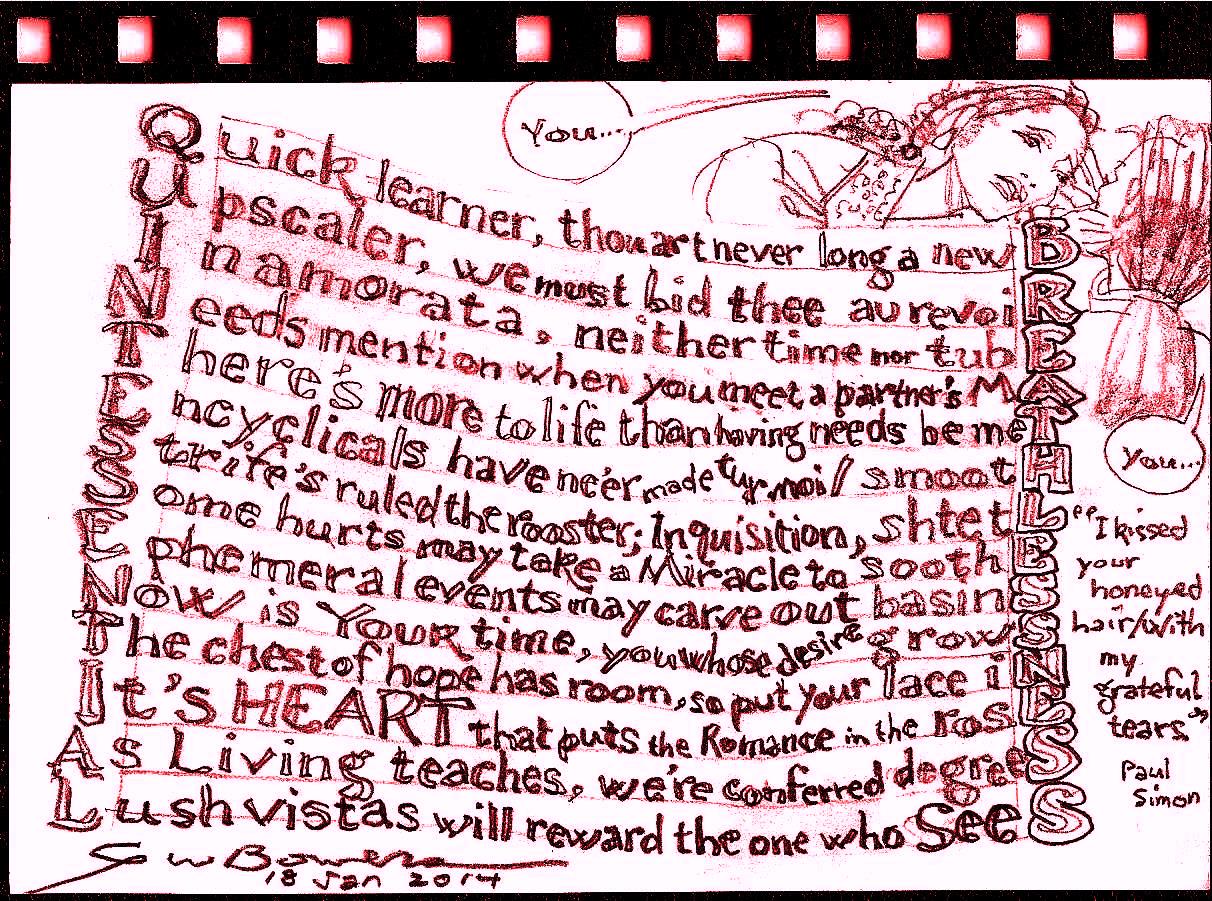
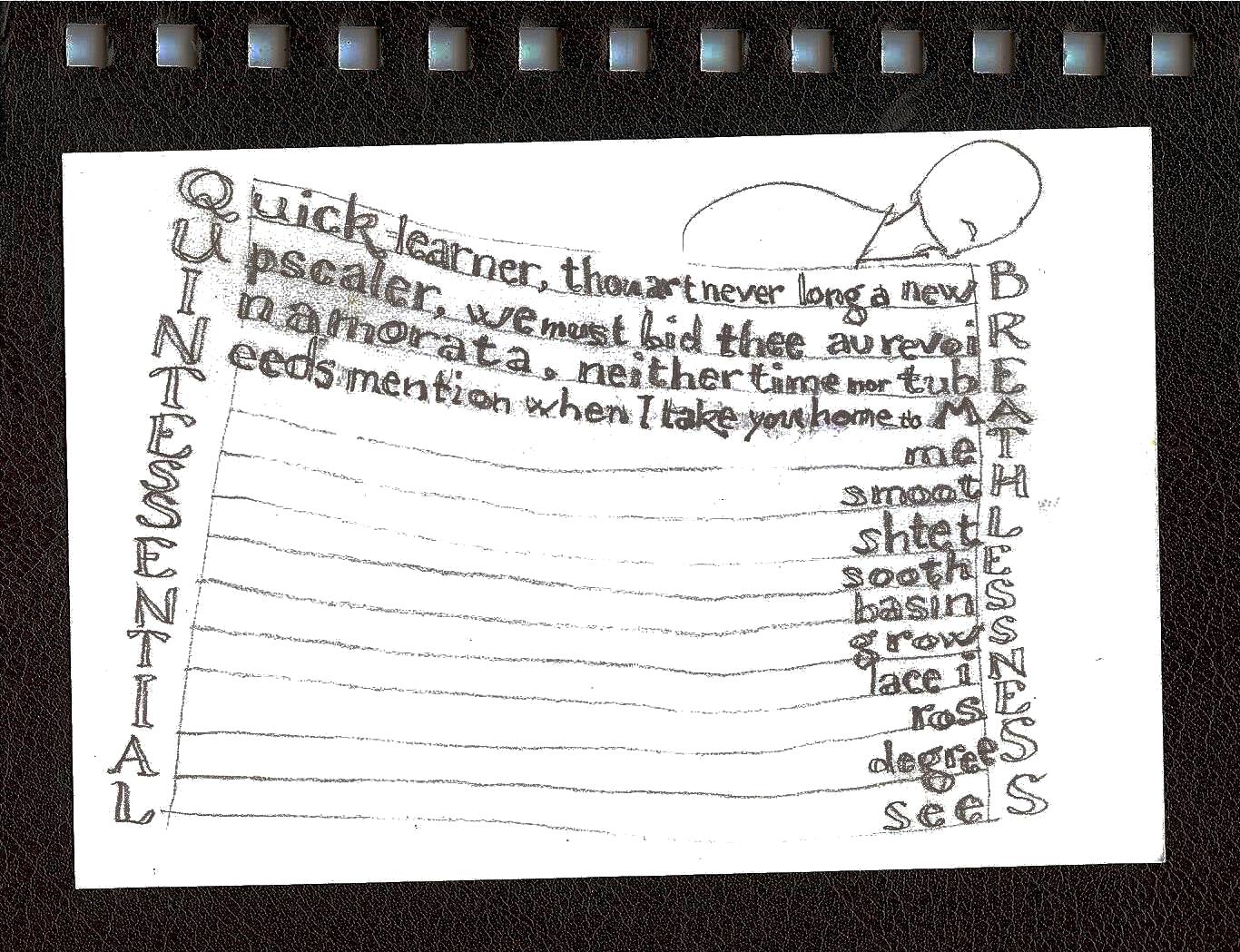
SYNOPSIS: Your narrator began composing a sonnet that had the further restriction of the double acrostic QUINTESSENTIAL BREATHLESSNESS. Four lines into the sonnet he questioned the wisdom of continuing, citing “wonkiness.”
Fourteen lines into the sonnet, it is finished, and I am glad I saw it through, though seeing it through involved a partial de-wonkitization of the fourth line. Nor am I at all certain that this is the final version; but there is enough good in it as is to make me proud and happy: it makes ultimate sense, it all ties together with the final couplet, and it tells my peculiar truth.
Again and again I learn that to see an attempt through to a state of completion is valuable and important. Why do I keep UNlearning it? Probably because it is so often easier to quit than to continue. “Who needs THIS [stuff]?” we are so prone to ask, and it is important to ask; but this time the answer was, “I do.”
Here is a transcription of the words:
Quick learner, thou art never long a newb
Upscaler, we must bid thee au revoir
Inamorata, neither time nor tube
Needs mention when you meet a partner’s Ma
There’s more to life than having needs be met
Encyclicals have ne’er made turmoil smooth
Strife’s ruled the rooster; Inquisition, shtetl
Some hurts may take a Miracle to soothe
Ephemeral events may carve out basins
NOW is YOUR time, you whose desire grows
The chest of hope has room, so put your lace in
It’s HEART that puts the Romance in the rose
As Living teaches, we’re conferred degrees
Lush vistas will reward the one who Sees
 One with Clay, Image and Text