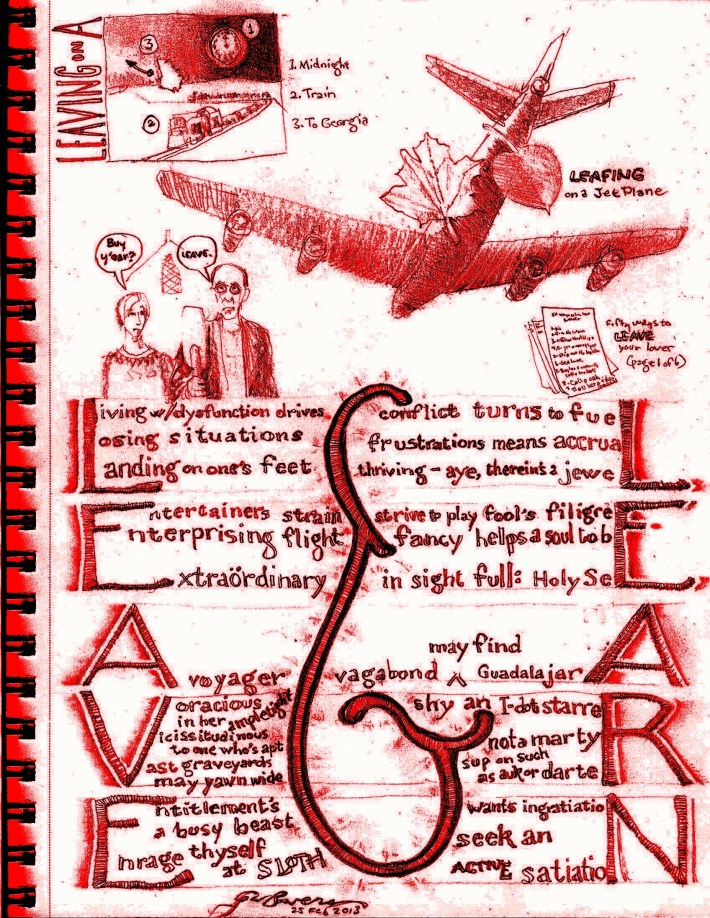
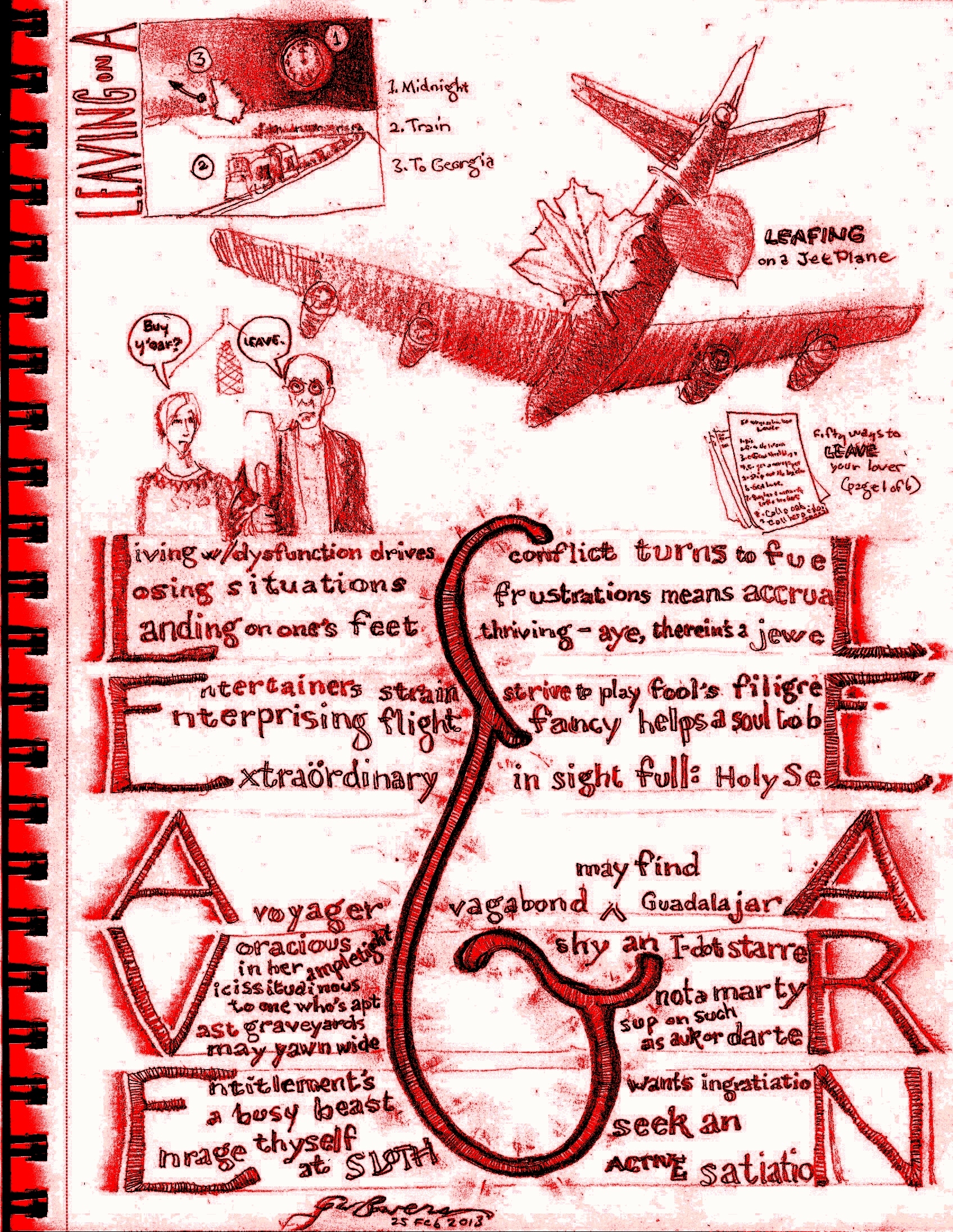
Here are the words:
Living w/dysfunction drives & conflict turns to fuel
Losing situations & frustrations means accrual
Landing on one’s feet & thriving–aye, therein’s a jewel
Entertainers strain & strive to play Fool’s filigree
Enterprising flight & fancy helps a soul to be
Extraördinary & in sight full: Holy See
A voyager & vagabond may find Guadalajara
Voracious in her ampletight & shy an I-dot starrer
Vicissitudinous to one who’s apt & not a martyr
Vast graveyards may yawn wide & sup on such as auk or darter
Entitlement’s a busy beast & wants ingratiation
Enrage thyself at SLOTH & seek an ACTIVE satiation
Here are some notes:
The word Situation once described desirable work. When I was young the classified ads of the local newspaper often had a section called “Situations Wanted” wherein the placer of the ad would describe the sort of job she or he was hoping to be hired for. Thus Charles Addams had Gomez retelling “A Christmas Carol” to Wednesday and Puggsley: “…then good old Scrooge, bless his heart, turned to Bob Cratchit and snarled, ‘Let me hear another sound from you and you’ll keep Christmas by losing your situation.’” As Richard N. Bolles has pointed out in What Color Is Your Parachute?, losing a situation is often a glorious opportunity.
I put an umlaut over the O in Extraordinary so that it would be pronounced in the reader’s head as a distinctly separate syllable. So that’s not really an umlaut; it’s a diaeresis.
An “I-dot starrer” is someone who dots their lower-case I with a star. Compare this with the “I-dot hearter.” Both subsets of humanity are cases of arrested development if the person in question is more than twelve years old.
Certain types of fish called Darters are classified as threatened or endangered. The particular auk known as the Great Auk was hunted to extinction by the same species that killed the Passenger Pigeon: Homo “sapiens,” the “human” race. Enterprise needs boundaries.
Entitlement is a hot topic nowadays. Many of my high school classmates Facebook-post denunciation of people who use welfare payments (which max out at about $900 per month per household of four, for instance) to buy alcohol and cigarettes. Some of these same classmates buy homes in the six-figure range and cheerfully claim a mortgage deduction well in excess of five figures; drive company cars to family vacations; dine and drink lavishly at “business lunches” and write off half the tab as a business expense, etc.
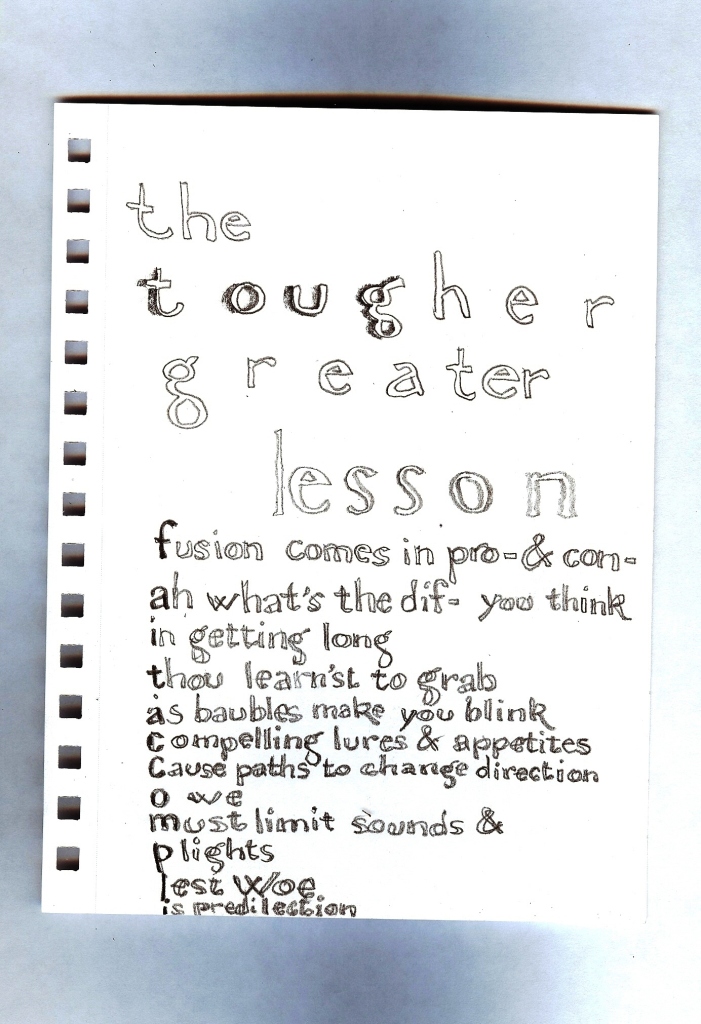
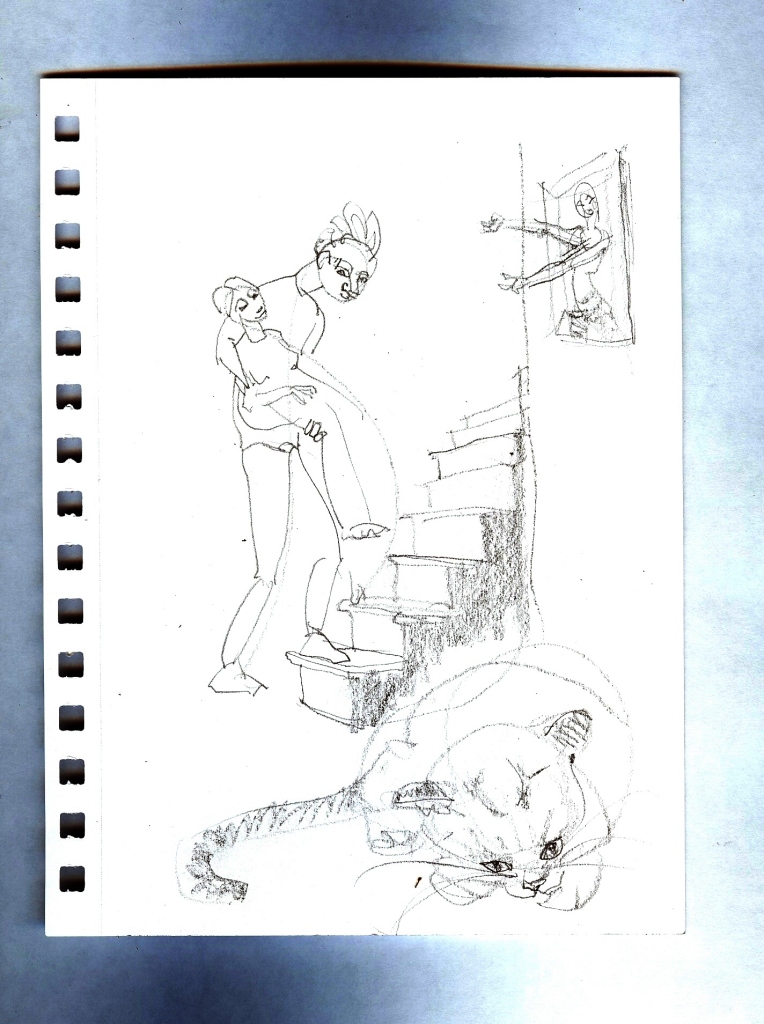
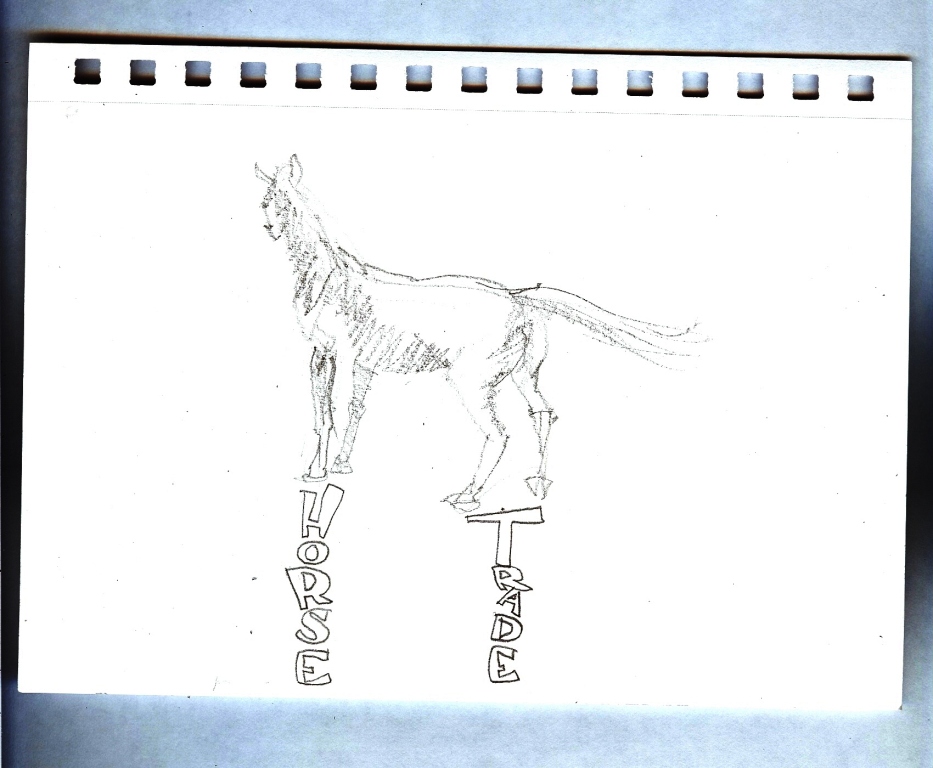
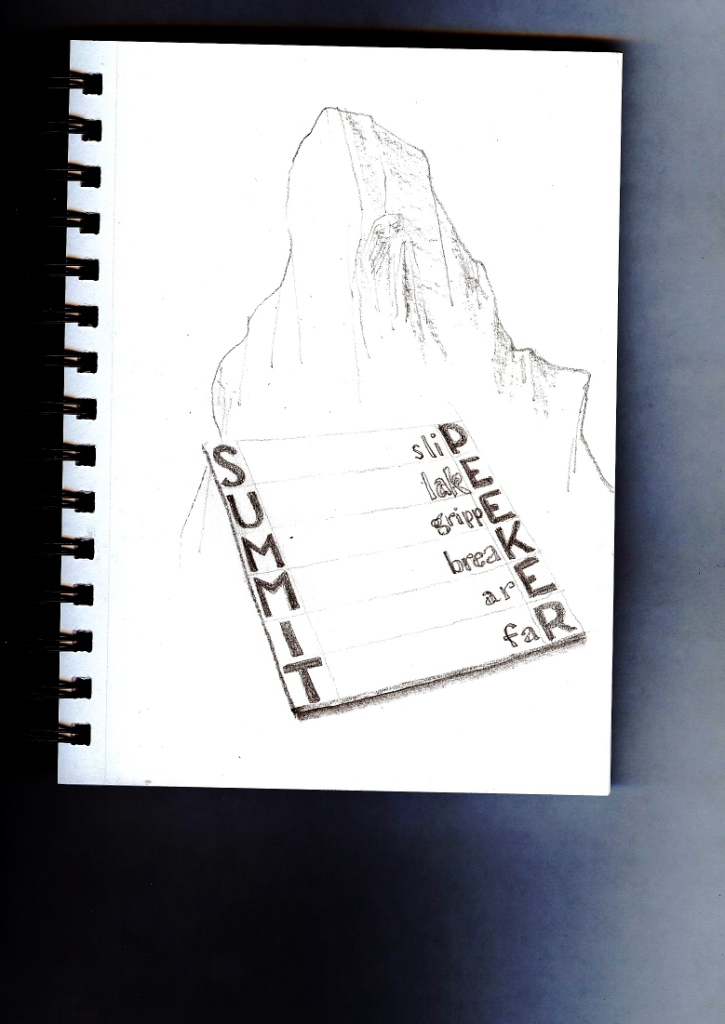
The bottom line of this poem serves as the bottom line of the theme. “Enrage yourself at SLOTH and seek an ACTIVE satiation” is advice I’ve been giving myself for a long time. That’s why, every day this year, I’ve striven to create a new work of art in the form of a journal page, challenging my creativity with a new (usually acrostic) thematic puzzle to solve via meaningful expression. Meeting these daily challenges has enriched my emotional health beyond description, and I heartily recommend such journaling to anyone who feels the need of an expressive centering.
At the end of his Hugo-winning novella Riders of the Purple Wage, author Philip José Farmer has Grandpa Winnegan, a man about a hundred and twenty years old, leaving his great-great-great grandson Chibiabos Elgreco Winnegan with a note, which he’d paid a man to deliver posthumously. Wikipedia synopsizes the note: “The note simply says that Chib must abandon Ellay, leave his mother, and break free so he can paint from love, not out of hatred.” May we all heed such advice, especially if it comes from our own hearts.
 One with Clay, Image and Text