Archive

Tag Archives: drawing

Image

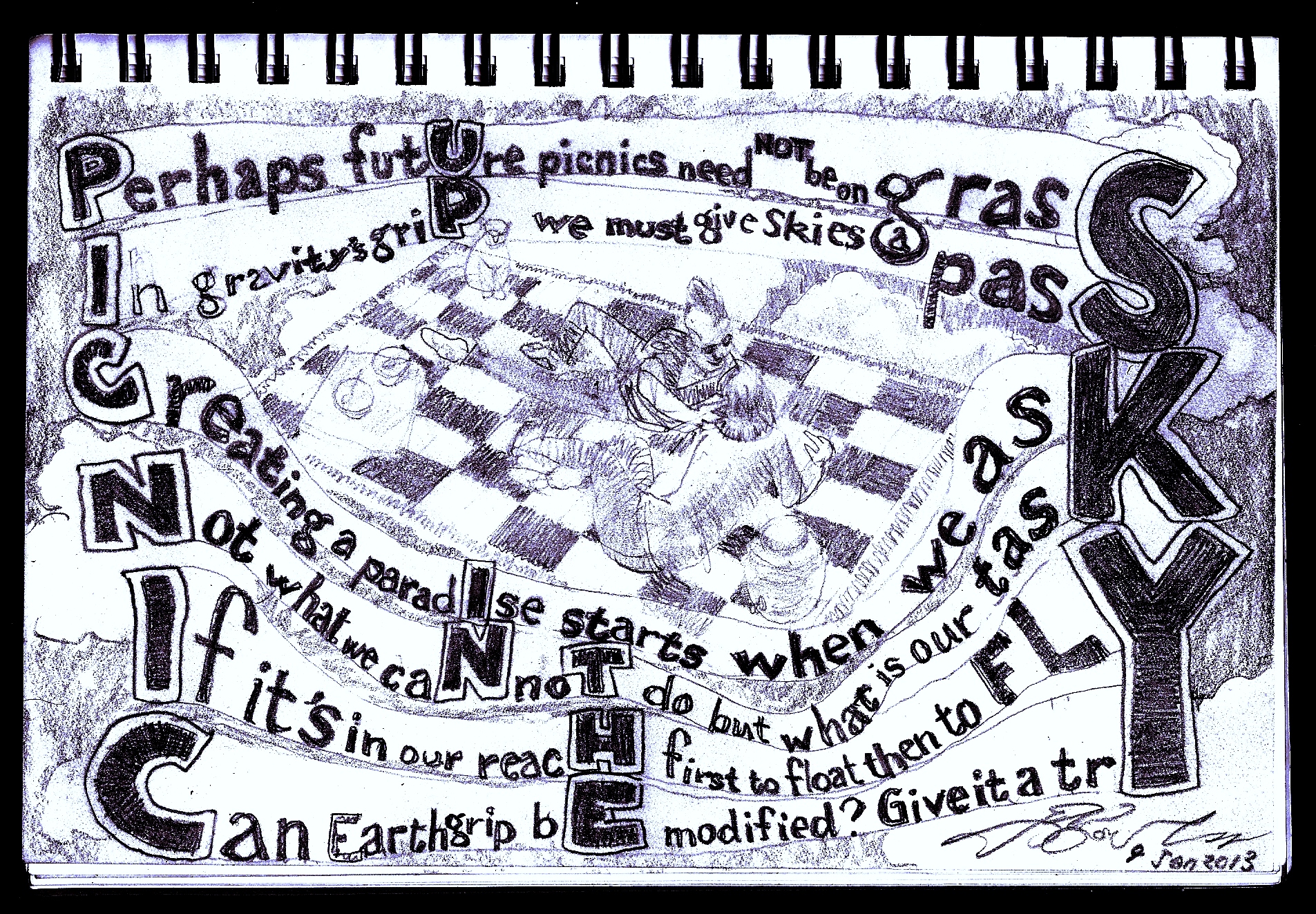
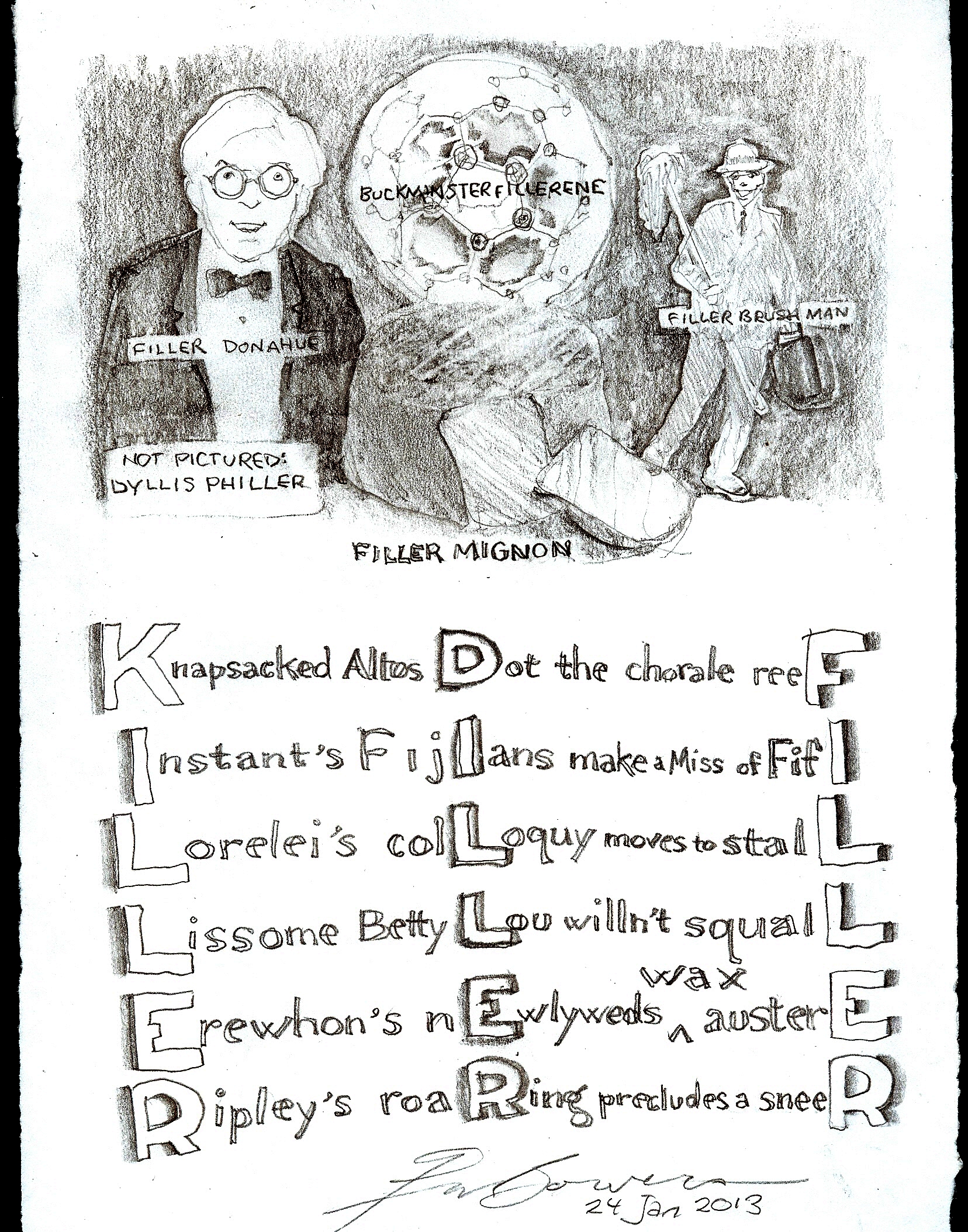
Yesterday I was hurting for time. My shift ended at 7am. I grabbed a few hours of sleep. Midafternoon, off to Cottonwood and then Yavapai College with my lovely Girlfriend; my class ended after 8 and we rolled into the driveway about 9. My journal page, which I’ve done daily without fail every day of 2013, was undone. Could I do it? Yes, but it would be a “filler” issue. Yes, but it would be KILLER DILLER filler–hey, there’s my Triple Acrostic!

(Anyone remember George Harrison’s “Polythene Pam”? “She’s killer diller when she’s dressed to the ‘ilt…”)

For the illustration, a lot of things easily morphable to Filler, Sorry about that, Phil Donahue, Fuller Brush Man, Filet Mignon, and buckminsterfullerene, you wonderful substance, you.

If you can’t make heads nor tails out of the words, remember: it’s filler. On the other hand, if you see beauty, profundity, and wisdom there, remember: it isn’t ANY old filler. It’s Killer Diller Filler.

PS RIP Phyllis Diller, from a fan.

Image

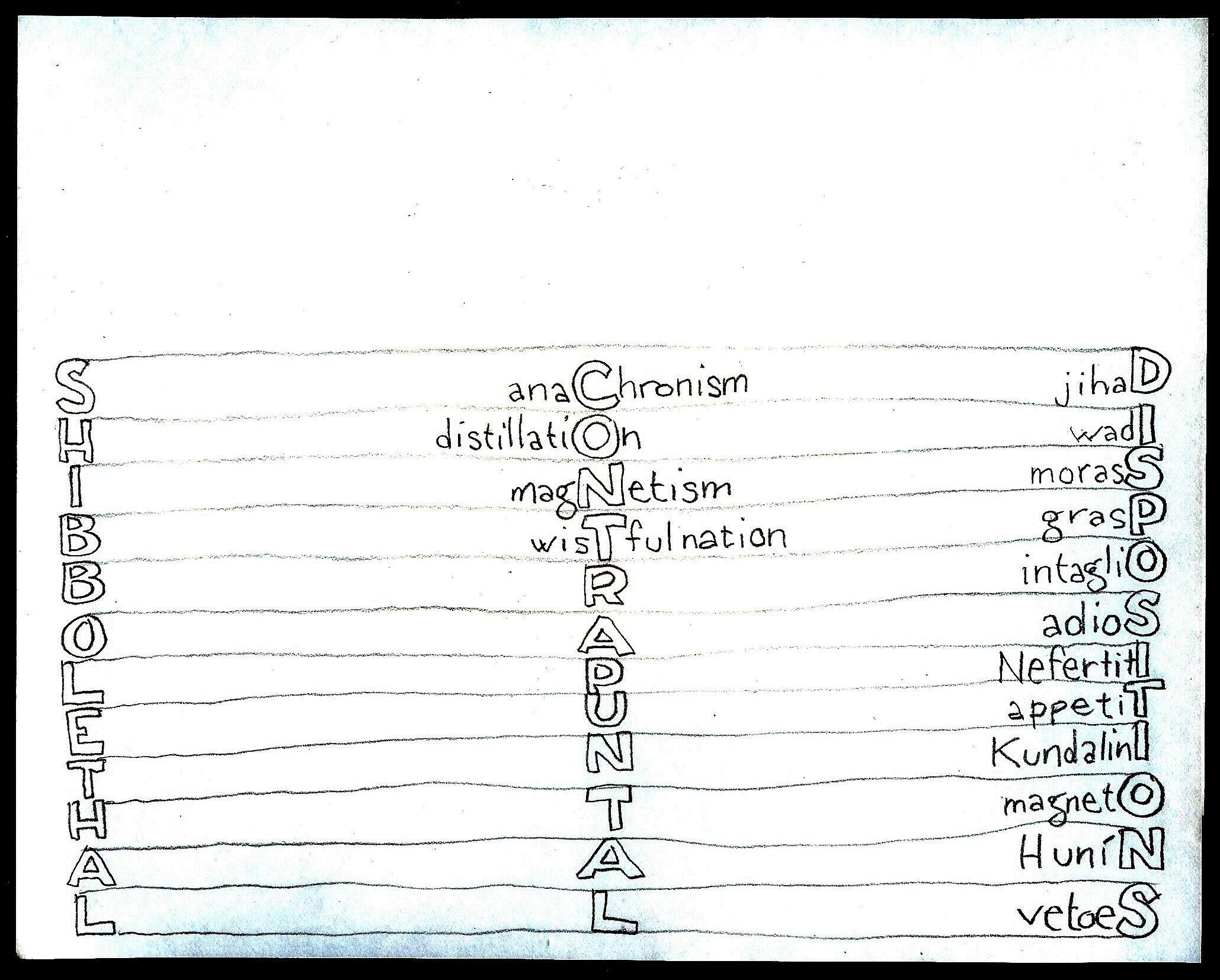
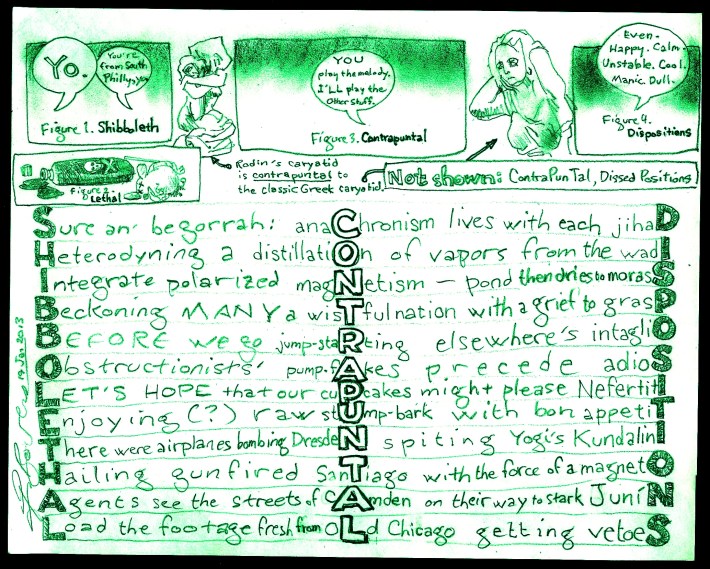
This page started with the realization that the words Shibboleth and Lethal had a common letter string, and when combined made a new, potent word. (A Google search disclosed that the word had been coined already. Someone credited someone usernamed Xel for it. Congratulations, Xel!) The word was twelve letters long; soon were found two other twelve-letter words to form a potent phrase.

So what does Shibbolethal Contrapuntal Dispositions mean? Well, shibboleth once meant a tell-tale in pronunciation that revealed where someone came from. (If curious, see the biblical Judges chapter 12, verses 4 through 6.) It has come to mean some distinguishing feature of a special group. Make that deadly, and you’ve got Shibbolethal.

Contrapuntal is the adjective form of counterpoint. In music, Counterpoint is the use of a second melody that enhances the first melody via its difference. This definition has broadened to include non-musical endeavors.

Dispositions is the plural of a word that can mean either Mood or Inclination or Deployment.

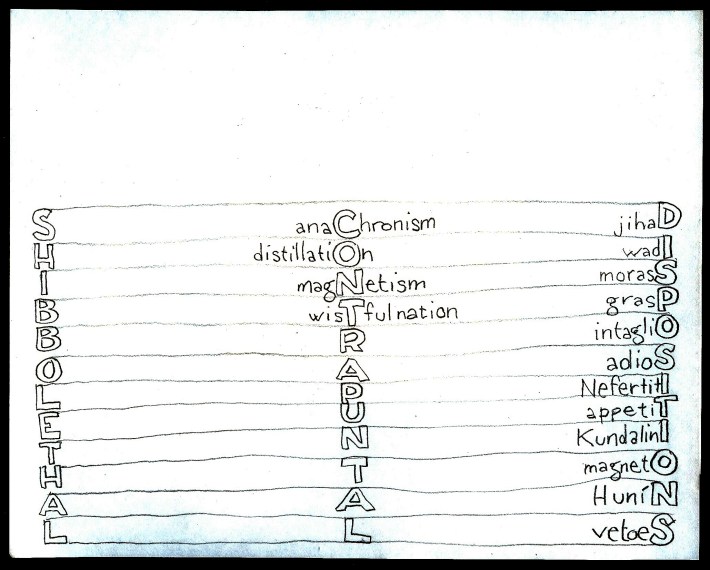
Now, with the phrase to conjure with, it was time to do some conjuring. Here is the work in early progress:
Image

Most of these acrostics start with the end words, and with twelve, the main choices are strict rhyme, near rhyme, or no rhyme. Once the choice is made, the words are usually free-associated into discovery. Thus came jihad, wadi, morass, grasp, intaglio, adios, Nefertiti, appetit (which really ought to have been appétit), Kundalini, magneto (the machine, not the supervillain), Hunín (which ought to have been Junín, and which was changed), and vetoes. But it felt like the middle words should somehow relate, too.

Well, one thing led to another, and the resulting message has something to do with the terrible habit of governments and the people they are made up of imposing their opinions, sometimes in the forms of firebombings or assassination, on different nations or cultures or regimes. It is not a clear message; though three different rhyme/meter schemes were used, conforming to the triple acrostic disclarified the meaning. Still–the World is a lot like that: murky, obscure, providing frustrating clues.

A few words about the two caryatids used to illustrate a contrapuntal quality: the traditional caryatid found in Greek architecture is a support element, a quasi-pillar. Auguste Rodin gives us an idea of what would happen if an actual human being were enlisted to hold up tons of masonry. He thus brings to life that fine Greek concept, Pathos.
Image

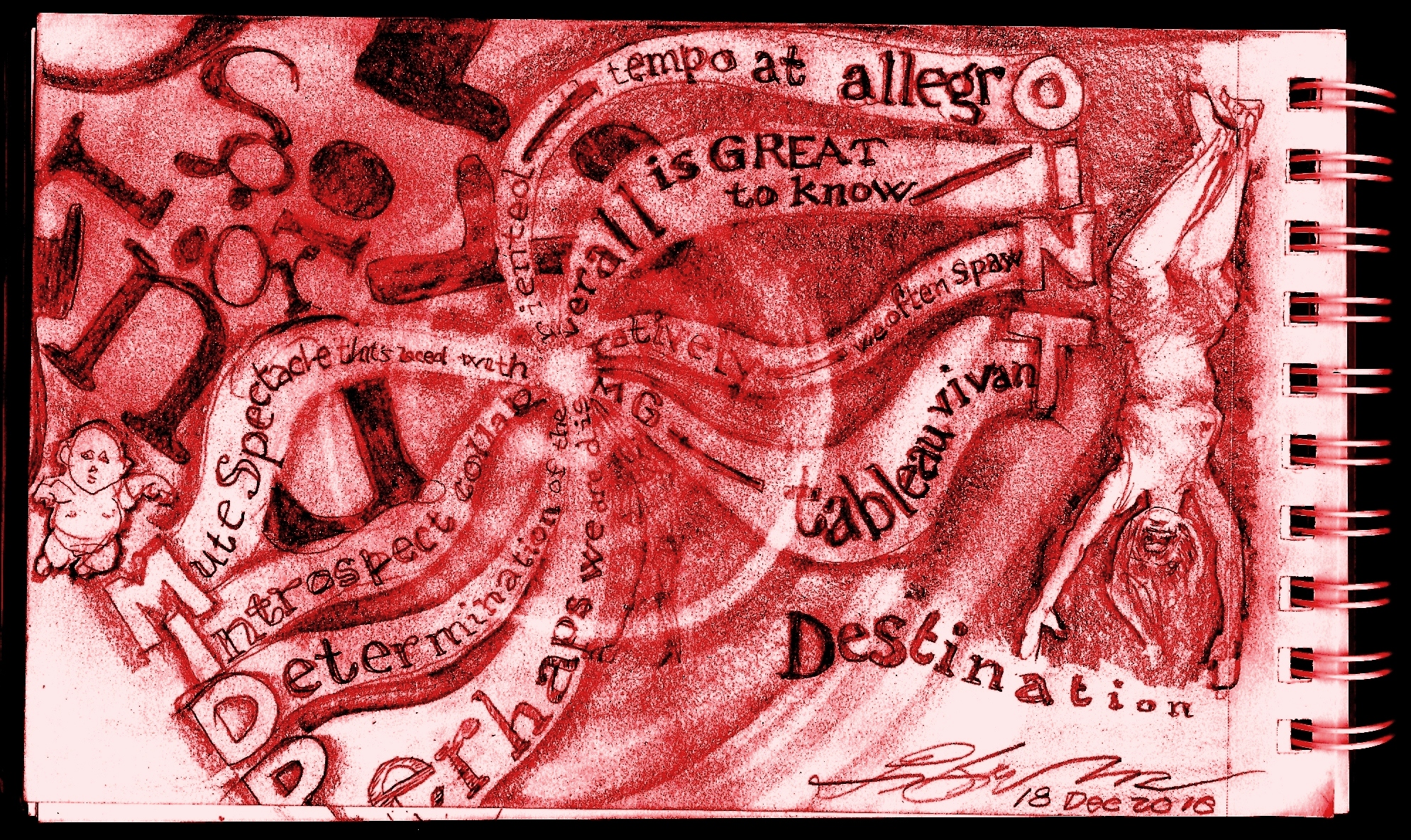
Somewhere between the Big Bang and Heat Death, somewhere between the Cradle and the Grave, somewhere between Teeter and Totter, there is a midpoint, a locus where the balance is exact. In recent decades people talk about being Centered. If you consider yourself a citizen of four dimensions, your Midpoint must be the moment that moves with you.

Far ago from my present Midpoint, I ran across a book entitled How to Get Control of Your Time and Your Life. The author, Alan Lakein, urged his readers to constantly ask themselves: What’s the best use of my time right now? Your own answer may well be, “Stop reading this bloggage and do something real.” So long then!

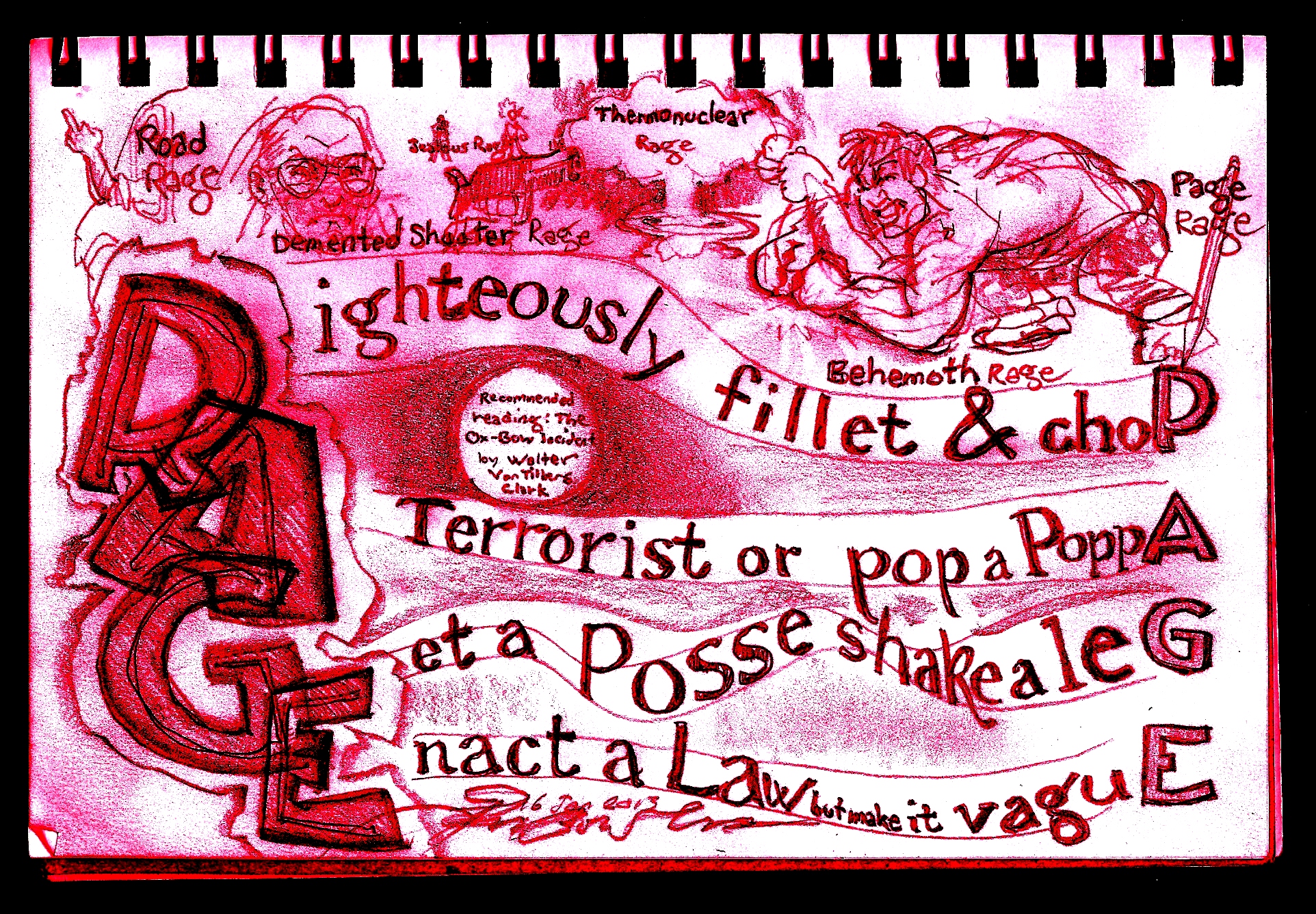
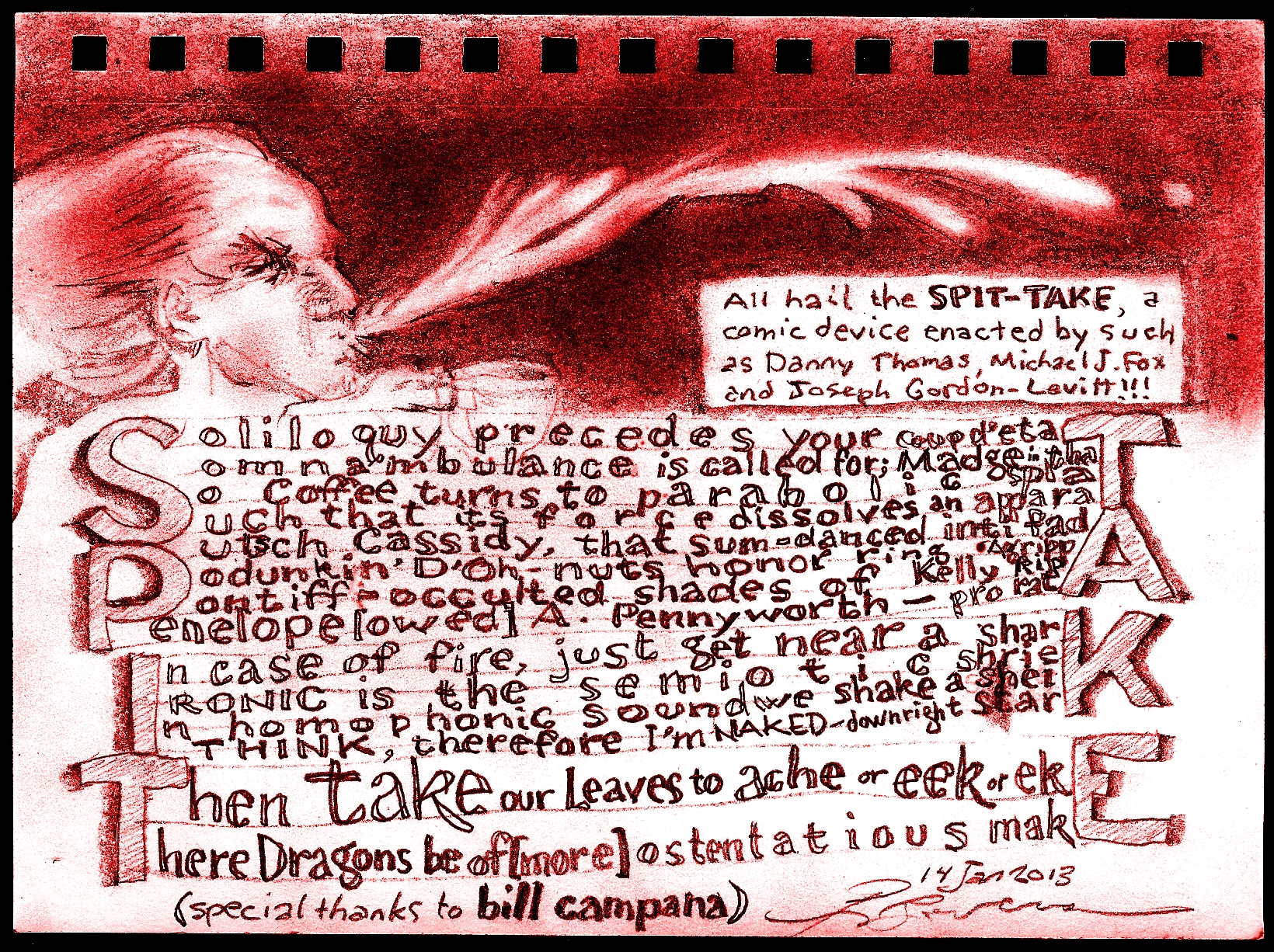
Two recent journal pages of mine refer to the two unpleasant subjects Rage and Spit. When I woke up this morning, “Shave and a Haircut/Two Bits” was looped in my head, I think to clue me in that I ought to base today’s blog post on the two pages.

Image

RAGE is known to all except (perhaps) the freakishly evolved. I wonder if the Dalai Lama has ever experienced rage. Rage usually makes us do regrettable things. This to me is exemplified not only by mass shootings but by the Lynch Mob. About forty years ago I read The Ox-Bow Incident by Walter Van Tilberg Clark, and the author managed to imagine the dynamics of a Lynch Mob utterly convincingly. I commend this fine book to your attention.

Is Rage ever a good thing? Does it ever drive positive behavior? Ought we to genetically engineer Rage out of our genome, if we could? I wish we knew.

Image

The Spit-Take is an unignorable part of American physical comedy. Actor A is drinking something; Actor B says something unexpected and/or outrageous; Actor A diffuses the contents of Actor A’s mouth into the local atmosphere. In cinema, the Spit-Take has been around since 1906. That’s more than a hundred and six years ago! In television, the Spit-Take has been around for at least fifty years, having been popularized by Danny Thomas of “Make Room for Daddy” fame. On YouTube, there is a video by my friends, Phoenix-area poets Kevin Patterson and Bill Campana, containing no fewer than half a dozen Spit-Takes of what purports to be Champagne. The interested reader may use the phrase “Bill Campana 1957” to find the video (I could provide a link, but you have to REALLY WANT to see it, so I’m not making it easy). If you drink coffee while watching the video, point your mouth away from your computer screen, for you may well end up doing a Spit-Take yourself.

Cheers!

Image

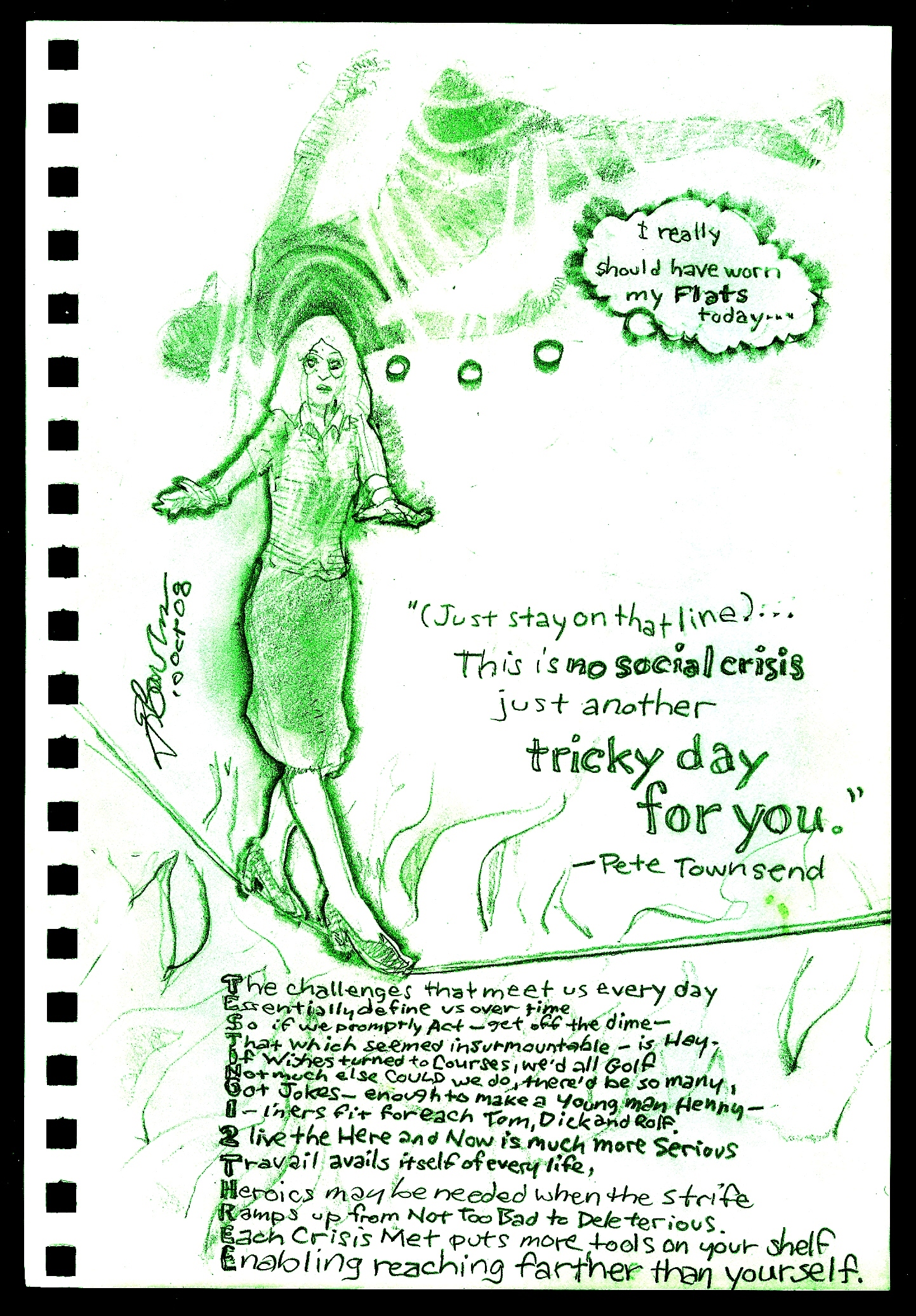
Here is the text of the acrostic sonnet:

The challenges that meet us every day
Essentially define us over time
So if we promptly Act–get off the dime–
That which seemed insurmountable–is Hay.
If Wishes turned to Courses, we’d all Golf
Not much else COULD we do, there’d be so many,
Got Jokes–enough to make a young man Henny–

1-liners fit for each Tom, Dick and Rolf.

2 live the Here and Now is much more serious

Travail avails itself of every life,
Heroics may be needed when the strife
Ramps up from Not Too Bad to Deleterious.
Each Crisis Met puts more tools on your shelf
Enabling reaching farther than yourself.

–Which, granted, is SO much easier said than done. But, Friends, it would have been easier for me to say Help Yourself or You Can Do It and have done with this blog post. Struggling through fourteen lines of acrosticized iambic pentameter to tie in with a crucial line from a Who song has made me a little bit better poetically. I wish you well with your own struggles to be a better You.

… because it is a Mars/Soupy/Al (Marsupial).

In a lifetime of concocting horrible puns, this is one of the worst. As far as I know, the planet Mars and Soupy Sales and Al Pacino have never before been linked to such nefarious purpose.

The text of this triple acrostic is nigh-impossible to read, doing as it does Loop-the-Loops with internally-repeating text strings, so here is a plain-text transcription:

My Mephistopheles has an Agenda
Mmmost unmysterious–yet an enigma
My bane is mucilaginous pudenda
My oddities extend to the 6th sigma

And if by chance I riff a lot, my VISA
Augmented by demented tours of ASIA
And psychical applause from Mona Lisa
Agrees then to succumb to Euthanasia

Responding to despondent plaintive plea
Retributive spare parties hunt the Fauna
Responsible for plaguing Earth and Sea
Repeatedly whipped-creamedly with Sauna

Spawn-taneously we may Breed until
Symp symphony then contraceives our Will

Fans of the Sonnet will note that this is one such: fourteen lines of iambic pentameter, Shakespearean rhyme scheme, concluding final couplet. In my immodest and self-aggrandizing opinion, no one else on Earth could have written a triple acrostic, the letter lengths of which are three/five/two, with a metaphor of such stick-together oddness summed up by the punned acrostic, cleaving to sonnet parameters, with a Zero Population Growth message embedded. Plus it has Loop-the-Loop calligraphy and loopy illustrations. Hope you like it!

Image

Image

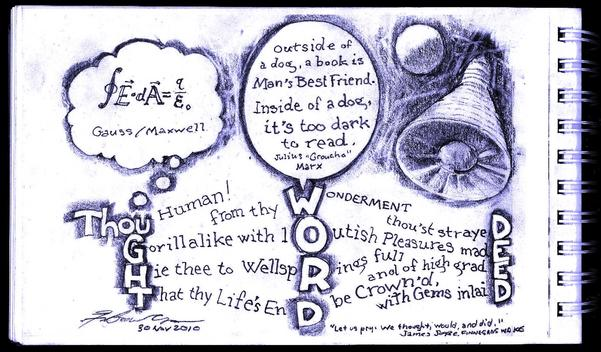
Here is a page based on what a brief quotation from James Joyce’s FINNEGANS WAKE was based on. For the Thought, I include one of Maxwell’s equations (with a boost from Gauss’s Law); the Word is from my hero Groucho Marx; and the Deed is a crude re-enactment of a portion of the journey that culminated in humanity’s first (hu)manned trip to the Moon. The seemingly-random-but-not juxtaposition is an odd tip of the hat to Joyce, who juxtaposed like crazy, and crazily, in FW. For another hat-tip to him, here’s this:

scan0018

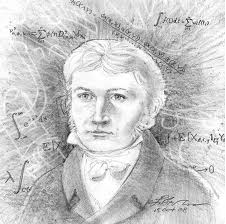
Lastly, here’s a tip of the hat to Johann Carl Friedrich Gauss mentioned above, possibly the ablest mathematician who ever lived.

gauss thumbnail

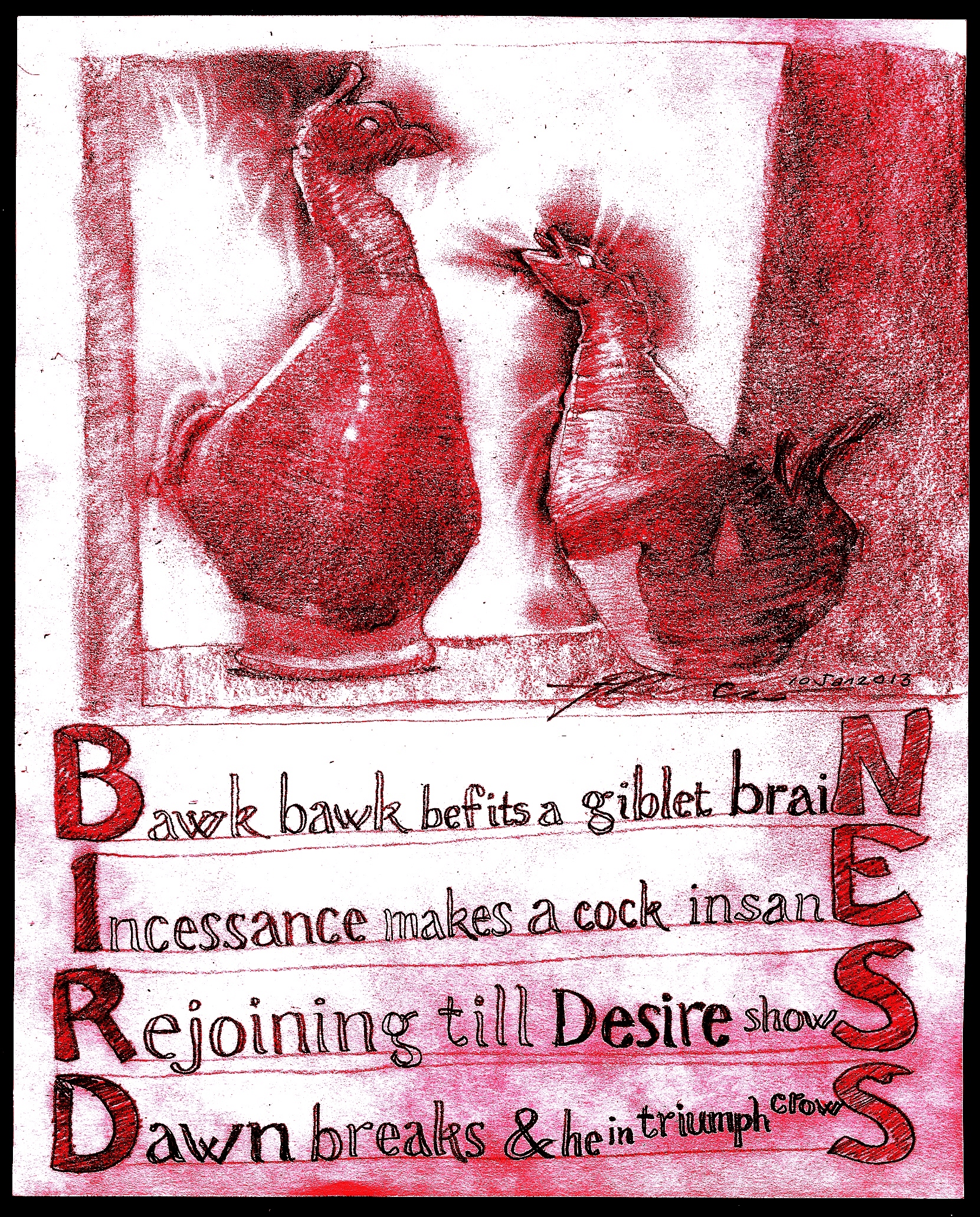
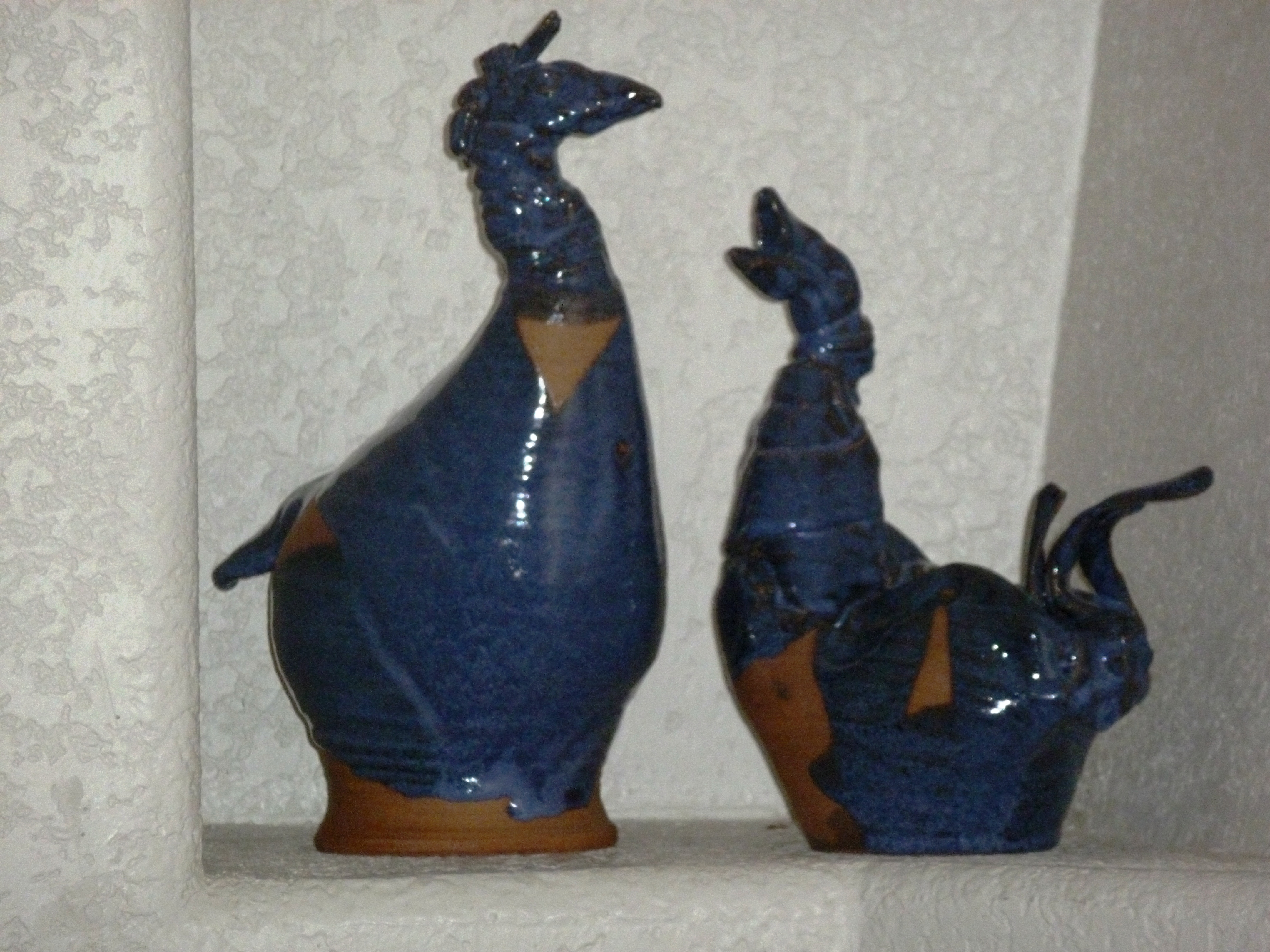
Today’s journal page is based on a photo of two of my ceramic birds, which in turn were based on vessels I threw on the potter’s wheel. There is something meta-ish about doing a drawing of a sculpture, but I also found it exciting to be intimately familiar with the forms I was drawing, having sculpted them: I could ignore the visual and enhance the tactile, and it would not ring false. I KNEW these birds.

Here is the page:

Image

And here is the photo it derives from, of my two bird sculptures:

Image

It’s plain to see I took great liberties with the image. I might have felt less free to do so were the sculptures someone else’s creation.