Archive

Tag Archives: essay

The Critique of Humanity, Phase Two: Now Look What You Made Me Do

All human beings so far begin their lives as babies. That may seem so obvious as to be absurd, but some day it may no longer be true, as will later be discussed.

Early things babies learn are: Bright lights can be nasty–it feels good to eat when hungry–it feels good to warm up when cold, but if it starts getting hot it doesn’t feel good any more–noises can be nasty–it feels good to relieve inside pressure, but doing so sometimes leads to loud noises or bright lights or both–it is fun to fall until there is a hard landing, and then it is scary to fall.

Babies graduate from babyhood when they start making sense of noises, including their own. There is a reason that there are simple, easy-to-say versions of the words for Mother and Father in every language. Interactions begin with Who’s Who and continue with Here’s What I Want, though of course Here’s What I Want is there at some level from the first cry of hunger on.

The first perception of Us and Them grows in complexity quickly. First They are the big ones that make things like food and warm happen. Then They may also be same-sizers or near-sizers who distract the bigger Thems from the provision of food and warm. By toddling time They include playmates, wrinkled dote-creatures, walking furballs, and Not-Us-At-Alls.

Reward and Punishment become more confusing. Rules are imposed. Violation of Rules is not cut and dried. Extenuating circumstances may be argued, and often are, if only as a delaying tactic.

In the fourth grade in the Southwestern United States it is not unheard of for a teacher to observe a child striking another child and, when the teacher begins to take appropriate action, two contradictory assertions made: “No, I didn’t. He hit me first.” Some form of those seven words, false-to-fact basis and all, is present in spirit throughout the history of human confrontational interaction.

The United States of America used to be honest enough to include a Department of War in its government, just as the insurance industry used to be honest enough to offer Death Insurance.

Now we congratulate ourselves on the containment of collateral damage, which is another way of saying we only killed a hundred thousand human beings with whom we had no quarrel instead of the who-knows-how-many-more it could have been. We apologize to the dead by shaking our finger in the face of those we DO have a quarrel with, and say in effect, “You shouldn’t have made us do this.”

Here is a quotation I just learned this week, and have come to embrace: “We must not be frightened nor cajoled into accepting evil as deliverance from evil. We must go on struggling to be human, though monsters of abstractions police and threaten us.” Poet Robert Hayden wrote that decades ago.

Now let us imagine a human being of the future. She has been born and raised to early adulthood with her mind in a virtual world and her body on automatic pilot via basic-functions software. The virtual world teaches her language and history and coping skills without the baggage of conflict. It is all nurture. She is never alone, any more than a person is alone who is making blog posts and receiving comments in real time. All her needs are met because the need for acquisition, for conquest, for superiority, never existed for her. She will never be able to say, “Now look what you made me do,” because she will not be made to do anything. She will make the choices that suit her and the world the best.

Now let us ask: could this happen? Should this happen? If it should not happen, how else may we remain human and build an improving world?
Image

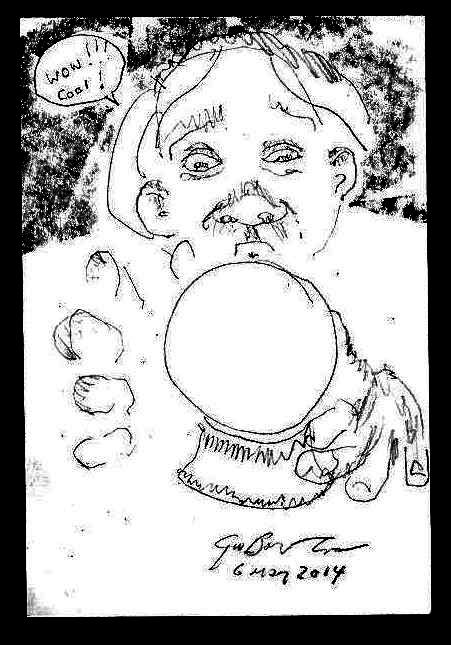
A few days ago I read a heartbreaking article in Reader’s Digest about Jude Deveraux, best-selling novelist, being taken for approximately $17 million by a predatory monster who claimed to be a psychic. Years before, I’d seen an infomercial for Dionne Warwick’s “Psychic Friends,” and noticed the disclaimer at the bottom For Entertainment Purposes Only or somesuch.

Now, I don’t call myself an atheist or an agnostic, but my tendency is heavily toward skepticism; even so, I LITERALLY don’t know what to believe. I ardently hope there is more to the Universe than random purposelessness. Being a sentient being with a mind and what amounts to free will, I am free to decide what makes sense, and what my own reason for living is–subject to change, of course. Consequently, I will find myself at night looking at the inside of my closed eyelids and seeking answers from beyond my insignificant self. I’m sure almost all of us have asked: What’s my next move? How do I handle THIS major issue? And one overwhelming question, which comes in many forms: What’s wrong with this picture, and what needs to happen to make it unwrong?

When we ask these questions, and dream on them, and hope for an answer to come to us in the form of a thought popping into our heads unbidden, or other sign from outside ourselves, we are being our own psychics. I am positive that Jude Deveraux would have been much the much better off if she had been her own psychic. The trouble was, she was insecure; she didn’t trust that she’d come up with good answers on her own.

So now, let’s walk through it: If we’re going to be our own psychics, how are we going to be the best psychics we can be? Here’s what I’ve come up with, but I am 100% sure that you who read will come up with something that suits YOU, and YOUR circumstances, better.

1. Learn what you REALLY want out of life. Do you really want to be a millionaire? Do you want to be suspicious of someone you don’t know wanting to be your friend? Do you want constant demands on your time and your money by people who think they know better than you do what to do with your time and your money? (By the way, your time is of equal or greater value than your money; I’ll try not to waste yours here.)

2. Formulate five questions you’d like God, or Nature, or the Cosmos, or Whoever, to answer. Here are mine:

What is the best use of my time, today, this week, this month, and this year?
Who in the world do I most need to learn from?
What do I not know that I need to know?
How much lifetime do I have left?
What is making my life more tragic, what makes it more joyful, and what can I do about this?

These are kind of fudgy questions in that there are subquestions in some of them. But my important question list is subject to change, especially if I learn something new (and I’m bound to) or my circumstances change. The thing is to keep asking these questions, and keep looking for the answers both actively (“Time to go to the gym and put another brick in the Life Extension Wall”) and passively. (“Hey, look at that! There’s my answer right there!”)

3. Beware the easy answer. It is tempting to, seeing a rainbow, infer that God or the Universe is trying to tell you something. But a rainbow is merely the organization of visible light at certain frequencies via its refraction in a myriad of water droplets. You can have a rainbow any time you want one if you have a sunny day and a garden hose; just use your thumb and turn until the angle is right. But if you get a burning bush, or gigantic text carved out of a mountain before your very eyes, I’d pay attention–BUT I’D STILL QUESTION THE MESSAGE. Try the answers you get out on your intuition, and do your best not to inject your own wishful thinking.

4. Live for more than yourself. When you do that, your psychic connection has more than you to answer to, and will consequently give you (and yours) a clearer picture.

Essay/Lecture over. That’ll be Zero Dollars and Zero Cents please. [smiles]