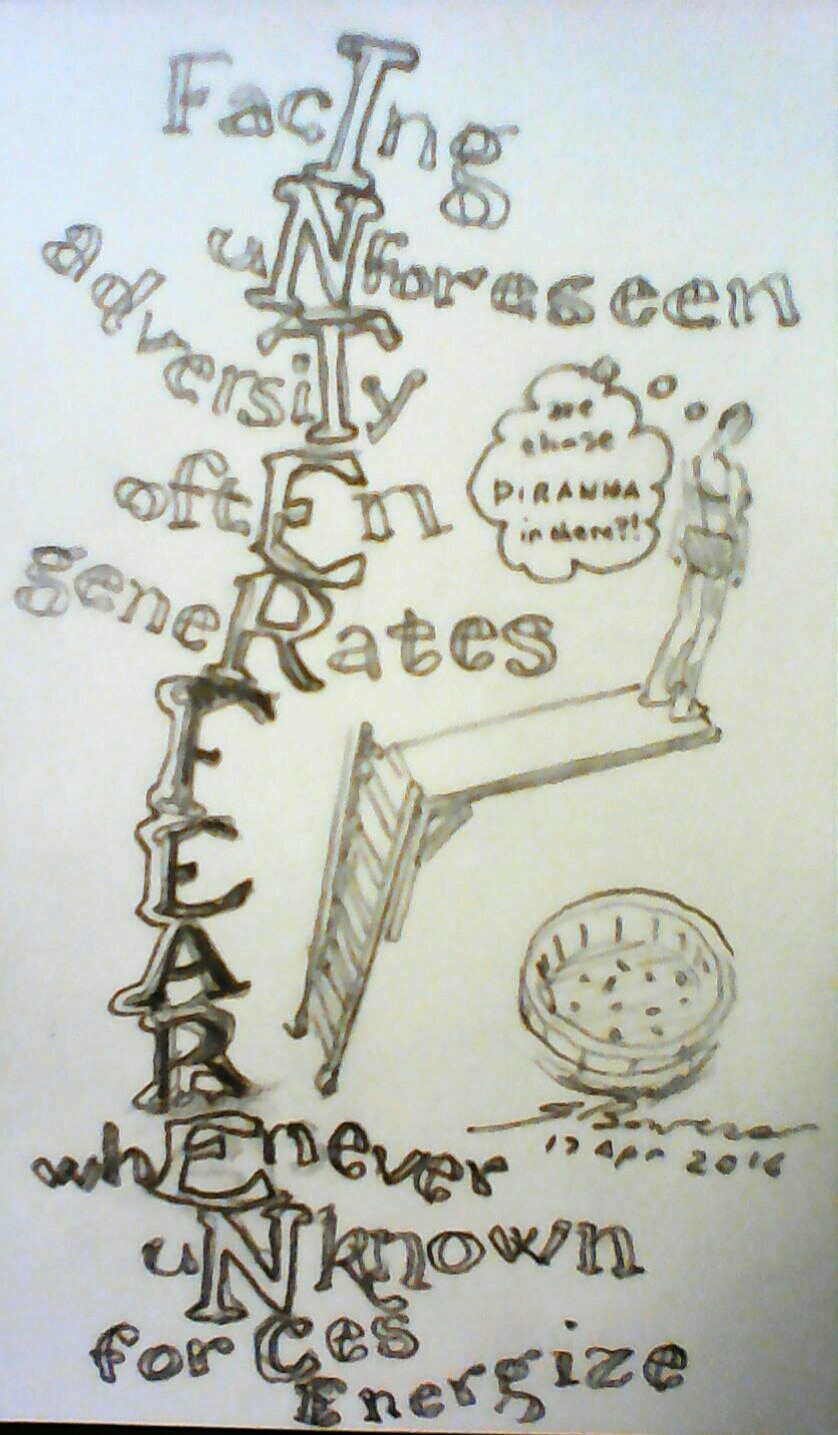
Facing unforeseen adversity often generates FEAR whenever unknown forces energize.
“Simple–almost comic,” as F Murray Abraham as Salieri said of the beginning of a Mozart piece in AMADEUS. So that’s where Fear comes from. But how do we make it go away? For Fear DOES interfere–with endeavor, with romance, with peace of mind.
There is a Vonnegut book called GALAPAGOS which imagines the next million years of human evolution beginning with a handful of survivors of a disaster that wiped out the rest of the human race. Their heads become more streamlined, that they may swim faster and catch the fish they need to survive; their brains become smaller and less capable of deceit and other problems “great big brains” create.
I have a strong feeling that Stephen Baxter, author of MANIFOLD: ORIGIN, has read GALAPAGOS and was influenced or inspired by it. In M:O different offshoots of hominids such as Homines Erectus, Australopithecus and Neandertalis are stranded on an outsized red-dusted, atmosphered moon, which has suddenly appeared in Luna’s place. Onto this moon Emma Stoney, lover/hater of Reid Malenfant, has fallen, due to Malenfant’s foolhardy go-fevered impulse . . .
Sorry about that. Off-track digression. Please read the book if you want an ingenious answer to Fermi’s Paradox, which may be oversimply stated as “If there are other intelligences than our own, why haven’t they been here already?” The M:O connection with Vonnegut has to do with Baxter’s imaginings of the different ways different intelligences could evolve in different species. The most intelligent of his lot, his Homo Superior folks, look a lot like gorillas, and walk on their knuckles as well as their feet. They are so intelligent that they move vast distances by mentally manipulating space.
Each intelligence has its upside and downside. Neandertals are unhampered by mythology. H. Superior with its short lifetime and limited resources tend to wring every atom’s worth out of their “farms” rather than go spacefaring. H. Sapiens make great intuitive leaps, but we also lie and steal and such.
Back to Fear: Emma Stoney is called upon to think like a Neandertal in order to breach a barrier. She learns of their fatalism, their involvement in the moment, and their lack of sentimentality for tools and other possessions. While making tools in the Neandertal fashion Emma suddenly finds herself becoming the tool she’s making, and in that moment her connection with the Neandertal is made.
Fear, I think, is a lack of connection with that which we fear. Afraid to show your feelings to a potential Special Someone? Learn about that person and what welcome your feelings would get. (Do not stalk, though.) Afraid to go off the High Dive into a washtub full of piranha? Find something better to do. 🙂
 One with Clay, Image and Text