Archive

Tag Archives: Gary Bowers

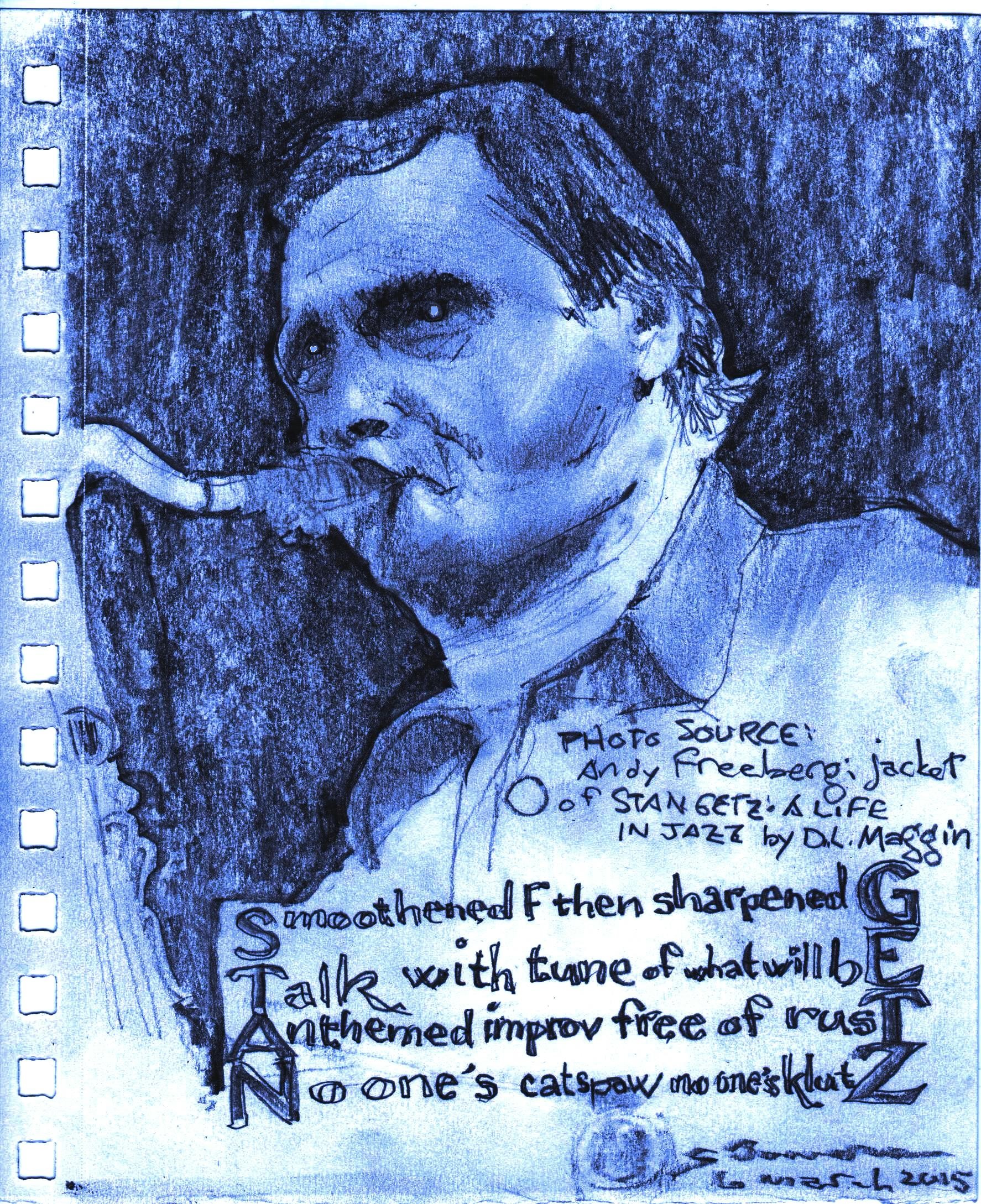
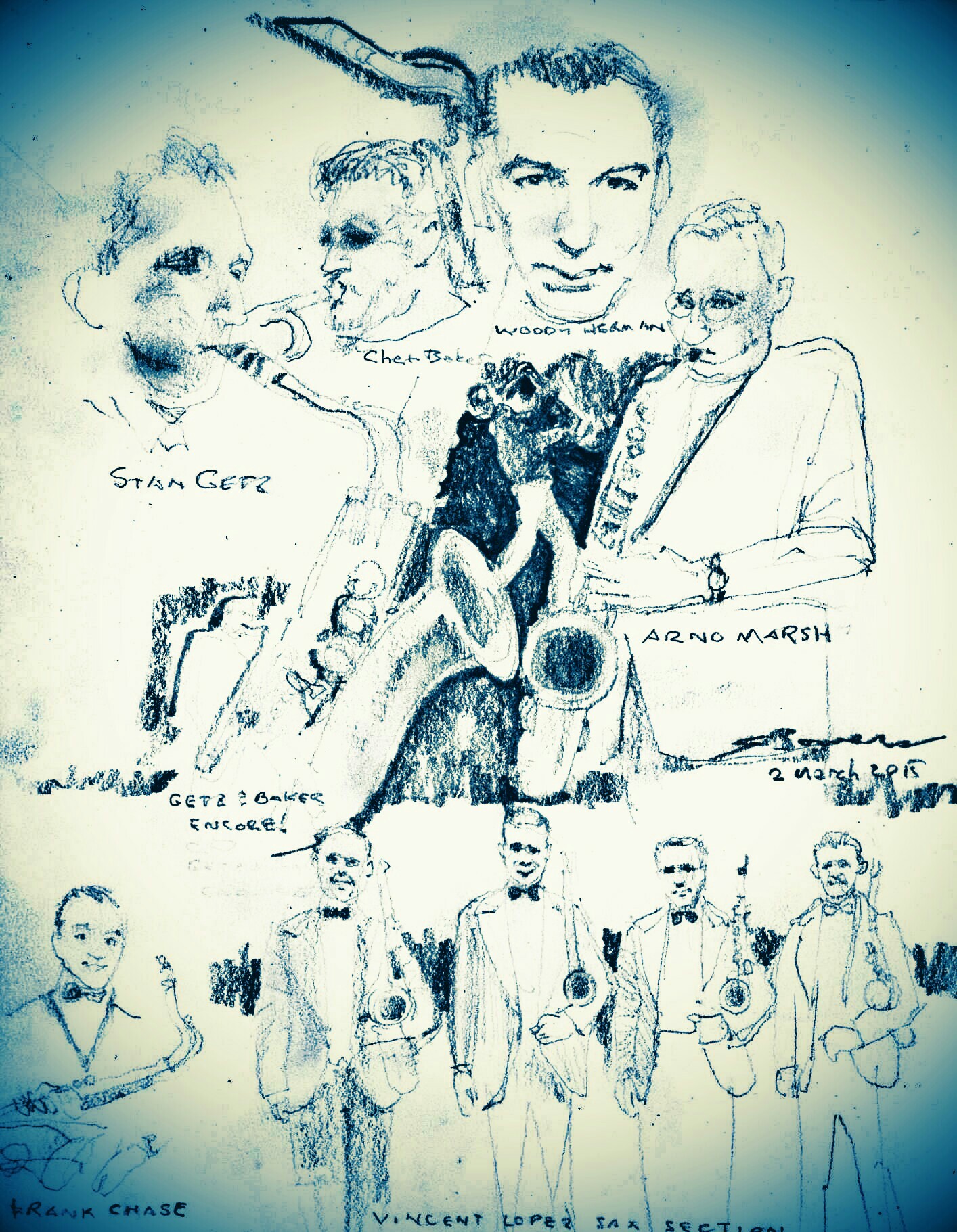
At this point I’ve learned enough about Stan Getz’s face to picture it and describe it without looking at a photo: Pale. Nose slightly aquiline. Short but not weak chin. Deep-set eyes, with sockets sloping upward toward the middle of the face. Ears small but protrusive. (Birth trauma trivia: Stan’s poor mom, Goldie, had 35 hours of labor. The doctor went in with forceps. Stan’s head was so big one of his ears was almost torn off and needed suturing. The doctor said they couldn’t leave with Stan until they’d paid an additional $52–a huge sum of money in 1927–for the ear work. “$52?” Al Getz gasped. “That’s too much. You can keep him.” Then he paid up.)

Here is a first take on a solo headshot of Stan Getz. There will be four more.

stan getz 030615

Words:

Smoothened F then sharpened G
Talk with tune of what will be
Anthemed improv free of rust
No one’s catspaw no one’s klutz

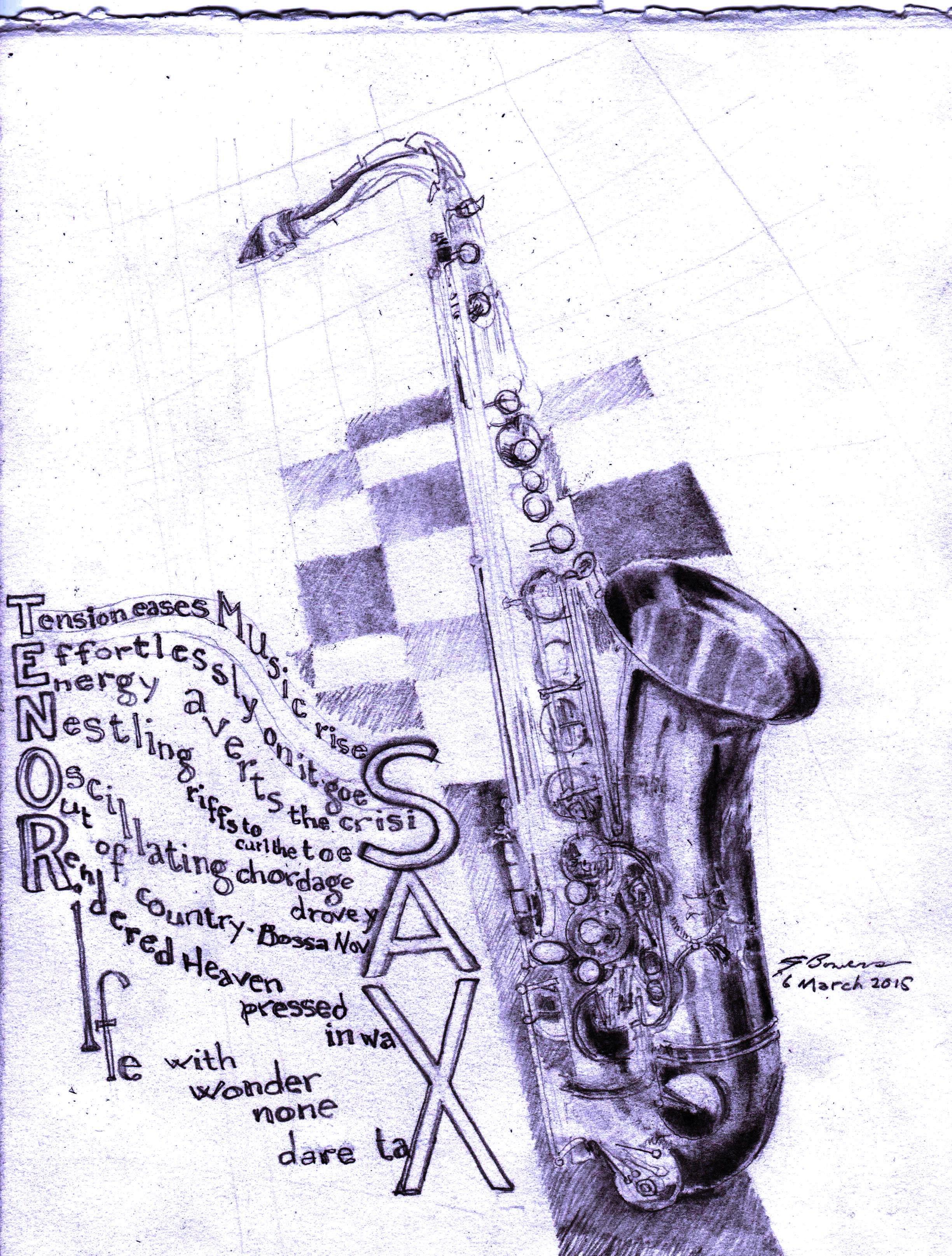
Here is that work in progress from a couple of posts ago. Adding the acrostic and a great deal of detail on the sax, and subtracting the “mood indigo” photoediting effects I had used before, turns it into a different visual experience.

saxophone 030615

Here are the words to the double acrostic poem:

Tension eases Music rises
Effortlessly on it goes
Energy averts the crisis
Nestling riffs to curl the toes
Oscillating chordage drove ya
Out of country–Bossa Nova
Rendered Heaven pressed in wax
Rife with Wonder none dare tax

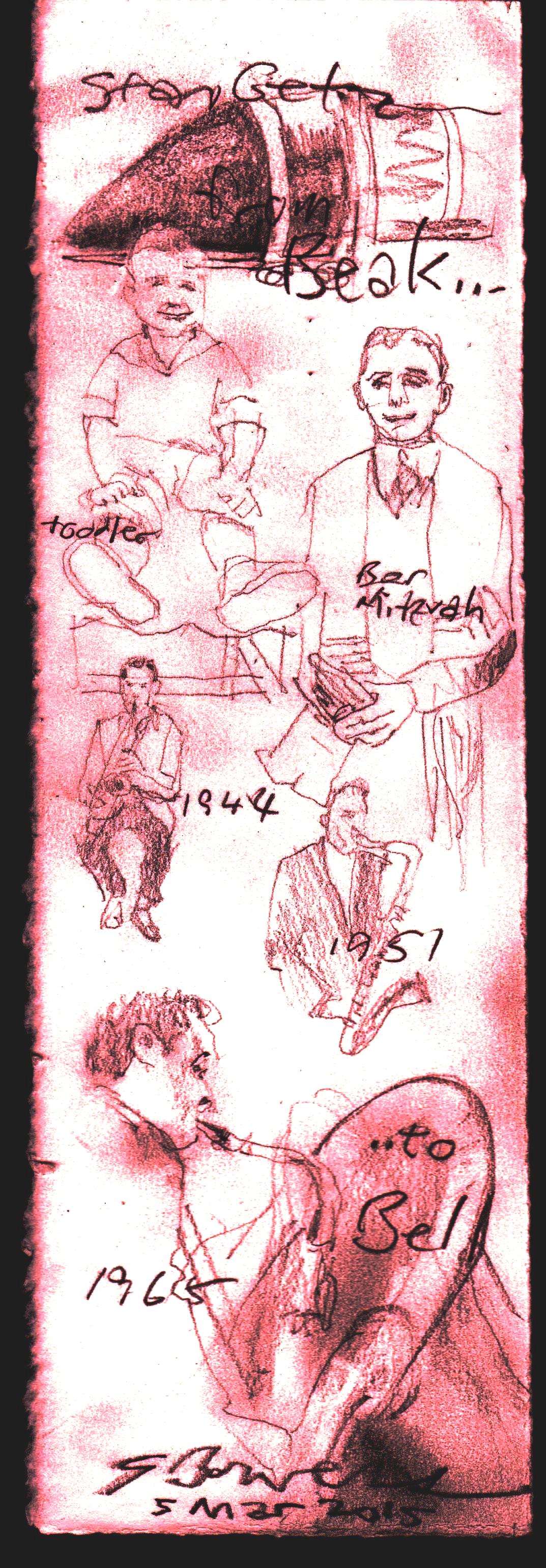
stan getz from beak to bell 030515

Now it can be told: My recent interest in the saxophone and the world of jazz is due to my acceptance of a commission to do a portrait of Stan Getz, the tenor saxophonist known as The Sound. I knew next to nothing about Getz, and was completely unfamiliar with the structure of the saxophone. Now, with several drawings under my belt, armed with the critically praised STAN GETZ: A LIFE IN JAZZ by Donald L. Maggin, and (just as important) having listened to some Getz sides, I am well on the way to meeting my deadline of April Fool’s Day with some familiarity with Mr. Getz and the world he inhabited. This is an enjoyable project, and I think I’ll come out of it a better artist. I’m a long way from the finish line, though!

0304152139-00~2~2~2

Here is a new drawing, a work in progress. For the first time there is a real effort to put some of the keys and rods where they belong–to learn how things work together. There’s also “post-production” work with the tablet’s photoeditor, experimenting with selective focus and “mood lighting.” All of this is in the service of making the final drawing of the series more genuine, and all that jazz.

saxophone 030115

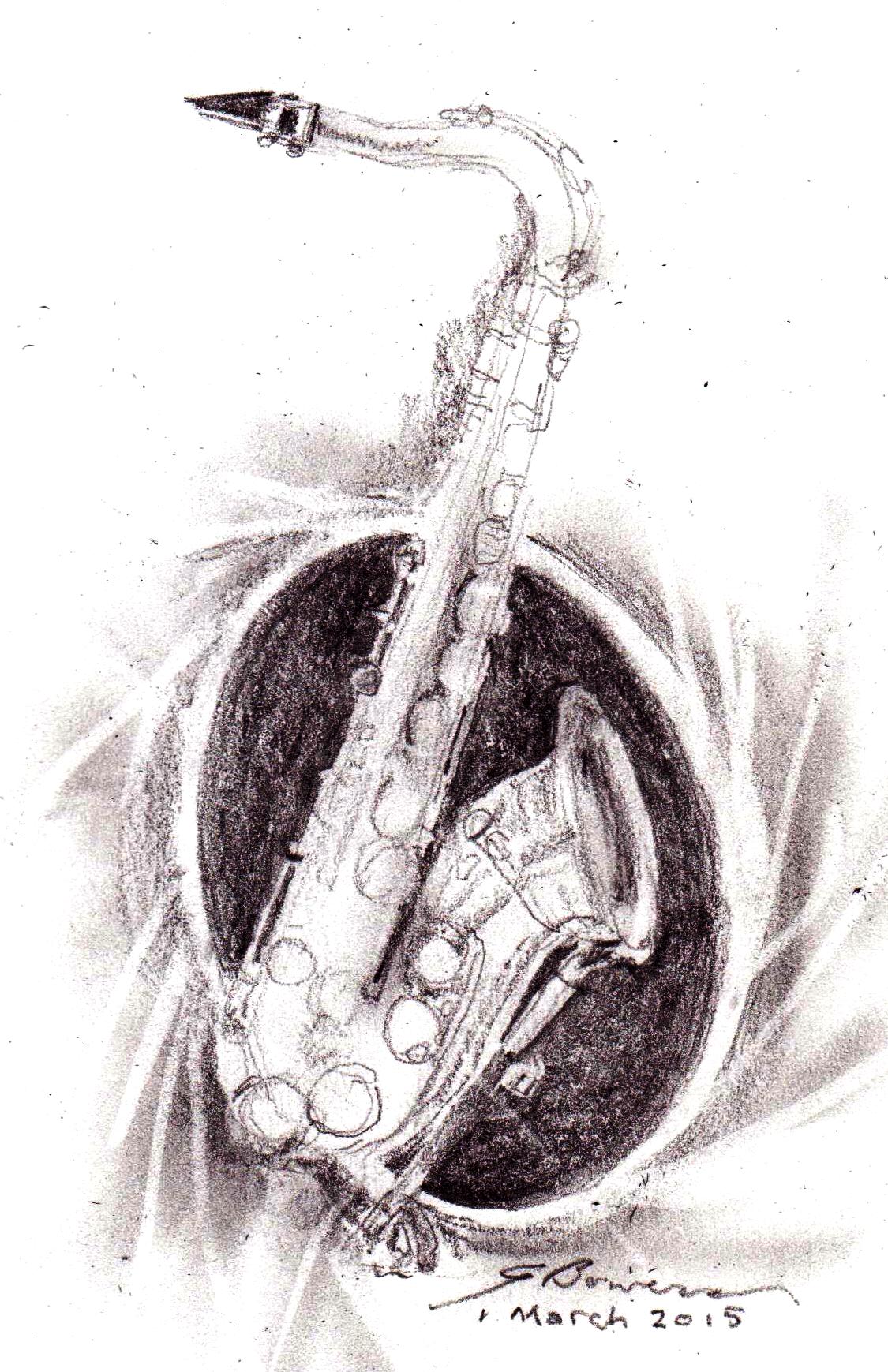
If March goes well, it will be chock-full of drawings of saxophones and jazz combos and portraits of major jazz musicians. In that spirit I kicked off March with a drawing of a saxophone of a friend of mine. No poetry, no “value added” distracting ancillary material–just a saxophone, a hint of the stand it rode in on, and some counterbalancing background.

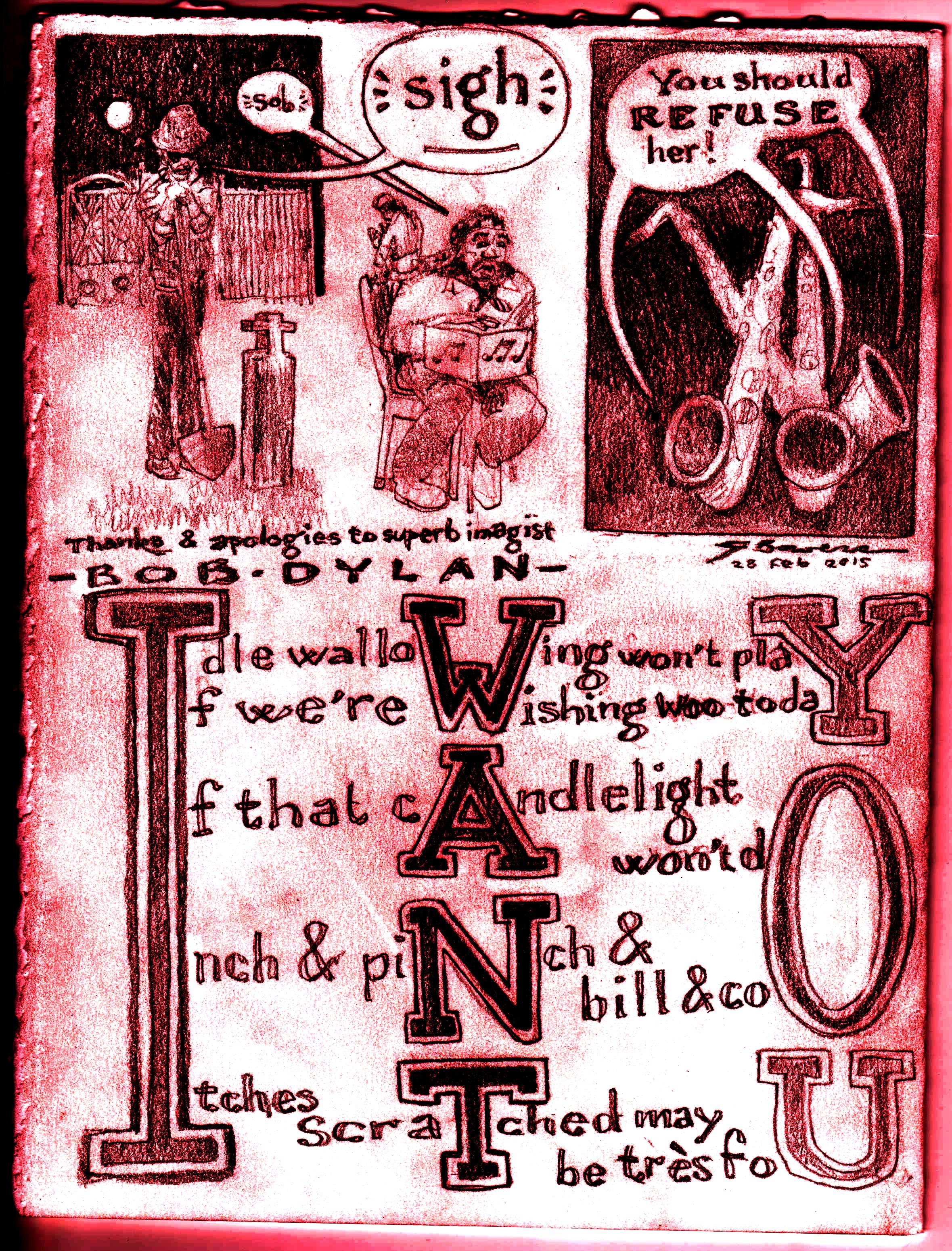
There’s this great Bob Dylan song whose title is repeated four times in its forthright chorus, thus:

I Want You
I Want You
I Want You
So bad
Honey, I Want You.

In its image-rich first verse there is reference to Silver Saxophones, thus:

The silver saxophones say I
Should refuse you . . .

Everything on the page I just made followed. It may be flavored by my recent partnerlessness (notice, for instance, how the word WANT is emphasized), but hey, so many love & longing songs have been fueled by such. I wonder if Mr. Dylan’s song had such roots. The Truth is out there, no doubt, but let’s find out later, if at all.

i want you 022815

Here are the words to the triple acrostic:

Idle wallowing won’t play
If we’re wishing woo today
If that candlelight won’t do
Inch & pinch & bill & coo
Itches scratched may be très fou

TRIVIA: In the film BREAKFAST AT TIFFANY’S, Holly Golightly uses the phrase “très fou,” thus: “I suppose you think I’m very brazen or très fou or something.” It means Quite Crazy.

HISTORICAL NOTE: The movie 50 SHADES OF GREY is currently playing in theatres around the world.

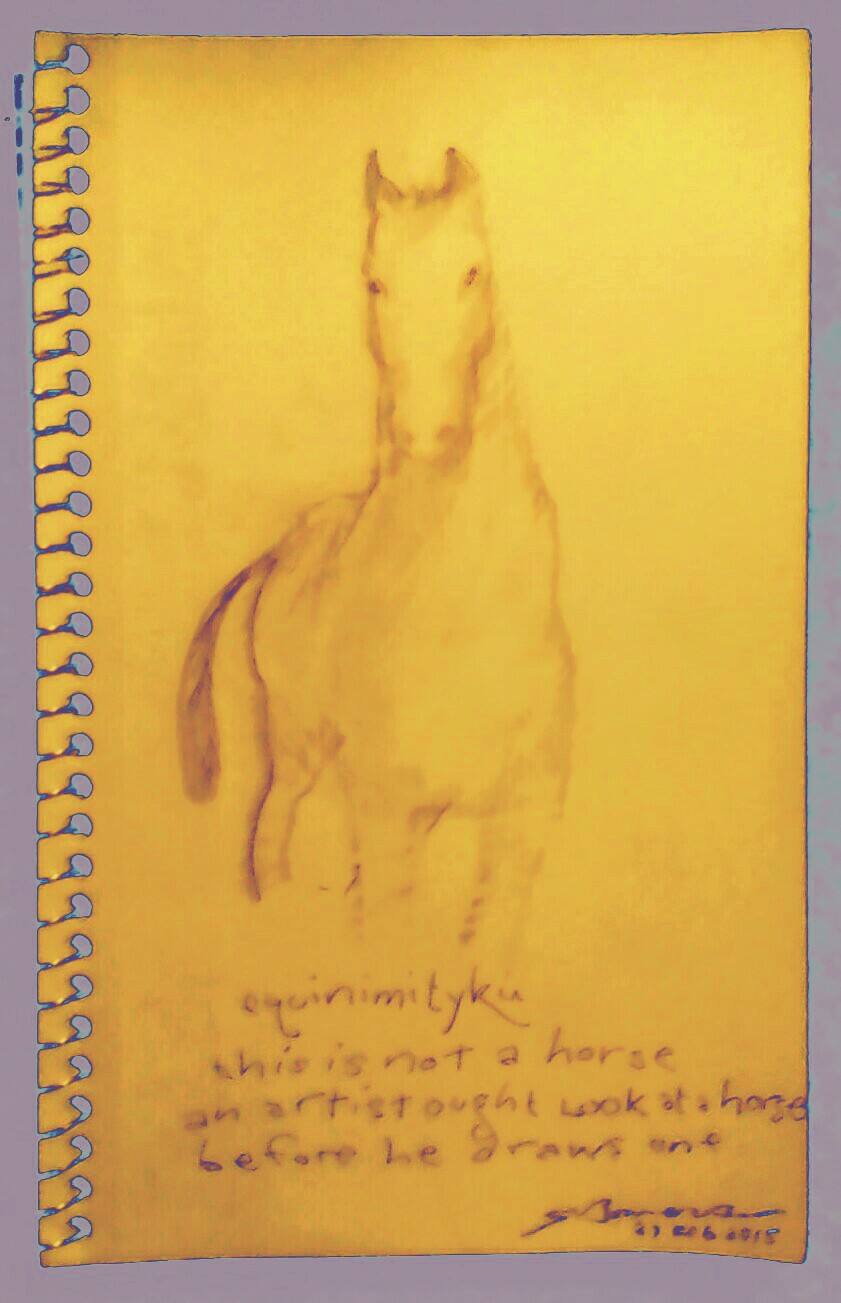
Today I tried drawing a horse without looking at a horse. I kept using drawing-trickery to disguise my ignorance of horse anatomy–then a Yiddish word popped into my head that I’d seen in Philip Roth’s PORTNOY’S COMPLAINT and also Herman Wouk’s YOUNGBLOOD HAWKE. The word is chazerai. Wouk defined it in HAWKE as “faking, foolishness, trash.”

So here’s my fake horse, under which is some fake haiku, with a bad-pun title to boot.

IMG_20150227_234015

equinimityku

this is not a horse
an artist ought LOOK at a horse
before he draws one

from more than half a life ago
some artifacts remain and so
they raise me up and lay me low

gb lm lm 022515

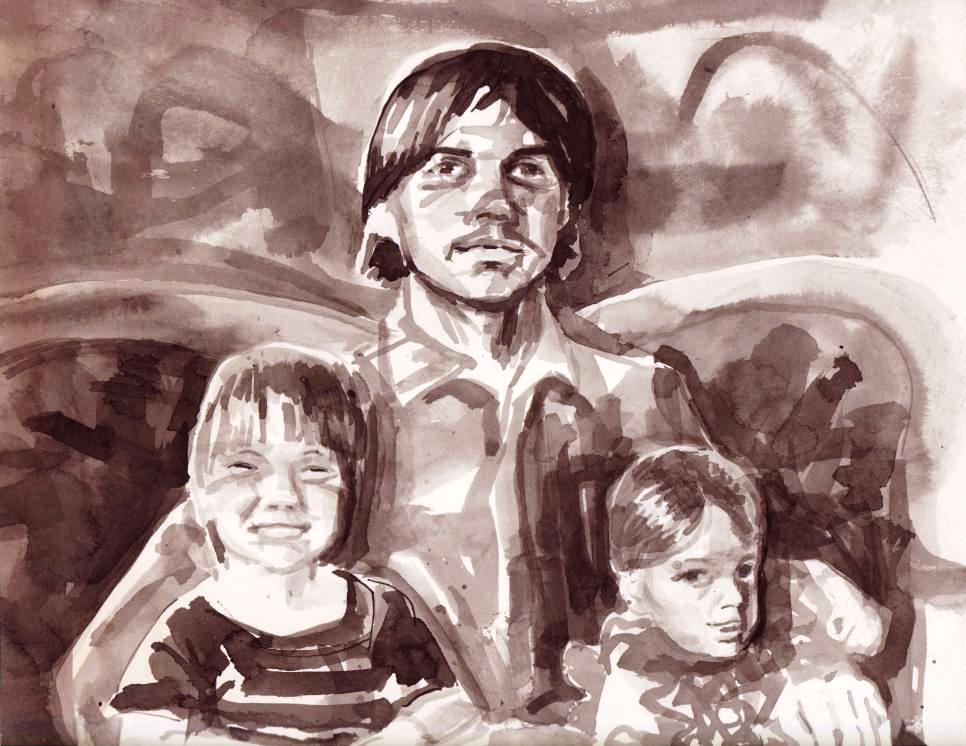
an uncle and his nieces sit
the inkwash sloppiness may fit
if smiles persist and moods acquit

gb inkwashes 022515

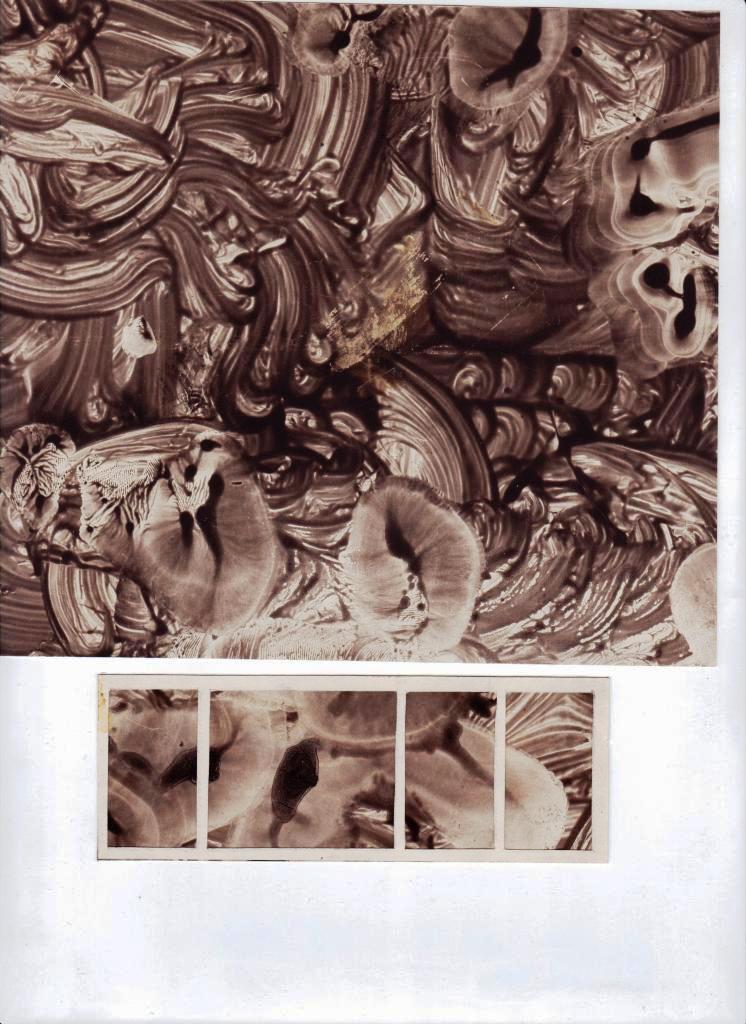
some ink dissolved in lithotine
on fingerpainting paper clean
may slosh then be erased–it’s keen

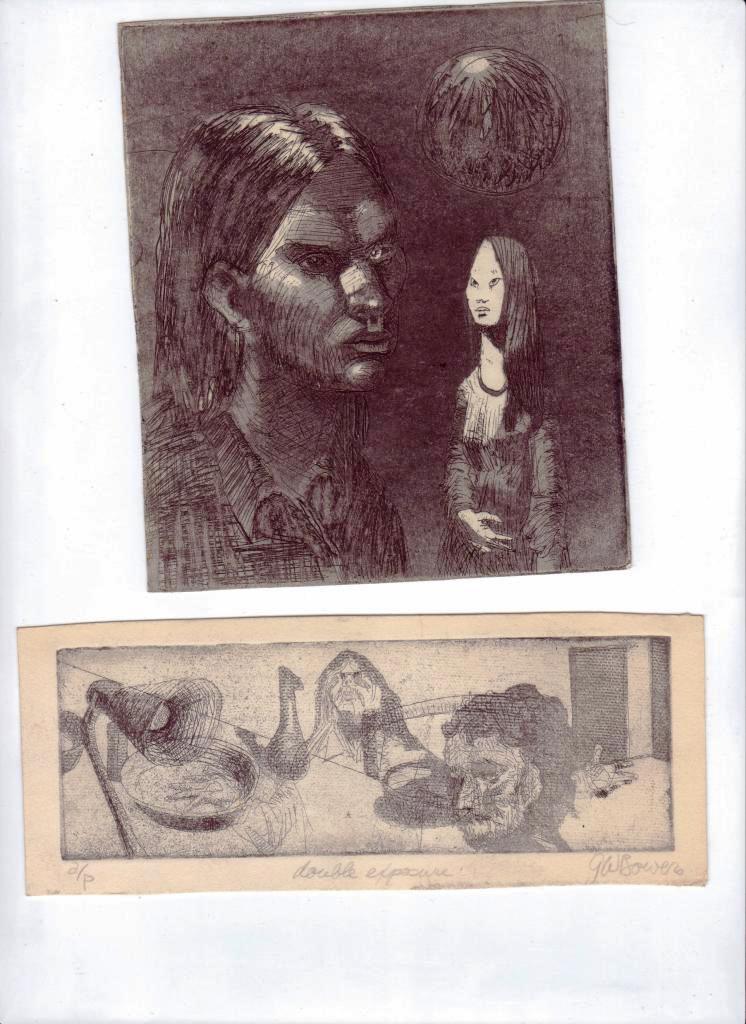
gb prints 022515

on plates of zinc with beveled edge
may be a mirror image–hedge
your bets and stack ’em on a ledge

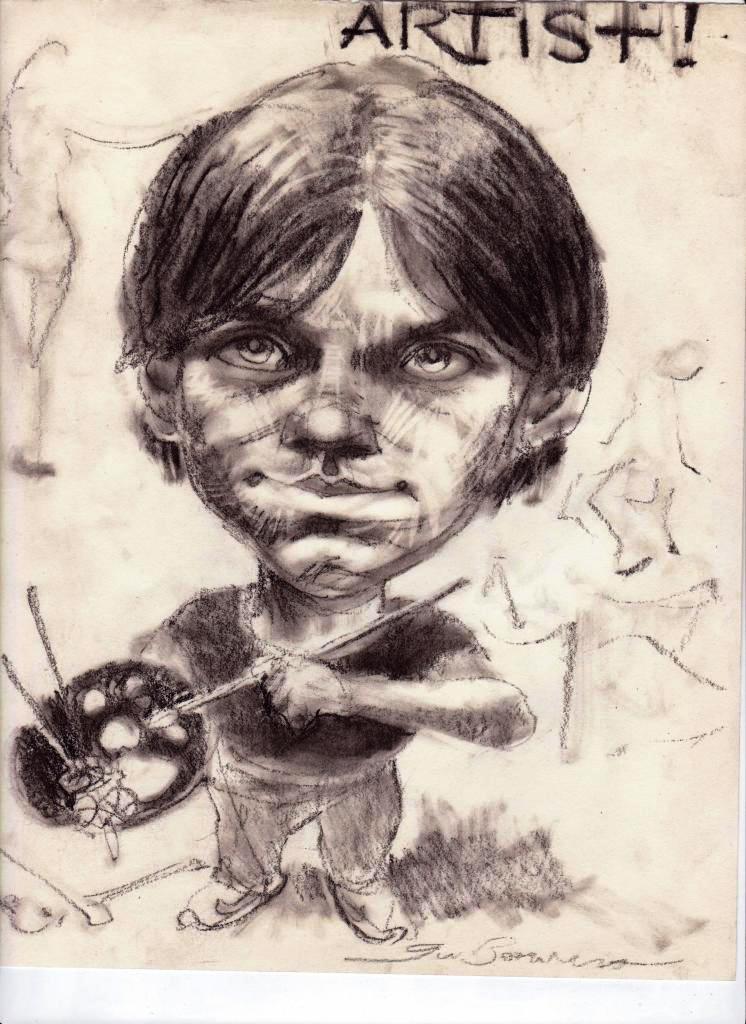
gb artist 022515

this fella thought he was so smart
and dabbed and dribbled at his art
a lifetime later? time to start

*****

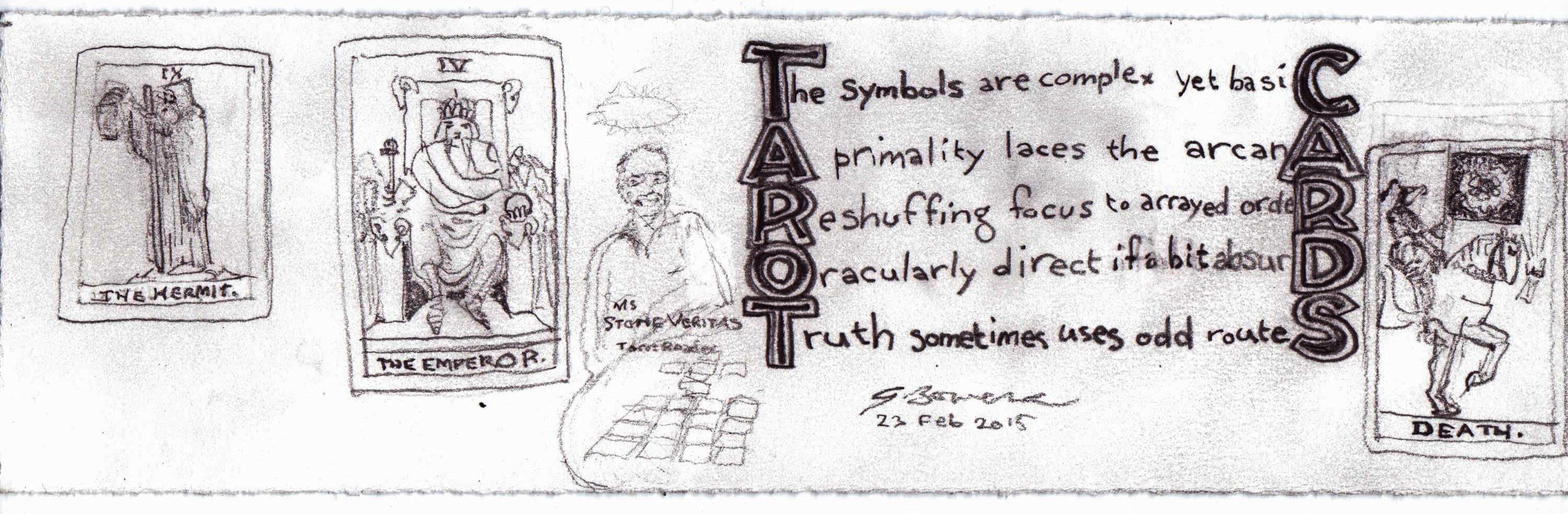
My brother Brian and I were going through boxes in the carport this morning and found many blasts from the past, from more than a century ago to and through the 1975-1982 period when these images of mine were made. Pride, embarrassment, a pang of grief for my now-deceased niece Lori Marie, and frustrated regret for the art career I never really had swept through me in five seconds or less. “What’s past is prologue,” said Shakespeare’s Antonio in THE TEMPEST. “It’s never too late to do something great,” I wrote in our Glendale High School 20th Reunion souvenir book more than 20 years ago. I hope I was right!

tarot cards 022315

Once upon a time in the late 70s, a classmate of mine brought a few of her Persian friends to the house I was raised in. It was that evening that the innocent, wet-behind-the-geopolitical-ears Bowers family learned of unrest in Iran, and got a hint of the misdeeds of the soon-to-be-deposed Shah and his Gestapo-like secret police. Some time later came what we came to call the “Hostage Crisis,” which much later came to be the springboard of Ben Affleck’s excellent ARGO.

That same evening one of the Persian gentlemen entertained many of us by giving Tarot Card readings. I waited patiently for mine, but alas, the gentleman grew too tired to continue before he got to me.

As the years went by, every so often I’d pass a house with PSYCHIC glowing in neon in one of the front windows. I never quite gumptioned up to go in–not that I put stock in the existence of psychic phenomena, you understand. No, I was sure it was “For Entertainment Value Only”–but I thought it would be a kick, and would also scratch the itch I got that evening at the Bowers residence.

Flash forward thirty-some years. I shuttled myself up to Camp Verde for a low-expectations lunch date with my now-former (sigh) Sweetheart, Denise. After a fine plate of Mexican food at a mom-and-pop called La Fonda, and a brief reunion with the critters I’d left behind when I left Cottonwood, Denise and I took a stroll in Old Town and stopped in a bookstore . . .

. . . and in the bookstore, up on a little platform, was a table and chairs and a sign offering Tarot Card readings. I sat in one of the chairs. Denise went elsewhere in the bookstore. Soon a woman arrived, beatific smile, close-cropped hair with a bit of gray on the sides, and introduced herself: Stone Constance Veritas. Solidity Everlastingness Truth–what a name!

As she riffled her well-worn Tarot deck, she gave me an overview. She would begin with a prayer. She would be using the words “abracadabra” and “hallelujah.” She would use a pendulum when she had yes-or-no questions, calling on “Loving Spirit” for the answer. She also valued the presence of Mary, and I think though am not sure that she meant the Virgin of Guadalupe version.

After the prayer, which if memory serves asked Loving Spirit for guidance, and the thrice-repeated Abracadabra (and here’s a brief but fascinating discussion of that numinous word, courtesy of Wikipedia: http://en.wikipedia.org/wiki/Abracadabra ) and Hallelujah, the cards were dealt, with a six-card plus-sign shape on the left and a sixteen-card four-by-four array on the right.

Death showed up right away, ending up in the middle of the plus sign. The Hermit and The Emperor flanked Death. There was also a thrice-stabbed heart, a lot of sticks, a lot of cups, and some geometric-looking crawlies that reminded me of Jack Kirby’s drawings of the Mole Man’s subterranean minions. (My monumental ignorance of Tarot cards is now evident.)

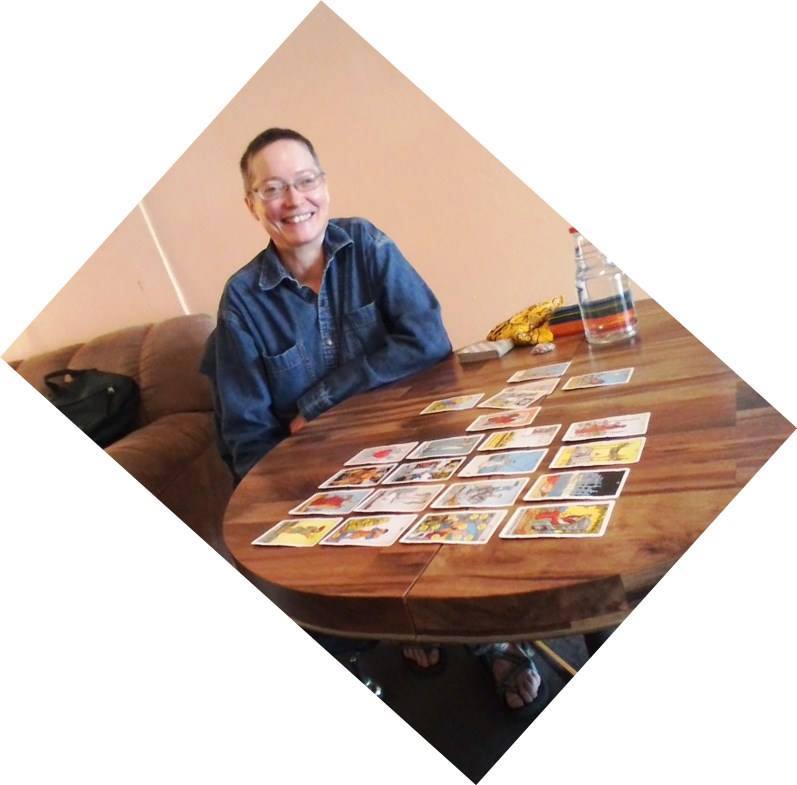
Stone was gracious enough to let me take this picture, of her and the array:
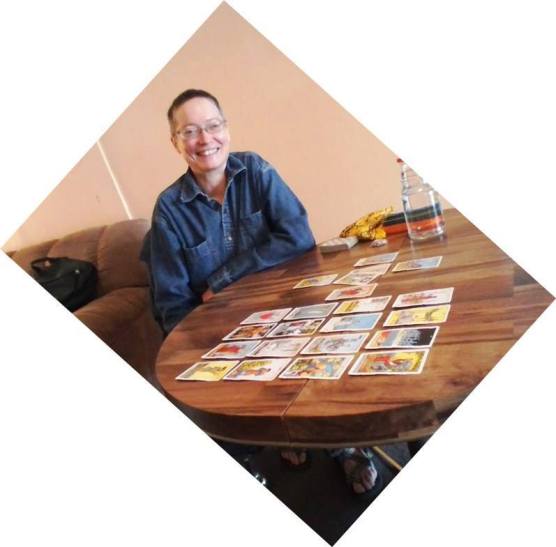
stone 022015

(In my “Tarot Cards” acrostic/drawing at top, you’ll see a really sketchy version of this photo in the middle.)

Stone was quick to assure me that Death symbolizes Transformation. A seed gives up its life, and Life is the result. And elsewhere in the array, she found that a meditation of where I was and where I needed to go was important, and that the pursuit of my calling would result; that healing would occur if a bereft person was consoled; that patience was all-important and that “Ego interferes with Love.”

I enjoyed her company immensely. The psychic connection she may or may not have was irrelevant: like the astrologer Madame Vesant, also known as Becky Vesey, that Robert Heinlein created for his game-changing STRANGER IN A STRANGE LAND, Stone is wise and good with advice, and uses the arcane medium as a tuning fork to fit the wisdom she has to the person she’s counseling. Whether her spirit guides exist exclusively in her imagination, or visit her from the vast Elsewhere, she puts them to good use. I would rather consult her than a psychiatrist, I think. Luckily I don’t need a psychiatrist–or do I? 🙂

Here are the words to the acrostic:

The symbols are complex yet basic
A primality laces the arcana
Reshuffling focus to arrayed order
Oracularly direct if a bit absurd
Truth sometimes uses odd routes