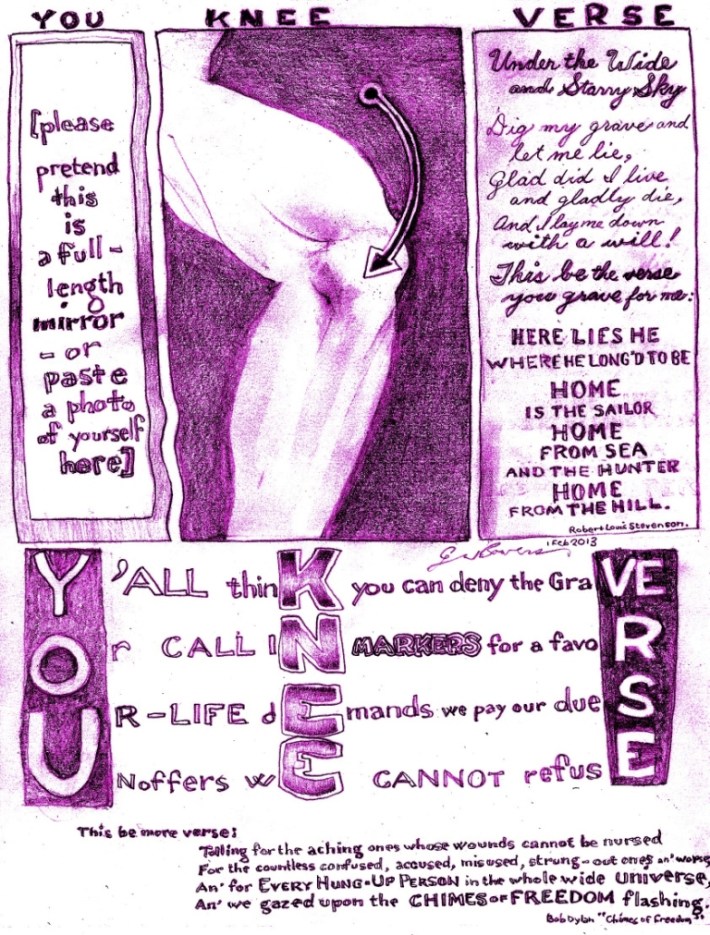
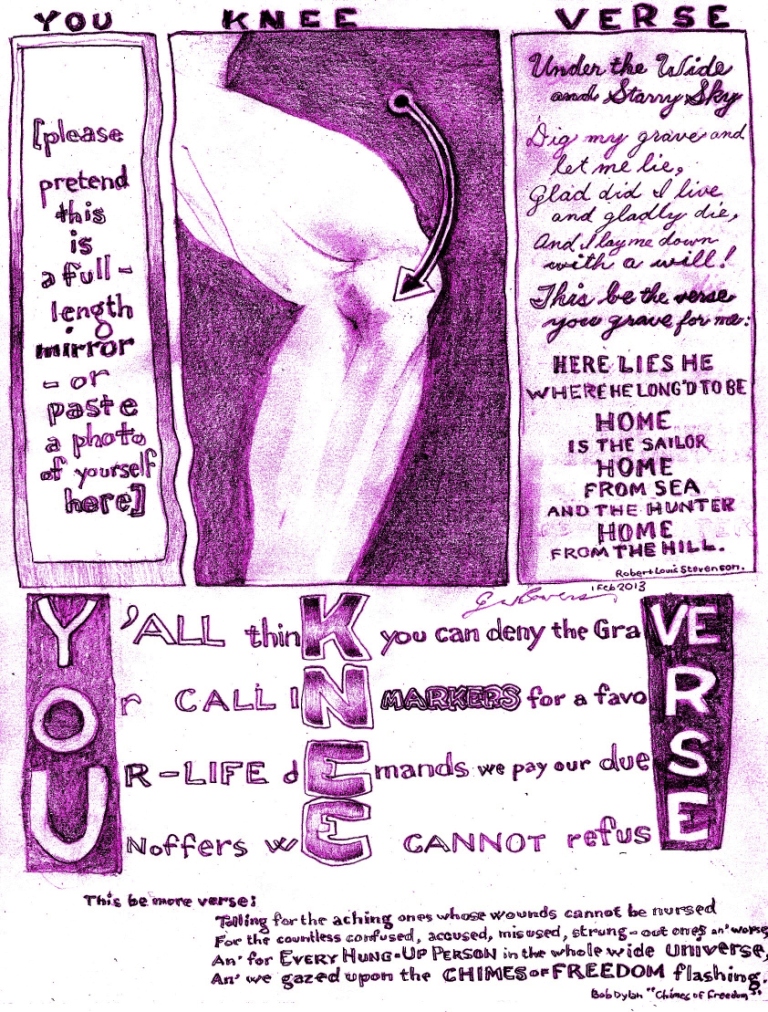
I don’t know what to say about this page except to describe it and tell a little of my choices.
At the top of the page are three panels labeled You, Knee and Verse. Interactive state-of-the-art does not permit me to insert an image of a given individual reader. If it did, the left panel would hold an image of YOU, the person who is reading these words. It would be the same image you would see if you dressed up and made up as you pleased and then posed in front of a full-length mirror. (Any reader who wants to please me no end is invited to fill the left panel with such an image and send the jpg of the revised page to onewithclay@hotmail.com. Really!)
The middle panel is this artist’s conception of a knee, with ancillary leg and an arrow pointing to the knee to be specific. I did not draw from a photo source, so it’s not too anatomically accurate.
The right panel contains a verse, a specific verse written by Robert Louis Stevenson and apparently intended for his epitaph. So after “This be the verse you grave for me” I made the rest of the verse epitaphesque, but it tickled me to isolate and emphasize “HOME” so the three Homes lined up. (Some readers may think it’s “home from the sea,” but I have it on good authority that “home from sea” is correct.)
My triple acrostic beneath reads:
Y’all think you can deny the Grave
Or call in MARKERS for a favor
UR-LIFE demands we pay our dues
UNoffers we cannot refuse
Fans of THE GODFATHER franchise will recognize the riff on “an offer he cannot refuse.” As for UR-LIFE, the prefix Ur means Primitive or Original.
At the bottom I’ve quoted another poet, this time Bob Dylan, from “Chimes of Freedom,” one of my favorite songs of his. “Tolling for the aching ones whose wounds cannot be nursed/For the countless confused, accused, misused, strung-out ones an’ worse/An’ for every hung-up person in the whole wide universe/An’ we gazed upon the Chimes of Freedom flashing.”
The last thing I did was sign and date it. I took a little more care with my signature, mainly because I thought I’d done so well with the G of “Glad did I live…” It’s similar to the way George Washington made his Gs.
Any questions?
 One with Clay, Image and Text