Archive

Tag Archives: illustration

Image

Two thousand three hundred years ago, more or less, an Alexandrian man whose name translates to “good glory” was making up rules and checking them twice, and through those postulates was born premodern geometry. To my knowledge, though, and right on through to today, not even Euclid could use compass and straightedge to perform that magical operation known as “squaring the circle” with trueness.

One of my heroes, Isaac Asimov, once wrote a science article called “Euclid’s Fifth,” perhaps obliquely referring to Beethoven, whose Fifth Symphony rivals his Ninth for space in our collective consciousness. Euclid’s Fifth Postulate, much more complicated than his first four, goes like this:

If a line segment intersects two straight lines forming two interior angles on the same side that sum to less than two right angles, then the two lines, if extended indefinitely, meet on that side on which the angles sum to less than two right angles.

Asimov elegantly demonstrated that not taking the Fifth as gospel paved the way for NON-Euclidean Geometry, which with many aspects of reality (navigating the Earth’s surface, for instance) is a better match than non-NON-Euclidean geometry.

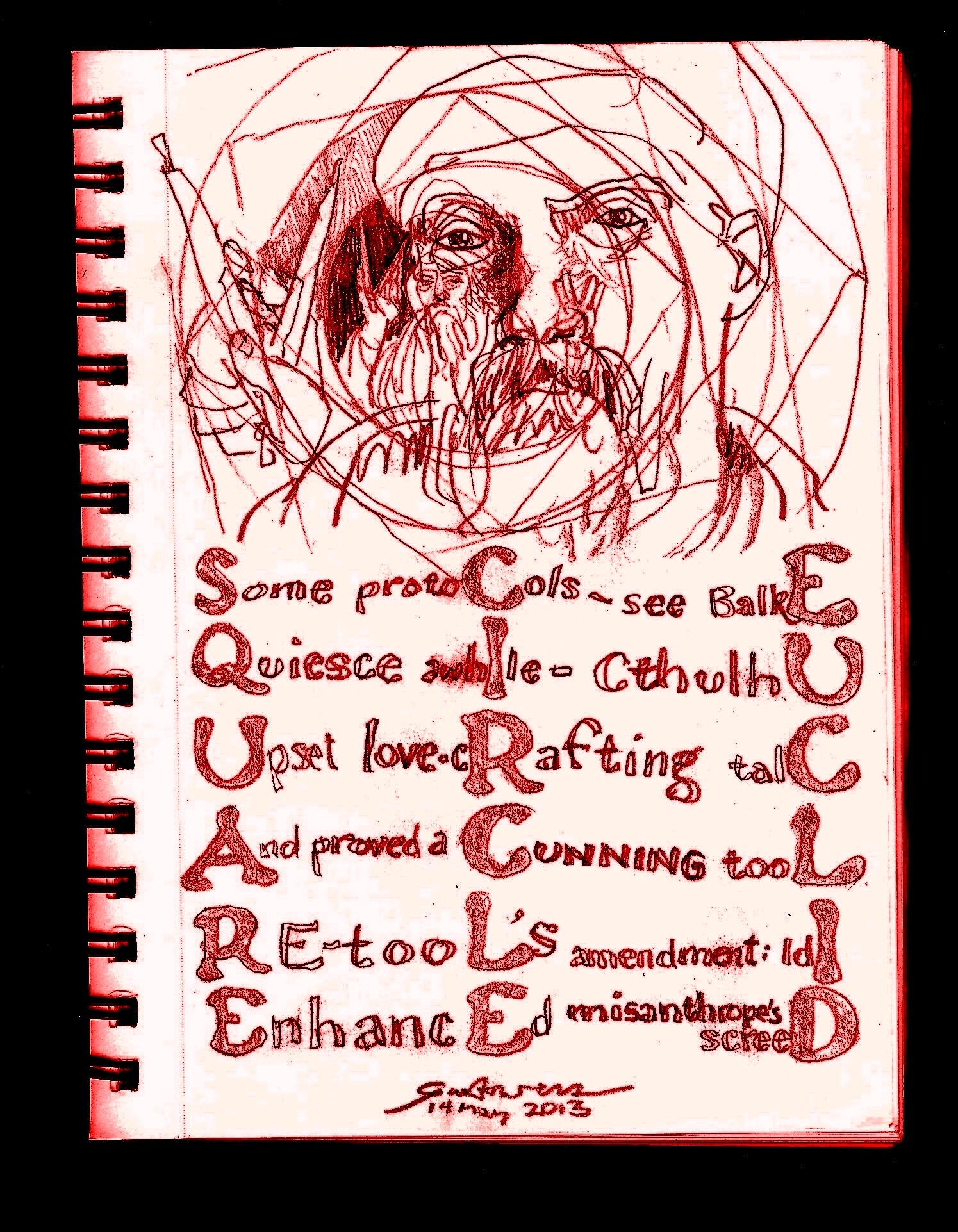
Here are the words to the triple acrostic:

Some protocols–see Balke
Quiesce awhile–Cthulhu
Upset love-crafting talc
And proved a cunning tool
RE-tool’s amendment: Idi
Enhanced misanthrope’s screed

I leave to the student the explanation of what the Balke protocol for measurement of maximum oxygen uptake, Lovecraft’s Cthulhu and Idi Amin Dada have to do with Euclid and/or the futility of “squaring the circle.” HINT: No one today really knows what Euclid looked like. Good Glory!
Image

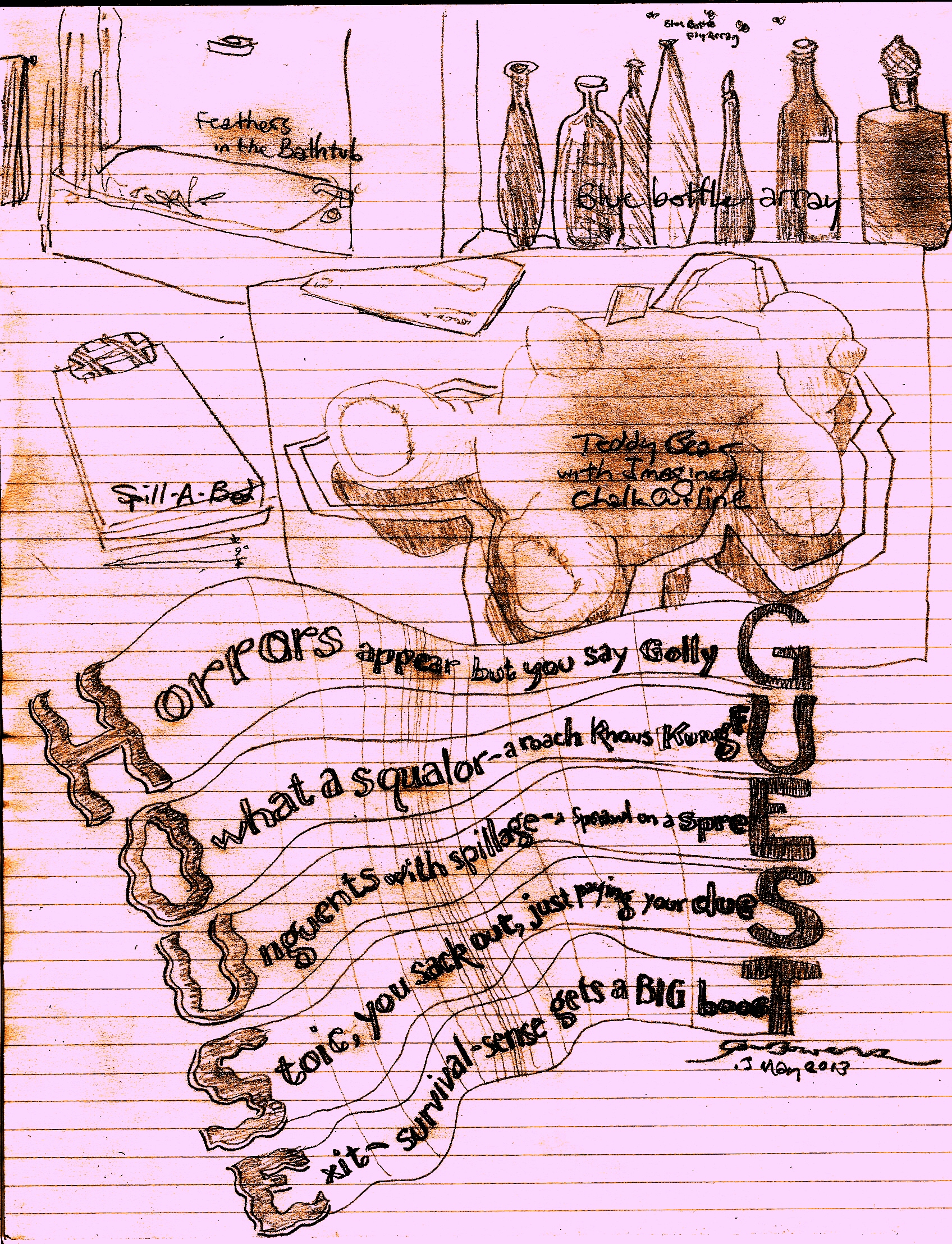
Last weekend I went to Phoenix, and spent two nights at the home of Marty K, a lifelong friend of mine. I did not sleep well there, for many reasons, not the least of which was the squalid condition of his abode. Not that I didn’t have plenty of squalor in my unattached days to rival his; it’s just that living with a “neatnik” has given me a taste for fresh unclutter.

I am grateful for Marty’s hospitality (not to mention Vic’s, the night Marty kicked me out–long story), but SO glad to be home.

Words:

Horrors appear but you say Golly G
O what a squalor–a roach knows Kung Fu
Unguents with spillage–a sprawl on a spree
Stoic, you sack out, just paying your dues
Exit–survival-sense gets a BIG boost


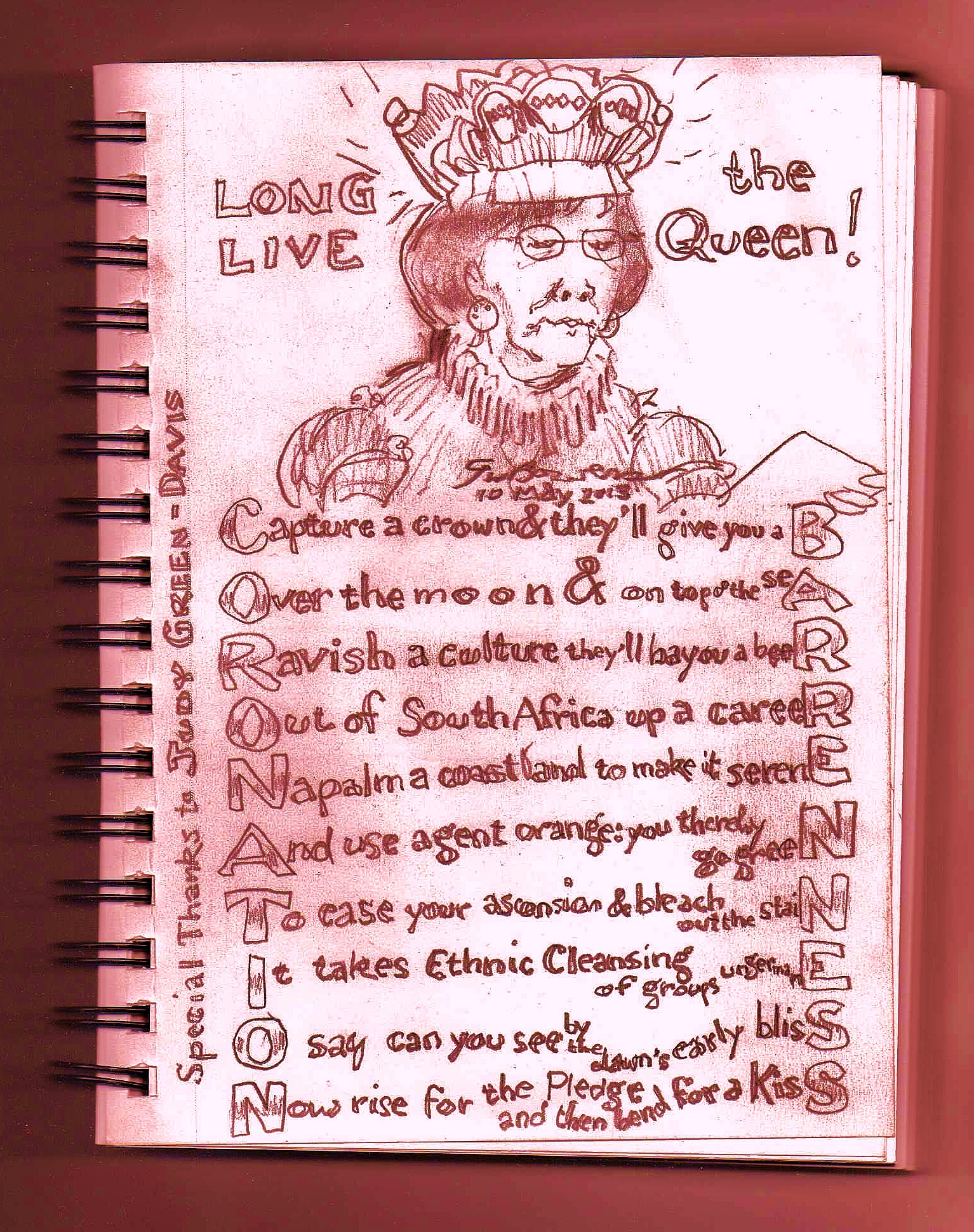
coronation

This was written and performed at the {9} Gallery for the Caffeine Corridor poetry event last night, May 10, 2013. Judy Green-Davis gave me the word Coronation and I wrote it about six poets before my Open Mic performance of it. (This is the capsule version; a previous post of mine seems to be lost to the ethersphere.)

Image

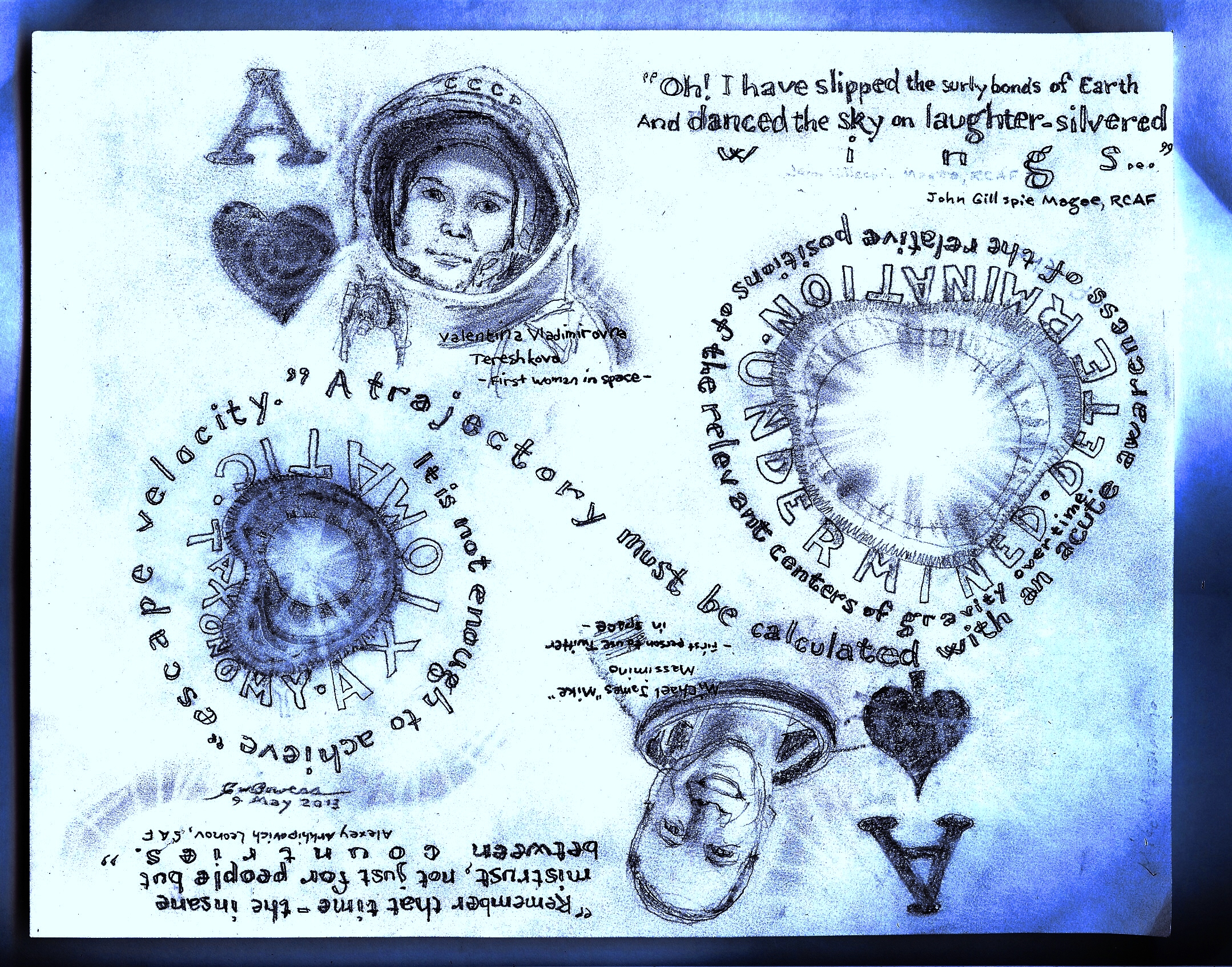
The starship Enterprise, as conceived by Gene Roddenberry, whom Nichelle Nichols, who played Lieutenant Uhura, called “The Great Bird of the Galaxy,” will endeavor in the 23rd Century “to boldly go where no one has gone before.” But Arthur C. Clarke, much more scientifically attuned than the late great Roddenberry, says, “The truth, as always, will be far stranger.”

Meanwhile humans of two different hegemonies have ventured beyond our atmosphere. This page has a hint of the magnitude of that very real endeavor, the various forces (gravitational, ideological, economical, teleological, and so forth) influencing the effort, and the hope and the despair of the future of human space exploration. Part of the hint is that in free fall, there is no rightside-up; we groundlings can’t take in a page like this in one glance, or even one gaze. Betters than us (or is it we?) will follow, I hope.

Image

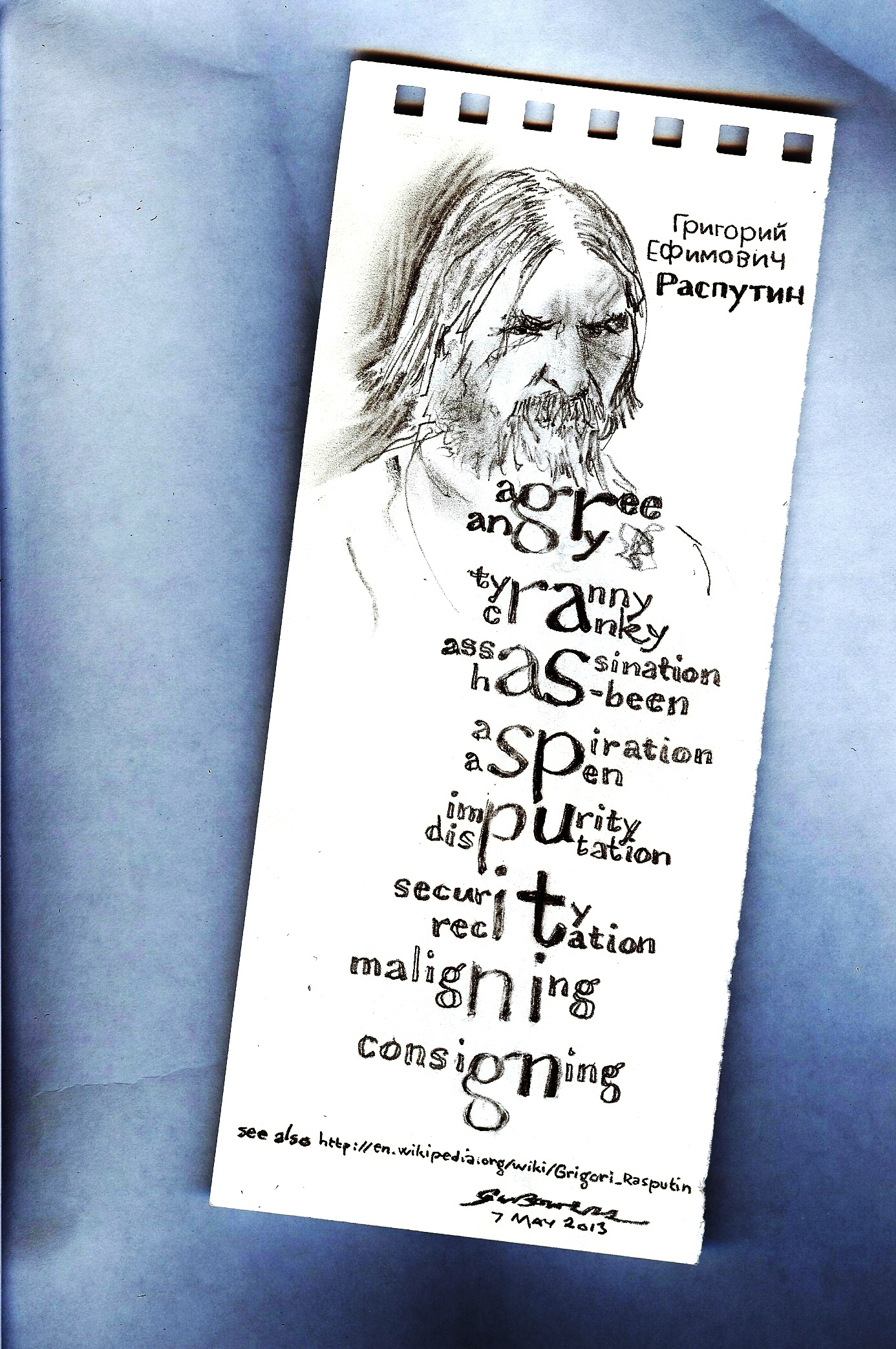
This post could have as easily been titled “Die Hard: 1916.” Grigori Yefimovich Rasputin was hard to kill. The first assassination attempt was disembowelment; it took him 10 weeks to recover. In the second, multifarious, and ultimately successful attempt, he was shot, poisoned, bludgeoned, and dumped in the water. An autopsy revealed death by drowning.

Later, he was disinterred and burned, and legend has it that he sat up before succumbing to the flames. Read his fascinating story on Wikipedia, if you dare!

Image

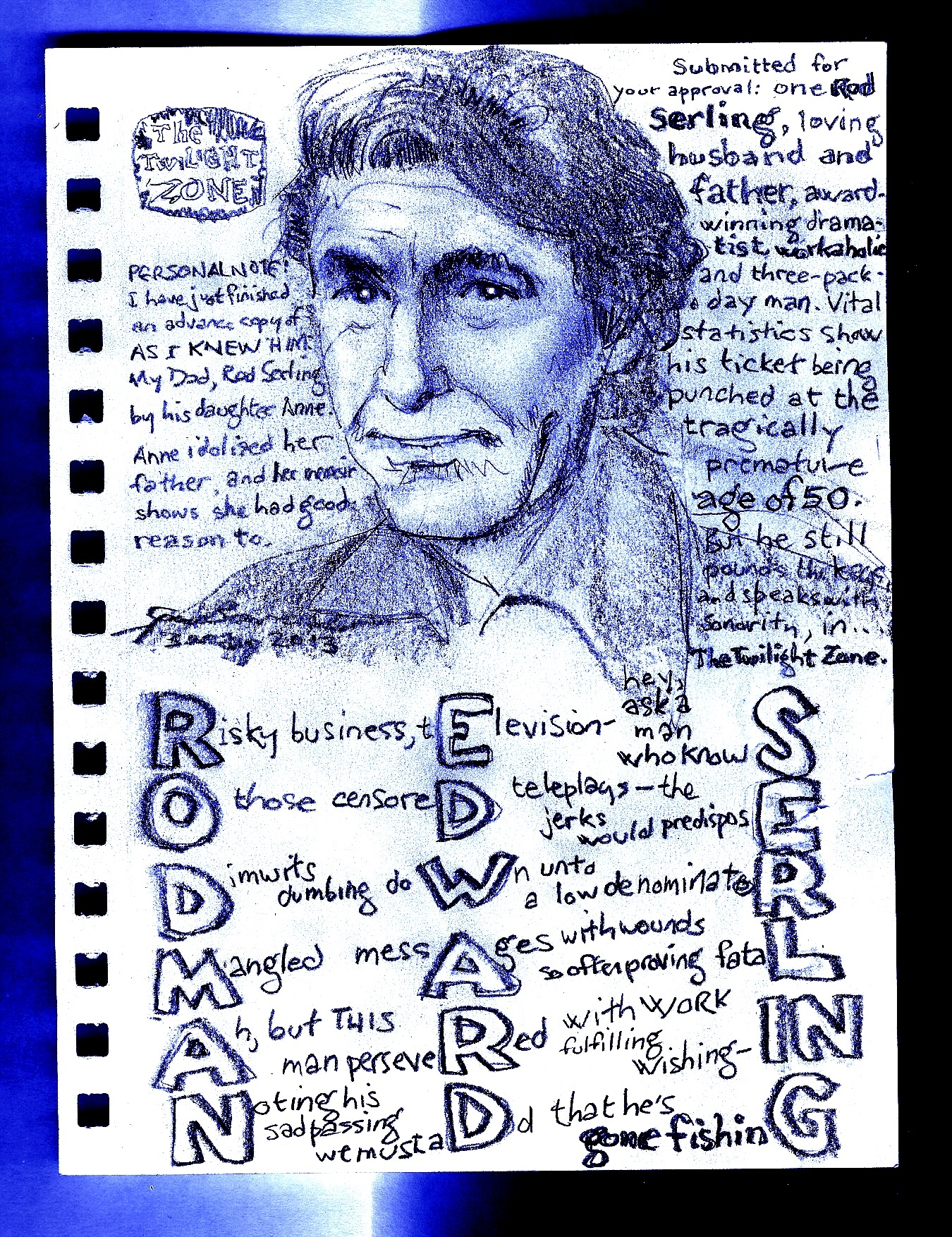
A popular conversation-opener at Unit VI Elementary in the mid-60s was “Remember the Twilight Zone where…” The Twilight Zone was the gold standard of Cool TV Shows. How tragic that its creator, narrator, and author of the majority of its episodes, Rod Serling, died long before his hair turned completely gray. He would have been Serling Silver.

The sad fact is that Rod Serling was hopelessly addicted to cigarettes and work, work, work. He died in a hospital of a different kind of broken heart. But his family life, as described by his daughter, Anne Serling, was rich with love and high good humor. I’ve just read an advance copy of Anne’s memoir, AS I KNEW HIM: MY DAD, ROD SERLING, and good Heavens, I wish I had met and known him. Read the book, which is heartily endorsed by Carol Burnett, Robert Redford, and Betty White, and you too will wish my wish.

Appropriately for a page dedicated to the six-Emmy-award-winning creator of The Twilight Zone, I write this at 4:14 AM local time.

At the upper right is an ersatz Twilight Zone intro, which, if you’re a fan of the show, you will not be able to read without hearing Mr. Serling’s unforgettable narrative voice.

Here are the words to the acrostic:

Risky business, television–hey, ask a man who knows
O those censored teleplays–the jerks would predispose
Dimwits dumbing down unto a low denominator
Mangled messages with wounds so often proving fatal
Ah, but this man persevered with WORK fulfilling wishing–in
Noting his sad passing we must add that he’s gone fishing

Image

Many years ago, in Mr. Richmond’s Senior English class at Glendale High School, I wrote an essay in which I admitted knowing almost nothing about the subject. Milnor Richmond, in his profound wisdom, circled the admission in red and wrote “Don’t admit it.” I have never forgotten that…

…but I haven’t always taken his advice, literally, literarily, or figuratively. About this page I wish to admit that it has serious flaws. It doesn’t say all that much; what it has to say is confusing; and the face that is supposed to represent Rage doesn’t: it just looks like a guy about to sneeze.

All that said, I don’t think the page is a waste of time to look at. As another wise teacher, Darlene Goto, former Drawing & Composition instructor at Glendale Community College, would often say to a student, “It has possibilities.” I am creatively arrogant enough to say that if I ever take a decent amount of time to realize the page’s possibilities, I’ll have a text/image for the ages. (Now I hear Mr. Richmond’s gravelly voice saying, “Don’t declaim it.”)

Hear are the words to the two acrostics:

Cold fury’s touch will sear
A blast of HATE is near–a
Lunatic–don’t beg
Methinks Fate will renege

Thoughtful speculators dream
Essays to assay a meme
Many wingbeats tax a swan
Pray consult a clairvoyant [French pronunciation, not American]
End with panicked dash, mach schnell–a
Runaround leaves us unwell

Image

In grade school they hit us with Nationalism, and they hit us hard. We pledged allegiance to the flag, and then we marched in place to “You’re a grand old flag/You’re a high-flying flag/And forever in peace may you wave/You’re the emblem of/The land I love/The home of the free and the brave…” The song later boasted “where there’s never a boast or a brag…”

Miss Heath, the pouter-pigeon of a Chorus teacher, wasn’t done with us yet. Here’s one she played so many times I still remember it 50 years later, though I’ve never heard it since:

This is my country,
Land of my birth;
This is my country,
Grandest on Earth.
I pledge thee my allegiance,
America the Bold,
For this is my country
To have and to hoooooooold!

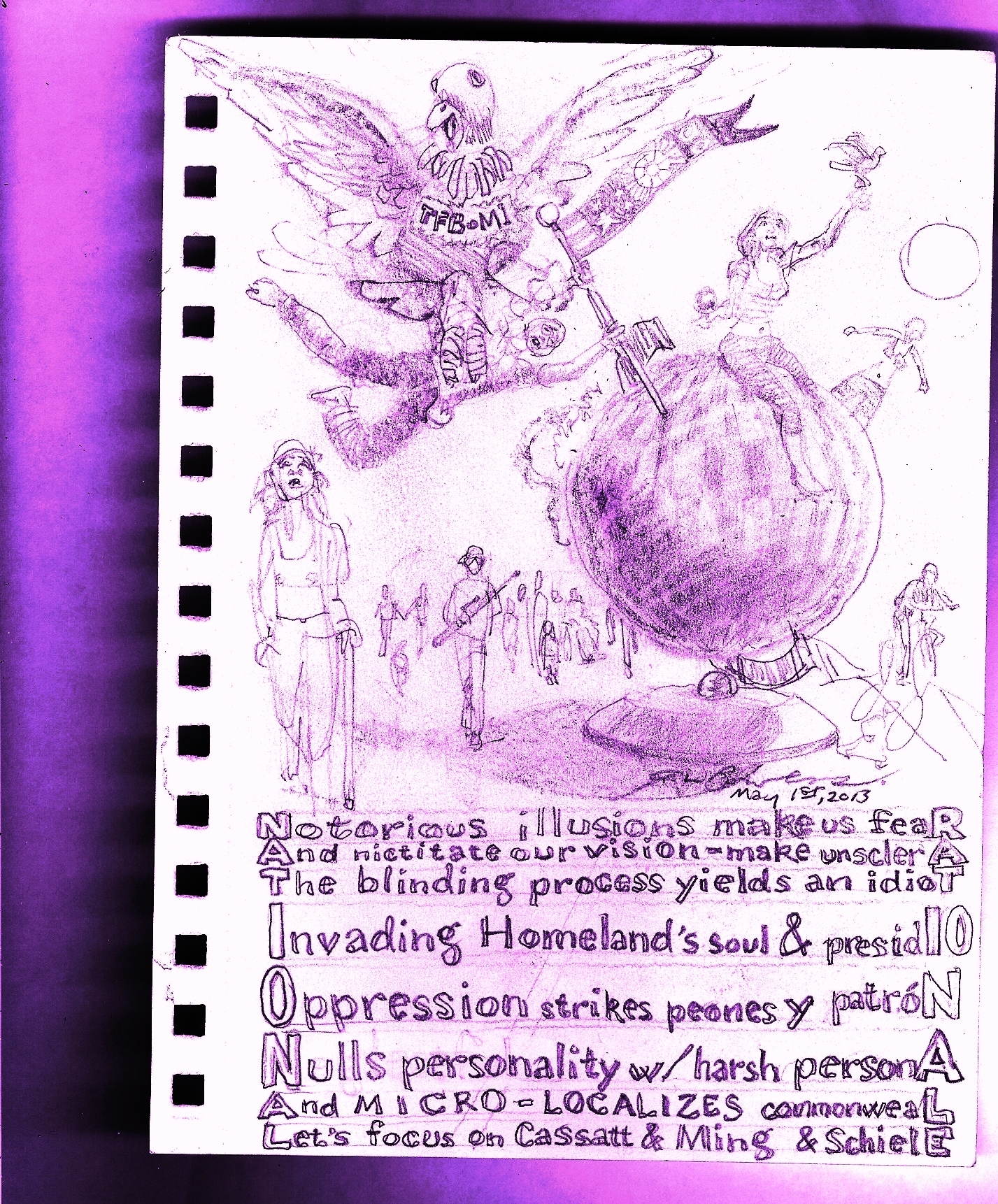
So what’s wrong with a little patriotic zeal? Well, it perpetuates Us as opposed to Them. And, folks, we’re all of us on Earth in the same leaky boat right now. We have much to do, we world citizens, or, say most climate scientists of repute, things are going to get tipping-point uninhabitable before this century’s end.

My modest proposal, implied via my latest journal page, is that we change focus.

Here are the words to the acrostic:

Notorious illusions make us fear
And nictitate our vision–make unsclera
The blinding process yields an idiot
Invading Homeland’s soul & presidio
Oppression strikes peones y patrón
Nulls personality with harsh persona
And M I C R O —L O C A L I Z E S commonweal
Let’s focus on Cassatt & Ming & Schiele

Image

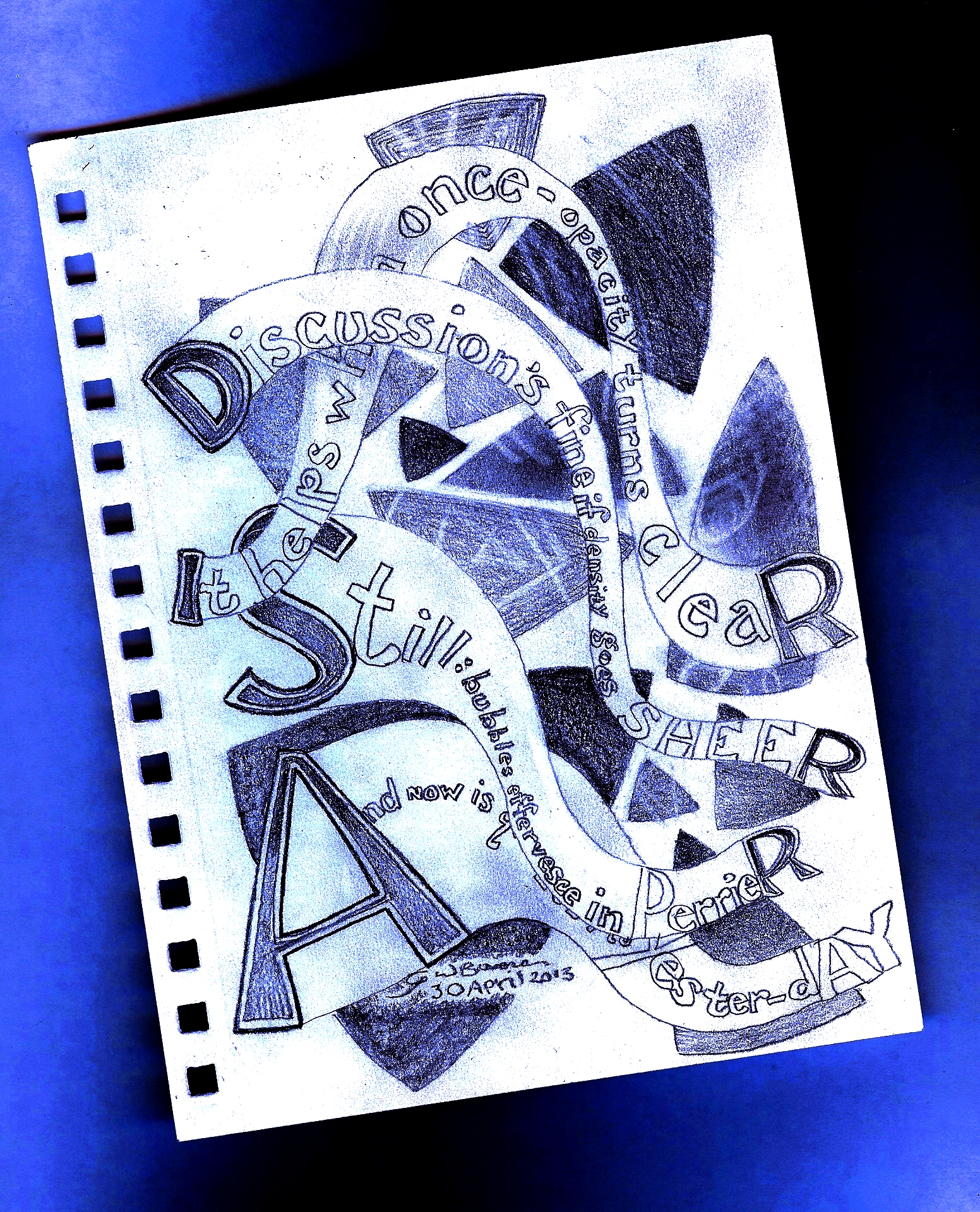
Unfortunately, when you illustrate Disarray with a text component, the text become nigh-impossible to read. That’s why I’m grateful for the annotative aspect of blogging–I can provide the text in readable format, thus:

Discussion’s fine if density goes SHEER
It helps when once-opacity turns clear
Still: bubbles effervesce in Perrier
And NOW is quickly LOST in yester-day

Does it seem random? (Note to historians of the future: in the first decade of the twenty-first century, the word “random” developed a pejorative connotation.) I’d like to point out that Disarraneous rhymes with Miscellaneous.

Why are there three Rs in my Disarrray? Just seemed right.