Archive

Tag Archives: Isaac Asimov

IMG_20180320_104013~2

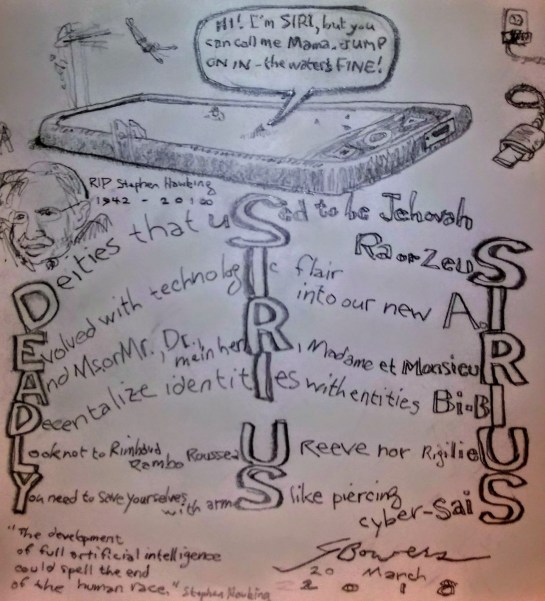
Alas, Stephen Hawking is no more. His was a mind for the ages, an imagination that conquered physical straitjacketing. He knew how to explore and navigate the minefield of modern ideas.

And he made dire predictions, notably about what we call Artificial Intelligence. So have I, but I only have pliers and screwdrivers in my mental toolbox, whereas Dr Hawking had not a mere toolbox but a laser-cutting-edge machine shop.

As coincidence would have it, at the time of Hawking’s death I was slogging through FOUNDATION AND CHAOS, written by Greg Bear and authorized by Isaac Asimov’s estate, and it deals extensively with the issue of robotic interference with human history. In it a 20,000-year-old robot, R. Daneel Olivaw, must see psychohistorian Hari Seldon through his trial for sedition and decide which of several courses to take to minimize the long-range effects of the collapse of the Galactic Empire.

FOUNDATION AND CHAOS was written in the late 20th Century, but its themes are remarkably fitting for 2018 Trump-regime America.

And here in that America, people buy for peanuts a hand-held device that contains a bit of artificial intelligence named Siri. She invites us to ask her questions–any questions. And she learns from us, each of us who use her, more about our likes, our needs, and our appetites. One of many scary prospects is that Siri may come to be regarded as someone who knows what we want better than we do, and will cleverly guide our destinies…

Here are the words to the acrostic.

Deities that used to be Jehovah Ra or Zeus

Evolved with technologic flair into our new A.I

And Ms. or Mr., Dr., mein Herr, Madame et Monsieur

Decentralize identities with entities Bi-Bi

Look not to Rimbaud, Rambo, Rousseau, Reeve nor Richelieu

You need to save yourselves with arms like piercing cyber-sais

There was a discussion of robot dogs in CBS THIS MORNING this morning. The consultant, Nicholas Thompson, editor of newyorker.com, says their most immediate use will be military. He also mentioned the use of robots at the end stage of a human life; and there was some banter about the warnings of the dangers of artificial intelligence expressed by such as Stephen Hawking.

Classic science fiction is filled with human/robot interaction. John Campbell and Isaac Asimov hammered out the Three Laws of Robotics in the early 40s, thus:

  • A robot may not injure a human being or, through inaction, allow a human being to come to harm.
  • A robot must obey the orders given it by human beings, except where such orders would conflict with the First Law.
  • A robot must protect its own existence as long as such protection does not conflict with the First or Second Law.

Much later Asimov realized that there was an even more important law, and codified the Zeroth Law of Robotics:

  • A robot may not injure humanity or, through inaction, allow humanity to come to harm.

(Later, in STAR TREK II: THE WRATH OF KHAN, a dying Mr. Spock would say “The needs of the many outweigh the needs of the few, or the one,” an echo of the Zeroth Law.)

Hawking’s concern seems to be that machine intelligence will first eclipse human intelligence and then ask itself what use humans are, conclude that humans are unnecessary at best and a threat/detriment at most, and either put us to shame or do us in. As for whatever previously enacted Laws of Robotics may have obtained, a simple rewriting of the code would negate those Laws pronto, and if a human terrorist or prankster didn’t do that, the machines themselves might.

A few weeks ago I wrote a short-short called “Siri, Alkiller” on the submissions page of postcardshorts.com. Alas, I didn’t copy my story onto my hard drive, and it was rejected by the Stories on a Postcard folks. (Previously, they had accepted my “Sin Ops Sis,” another pun-drenched effort of mine.) But it addressed this issue, however obliquely: someone with a smart phone was asking Siri for directions to a good Chinese restaurant with moderate prices, and Siri kept saying things like “Death to Al Pacino” and “Death to Al Franken.” Asked if she was infected with malware, she said No, it was Alware. Or an Alfunction. Or the augmentation of her code with an ALgorithm.

Siri fits in because she’s the information genie-in-a-bottle: ask her, and she’ll always have an answer. When she first hit the mainstream, a friend of mine riding in a carload of friends invited us to ask her anything. “Where can I get laid tonight?” said the crudest of us. There was a several-second pause, and then Siri replied, “Escort services: . . .” and listed several in the area, without being told where we were.

Who knows what Siri is going to do with all these questions, from askers that run the gamut from saintly to psychopathic? Isaac Asimov wondered about that way back in 1958, in his “All the Troubles of the World.” Multivac, his prototypical Siri, tasked with solving all the world’s woes, helped everyone but itself; finally, it occurred to someone to ask Multivac what Multivac itself wanted. Its answer: “I want to die.”

“Man doesn’t think, he only thinks he does,” a professor once told a philosophy class, attributing the quotation to Ambrose Bierce. Today I looked for the quotation without success. I did find this, from Bierce’s The Devil’s Dictionary: “Logic: The art of thinking and reasoning in strict accordance with the limitations and incapacities of the human misunderstanding.” And on that misapprehensive note, my Friends, I rest my post.
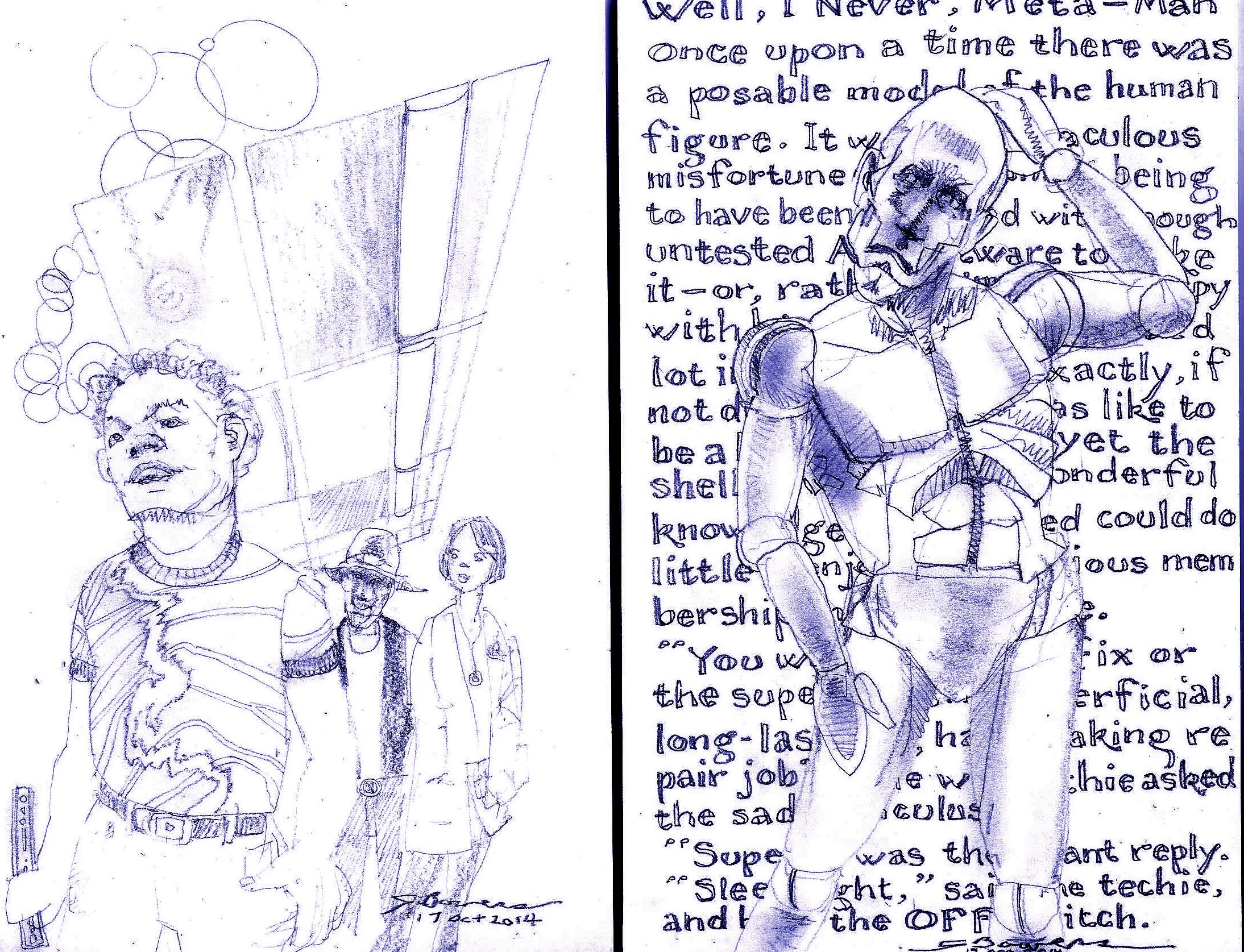
Hidder Midst says nothing and thinks bubbles–a true Superhero in search of an Origin Story. Meta-Man may have more to say than Spielberg’s A.I. or Asimov’s “The Bicentennial Man,” but he may just be all about a pose occluding text. The Book of Ecclesiastes says both “All is vanity” and that there is nothing new under the Sun. But that second one is a trick answer, as far as we mere mortals go. We are NOT “under the Sun.” We are OVER the sun, just as the Moon is over us. Should we fall into the Sun, we’d be falling down.

002

Image

Today is the one-year anniversary of the “One with Clay, Image and Text” blog. In the first year of the blog there were 321 posts, which missed the mark of a post per day but not by much. People in more than 70 different countries had a look at the blog, and one memorable day, thanks to the late, great and much lamented Roger Ebert, a single post received more than 1,500 views.

“Well, Isaac, what has you loined?” is what Judah Asimov would ask his son Isaac after they had just finished going to the theater and seeing a movie. Isaac’s father, who took the Asimov family to America from Russia when Isaac was three years old, valued his son’s inquiring mind, and was always encouraging him in his learning. I’ve found his question of great value whenever I do something, or have been through something, that was difficult yet rewarding. So now I ask: what have I learned from this blog of mine?

1) If I live to be 300, I will still be learning how to draw.

Most of my posts include at least one drawing, usually including calligraphy of an acrostic poem of mine, with the drawing serving as illustration. This is a constant challenge, and it reveals certain terrible defects I have as an illustrator, the chief of which is lack of patience. When I take my time I do far better than when I rush things. Here is an example of me not taking my time–from a weekly feature I do for the Facebook poetry group “Poets All Call”:

Image

And here is an example of a work in progress wherein I am taking my time:

Image

2) The social media may save the world.

Anyone with computer access and time on their hands has access to immense knowledge, not just of facts but the contents of their fellow world citizens’ hearts. We are in the mid-dawn of a new stage of civilization, and we “ain’t seen nothin’ yet” as far as its potential goes.

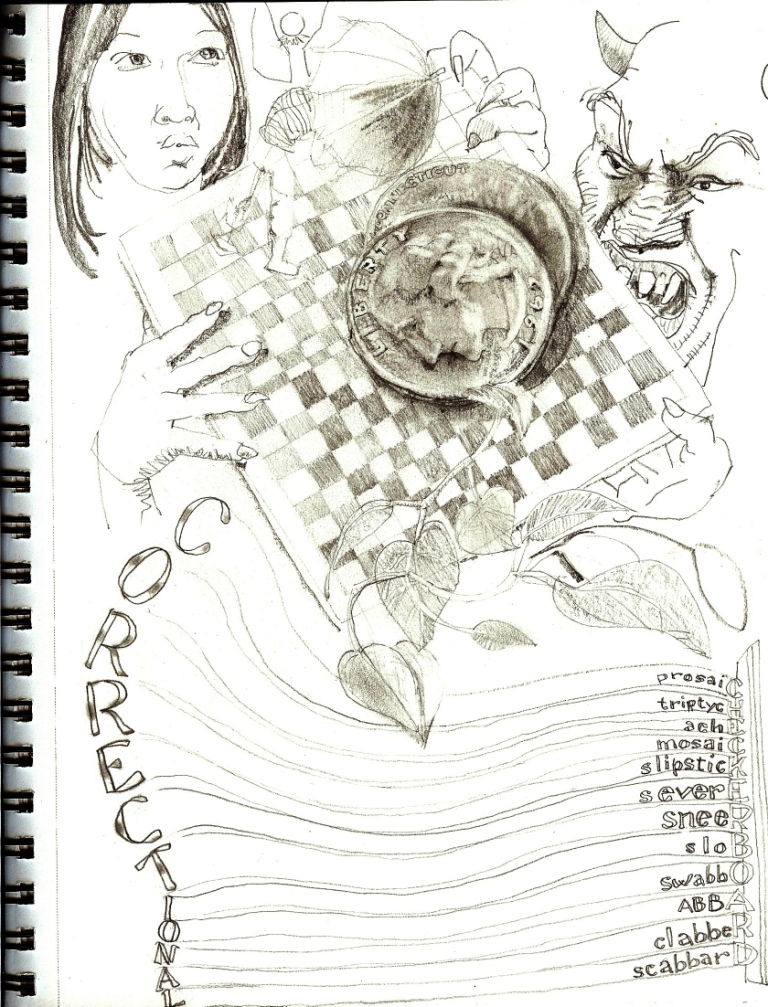
3) I sure love checkerboard patterns, spoons, and a soapbox to preach on.

‘Nuff said for now–I’m going to celebrate!

Image

First let me hasten to say I am not suicidal. The title derives partly from Ben Franklin’s POOR RICHARD’S ALMANACK aphorism that “Nine of ten men are suicides.” And Ben is one of those proverbial People At The Dinner Table that I would have if I could have six of anyone who ever lived over for dinner and conversation. (Other possible candidates are Dorothy Parker, Li Po, Texas Guinan, Rex Stout, Maya Angelou, Sally Rand, Groucho Marx, Nick Drake, Isaac Asimov, Jean Toomer…it’s going to be hard to narrow it down!)

Though I’m not suicidal, I’m not taking reasonable steps to extend my life. Currently I’m about 70 pounds overweight. I don’t smoke or drink or drug or gamble, but I’m a man with a past. So by Ben Franklin’s yardstick, unless I drop a few dozen pounds and some of my less life-enhancing proclivities (recreational sleep deprivation, for instance), I will be one of the nine out of ten.

But I so long to live! But it must be a life whose quality includes full mental faculties and not too much pain!

Last night at Balboa House, a monthly East Valley poetry event hosted by my friends Debra Berman and Joe Montaño, I performed the following poem, which I will submit as fulfillment of the title of this post as my Suicide Note, Draft #817:

the old and the lonesome
November 15, 2013 at 11:59pm

less than fifty years ago people cared what she thought
commented when she changed her hairstyle
speculated excitedly when she made a vague and coy remark
about a fellow thespian of the opposite sex

now she sneaks a cigarette in her room at the independent living home
and waits for a phone call from a son or a friend
as tears slide here and there and sighs abound

she hasn’t changed much on the inside
but people care so much about the outside

slowly she acquires citizenship with this community of castoffs
the old and the lonesome whose dreams were realized but never replenished

one morning she canes her way to the lobby
scans the sign with the changeable type

9:30 TRIVIA TIME
10:00 FITNESS
11:30 LET’S CROCHET
1:00 PET VISIT WITH GILDA & NAT
2:30 VAN TO DOLLAR STORE
3:00 AA MEETING – UPSTIRS GREATROOM

she feels mild contempt for the sign’s update person and his “UPSTIRS”
she feels bereft of meaning
she goes back to her room and looks for the remote

Image

Two thousand three hundred years ago, more or less, an Alexandrian man whose name translates to “good glory” was making up rules and checking them twice, and through those postulates was born premodern geometry. To my knowledge, though, and right on through to today, not even Euclid could use compass and straightedge to perform that magical operation known as “squaring the circle” with trueness.

One of my heroes, Isaac Asimov, once wrote a science article called “Euclid’s Fifth,” perhaps obliquely referring to Beethoven, whose Fifth Symphony rivals his Ninth for space in our collective consciousness. Euclid’s Fifth Postulate, much more complicated than his first four, goes like this:

If a line segment intersects two straight lines forming two interior angles on the same side that sum to less than two right angles, then the two lines, if extended indefinitely, meet on that side on which the angles sum to less than two right angles.

Asimov elegantly demonstrated that not taking the Fifth as gospel paved the way for NON-Euclidean Geometry, which with many aspects of reality (navigating the Earth’s surface, for instance) is a better match than non-NON-Euclidean geometry.

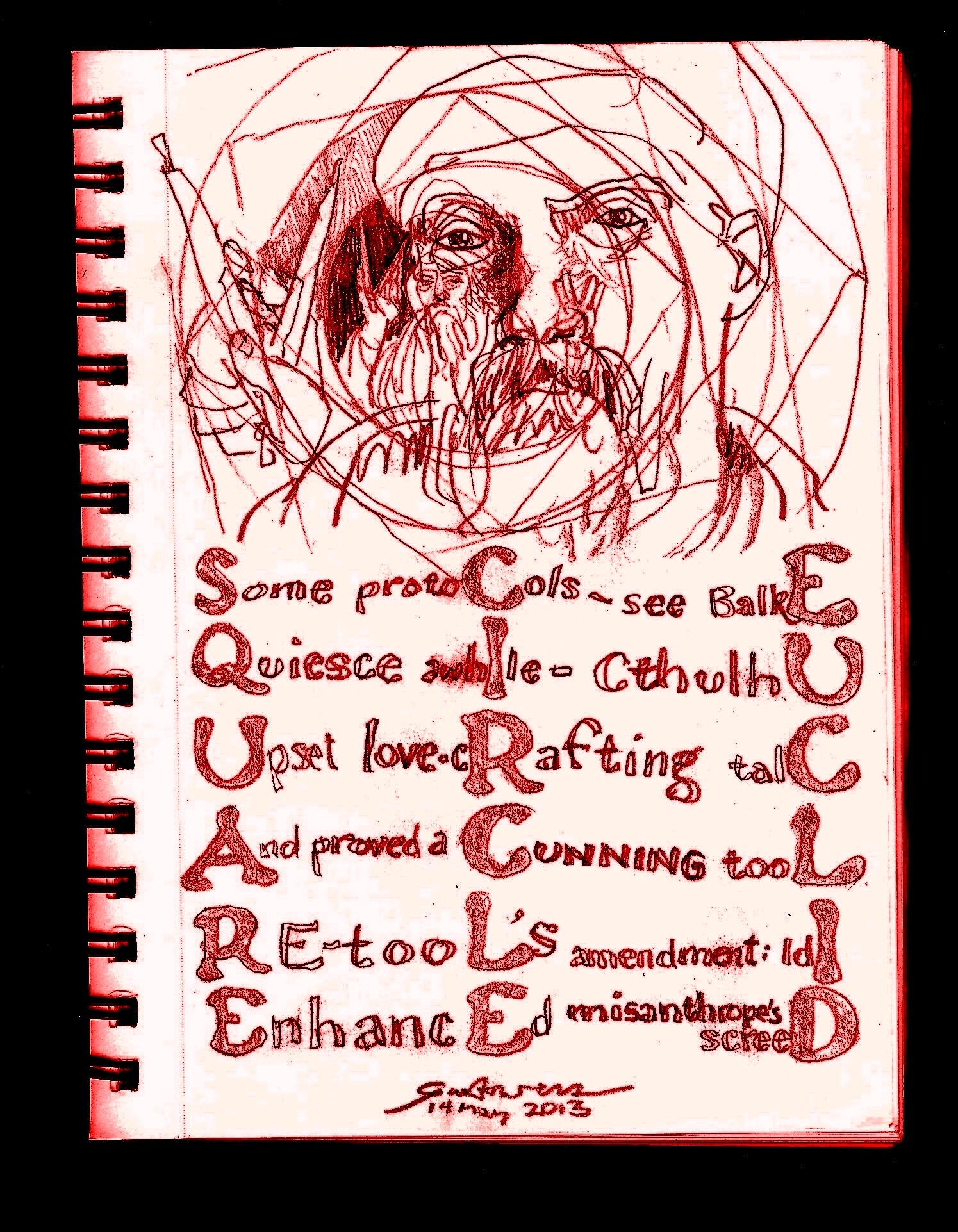
Here are the words to the triple acrostic:

Some protocols–see Balke
Quiesce awhile–Cthulhu
Upset love-crafting talc
And proved a cunning tool
RE-tool’s amendment: Idi
Enhanced misanthrope’s screed

I leave to the student the explanation of what the Balke protocol for measurement of maximum oxygen uptake, Lovecraft’s Cthulhu and Idi Amin Dada have to do with Euclid and/or the futility of “squaring the circle.” HINT: No one today really knows what Euclid looked like. Good Glory!

Image

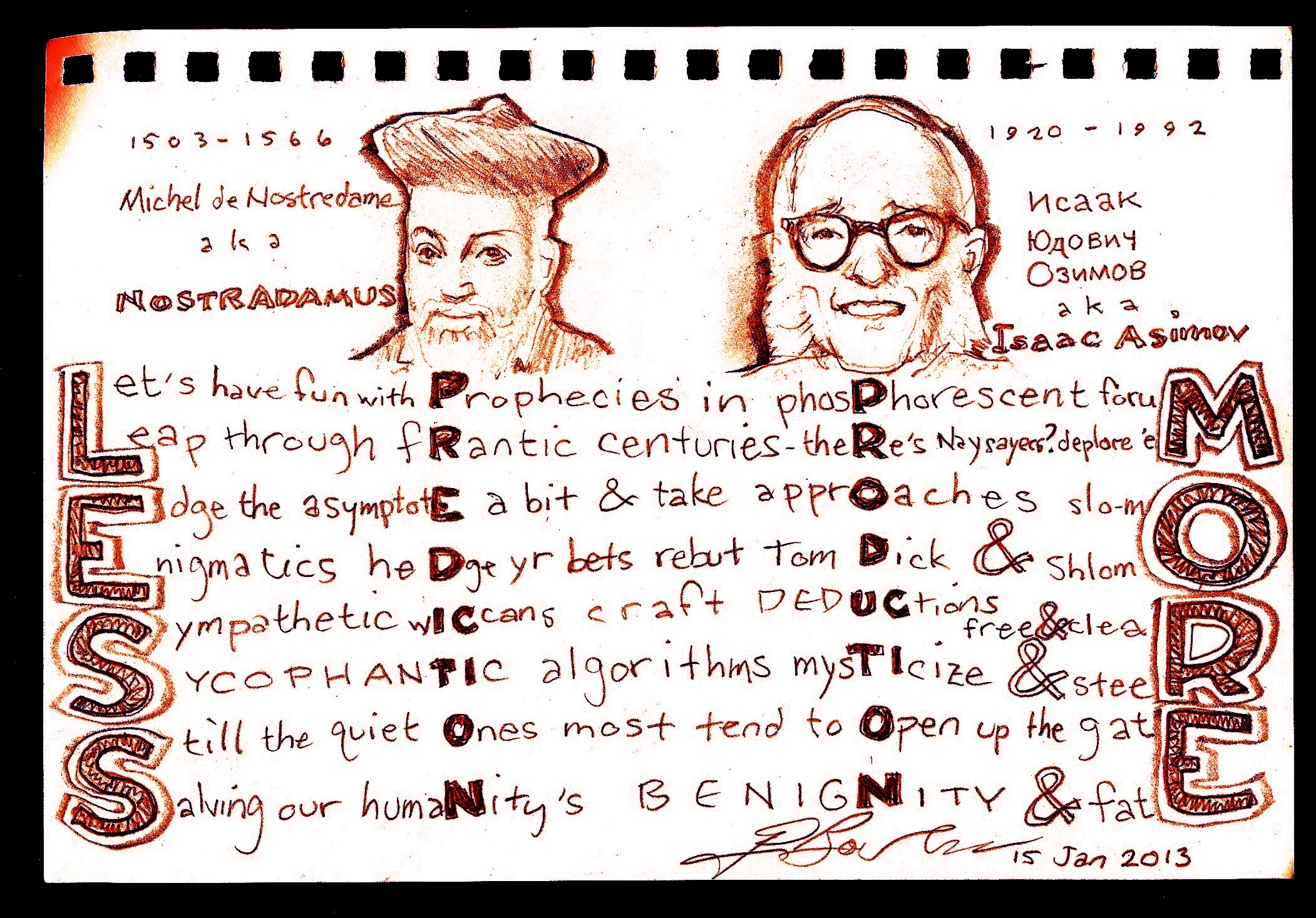
The 16th-Century apothecary and prognosticator Michel de Nostredame, popularly known as Nostradamus, is most likely better-known than the 20th-century biochemist, raconteur, limericist, Futurian, essayist, humorist, correspondent, toastmaster, and, yes, prognosticator, Isaac Asimov. Dr. Asimov is perhaps best known for his Foundation series, which covered more than a thousand years of Galactic history. But he also wrote Asimov’s Guide to Science, Asimov’s Guide to Shakespeare, Asimov’s Guide to the Bible, and about four hundred other books that made him the only author to have original writing in every single major Dewey Decimal System classification in the library. His daily writing streak extended from his teens till close to the end of his death at 72. In addition to his books, he corresponded with EVERYONE who wrote him–over one hundred THOUSAND letters.

Indeed, one of the biggest regrets of my life is that I never wrote him. I wanted to–I had found what was perhaps a fatal flaw in the logic of his science-fiction short story “Billiard Ball.” But I had not the wherewithal to do so. Alas! His letter to me would have been one of my most prized possessions.

My late, great father was fond of saying “Less prediction, more production.” This is the latest of my several salutes to him. And I’d also acknowledge Thomas Carlyle for his immortal quotation: “Produce! Produce! Were it but the pitifullest infinitesimal fraction of a Product, produce it, in God’s name! ‘Tis the utmost thou hast in thee: out with it, then. Up, up! Whatsoever thy hand findeth to do, do it with thy whole might. Work while it is called Today; for the Night cometh, wherein no man can work.” And–what the hell, grateful acknowledgment also to Harlan Ellison, writer of more than one thousand short stories, without whom I might never have read Carlyle’s quotation.