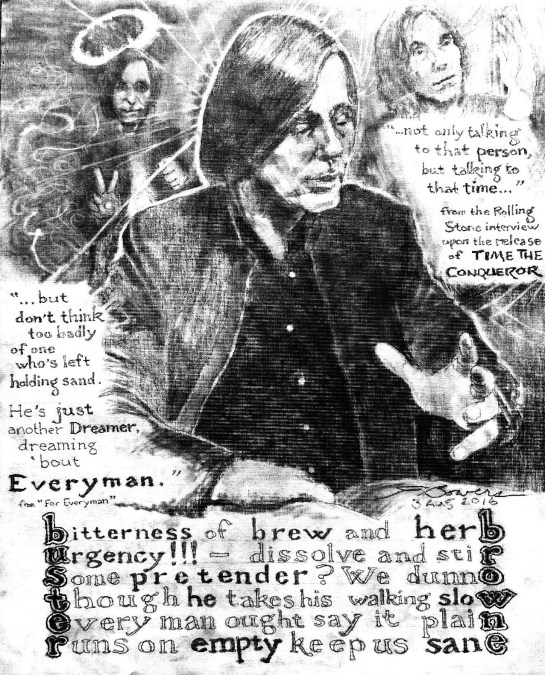
Here is the “final” version of “buster browne,” my acrostic homage to Jackson Browne. I put “final” in quotes because I had intended to make this an oil pastel, and I may yet, when I am sure I will not ruin it. I refer you to Part 1 for a clue as to how shaky my proficiency with oil pastel is. This drawing has nuances that I cannot yet transcribe into that more difficult medium; but I see nothing wrong with glorious black and white, for now.
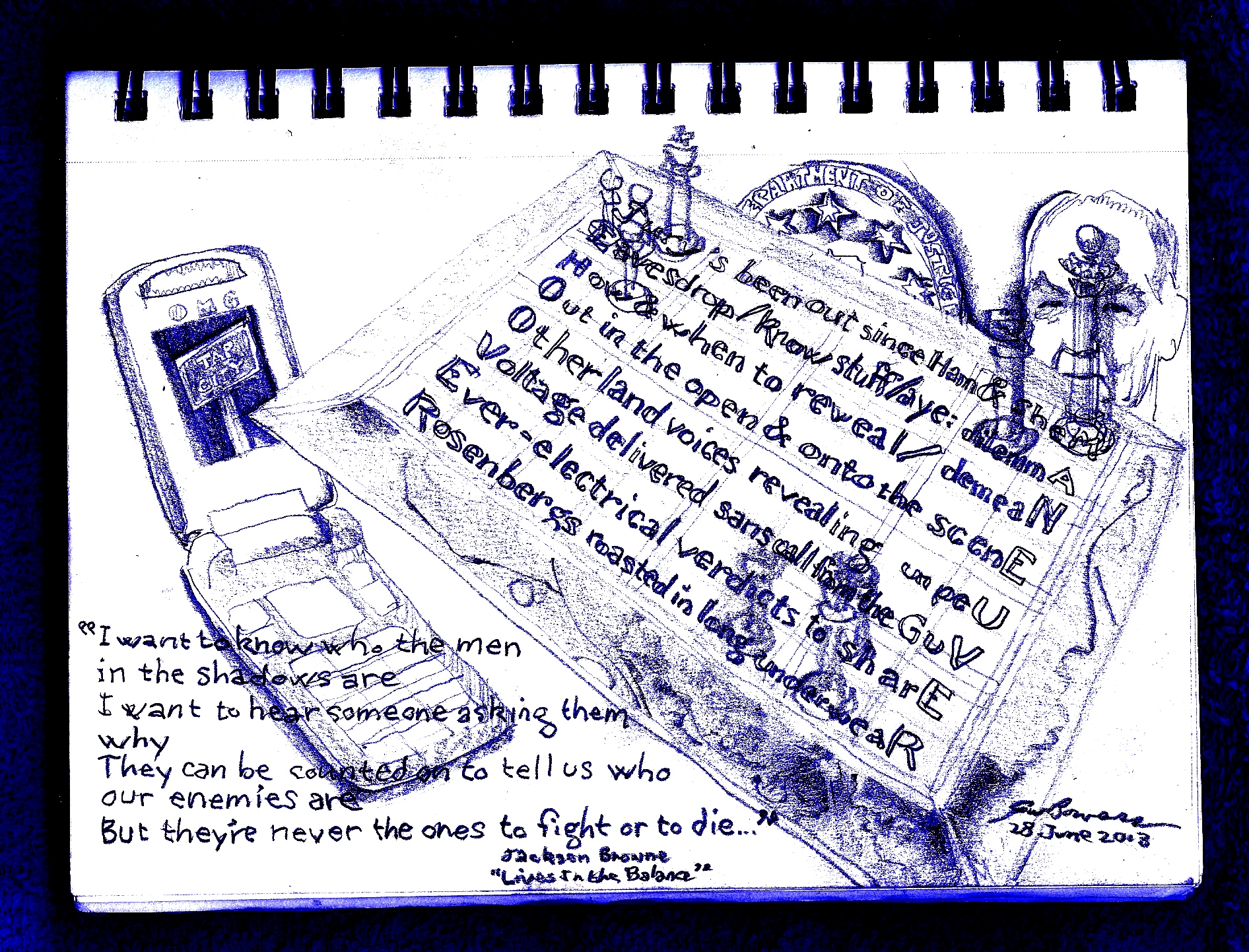
The title/acrostic is “buster browne” both for the irony of the reference to the shoe spokesboy Buster Brown and for my admiration for certain of Browne’s songs, in particular “Lives in the Balance,” wherein he calls to account (busts) the Reagan Administration and its shenanigans in Central America. “Lives in the Balance” is equally applicable to other misdeeds worldwide, with passages like this:
In the radio talk shows and TV
You hear one thing again and again
How the USA stands for Freedom
And we come to the aid of a friend.
But who are the ones that we call our friends?
These governments killing their own?
Or the people who find they can’t take any more
And they pick up a gun
Or a brick
Or a stone . . .
Browne is deservedly in the Songwriter’s Hall of Fame. He has solid songs in each of five consecutive decades. A year ago January I recited “For a Dancer” in its entirety, from memory, at a poetry event after the death of my beloved friend Karen Wilkinson. Here is its finish:
Keep a fire for the human race
Let your prayers go drifting into space
You never know what will be coming round . . .
Perhaps a better world is drawing near
Just as easily it could all disappear
Along with whatever meaning we may have found . . .
Don’t let the uncertainly turn you around–
( The world keeps turning round and round)
Go on and make a joyful sound!
Into a dancer you have grown
From a seed somebody else has thrown;
Go on ahead and throw some seeds of your own,
And some time between
The time you arrive
And the time you go
May lie a reason you were alive,
But you’ll never know . . .
Browne could be a bit of a rascal, too, with sexual innuendo. Try on his song “Red Neck Friend” and see where it gets you. And his song “Rosie,” about a sound man who lost a girl to the drummer of the band, has this chorus:
But, Rosie, you’re all right (you wear my ring)
When you hold me tight (Rosie, that’s my thing)
When you turn off the light (I got to hand it to me . . .)
Looks like it’s me and you again tonight,
Rosie.
And that is why in my drawing, in the background sub-portrait, I have Jackson Browne sporting a halo that also puts bunny ears, or devil’s horns, on him.
Here are the words, which refer to his songs “The Pretender,” “Walking Slow,” “For Everyman,” and “Running on Empty.”
buster browne
bitterness of brew and herb
urgency!!! dissolve and stir
some pretender? we dunno
though he takes his walking slow
every man ought say it plain
runs on empty keep us sane
*****
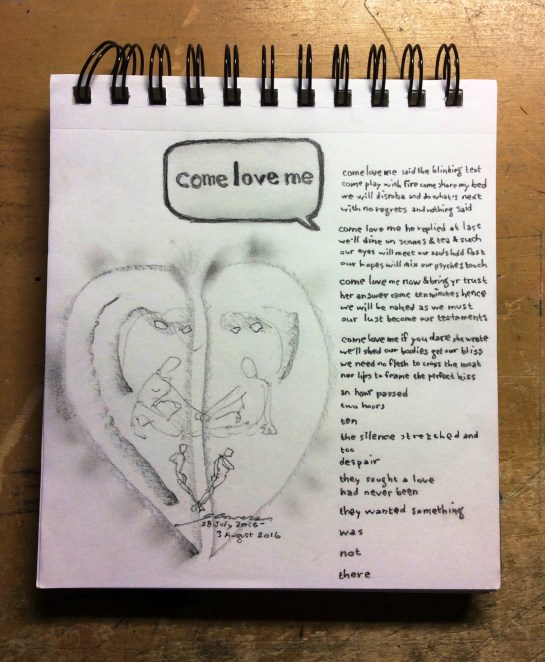
Here is a rough cut of the illustrated version of my poem “come love me.” In Part 2 I intend to have a less sketchy illustration and a more calligraphic transcription, and I am also thinking of writing variations and additional stanzas. But as of now the words are these:
come love me
come love me said the blinking text
come play with fire come share my bed
we will disrobe and do what’s next
with no regrets and nothing said
come love me he replied at last
we’ll dine on scones & tea & such
our eyes will meet our souls hold fast
our hopes will mix our psyches touch
come love me now and bring your trust
her answer came ten minutes hence
we will be naked as we must
our lust become our testaments
come love me if you dare he wrote
we’ll shed our bodies get our bliss
we need no flesh to cross the moat
nor lips to frame the perfect kiss
an hour passed
two hours
ten
the silence s t r e t c h e d and
too
despair
they sought a love
had never been
they wanted something
was
.
not
.
.
there
 One with Clay, Image and Text