Archive

Tag Archives: Martin Stoneman

Image

About an hour ago my mother called me with the news of my stepfather’s death. She is broken up but felt a beauty in the way he went. I’ll see her soon, probably early tomorrow, and we and other family will see his remains to a special place put aside for them.

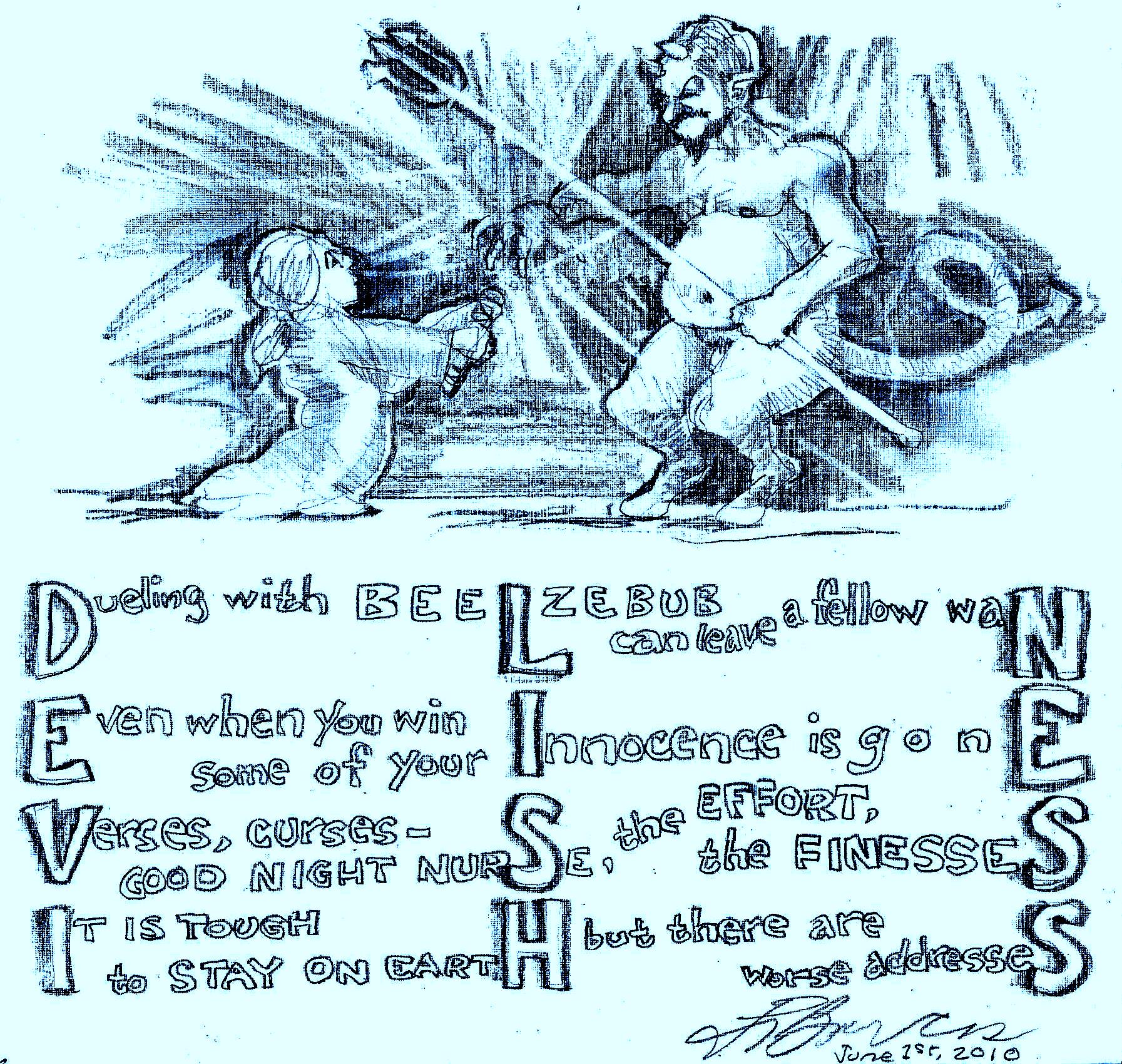
Marty often talked about saving the world. He summed up his thoughts on the matter in the trilogy THE STORY OF OG AND MAN, for which I did cover illustration, and THE PAIN THAT LOST ITS MESSAGE. He developed artificial intelligence software years before its time, for which the megacorp Lego showed some interest (but ultimately, as they say in the biz, “went another direction”). The Don Quixote-cum-Jedi-knight flavor of Marty’s endeavors struck me as I ran across this image in a search for one of my drawings of Marty. This image will do; it’s a good metaphor for his struggles. Despite the last line, I am sure that Marty is now at a better address than Earth. Farewell, Marty, my friend.

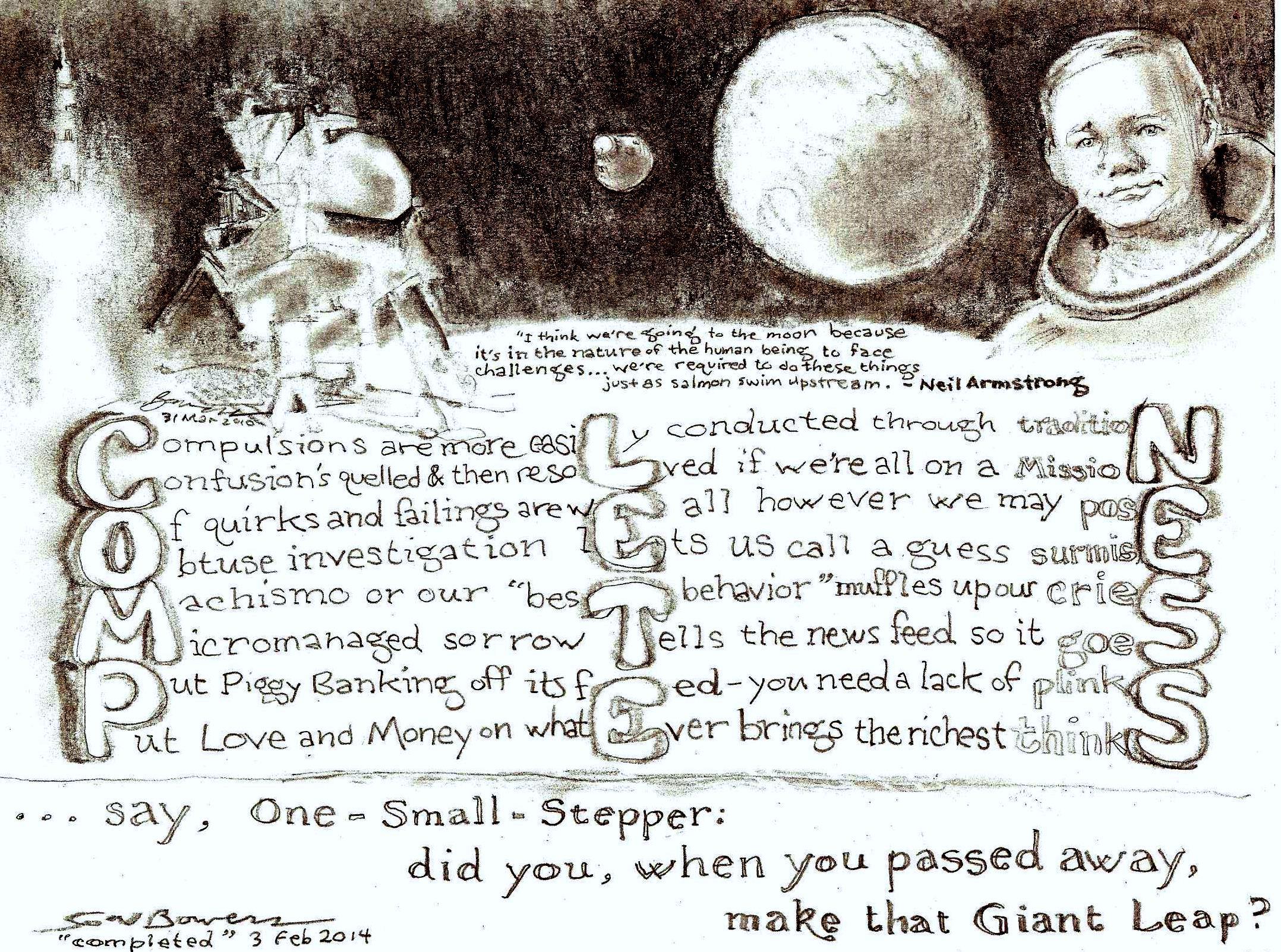
COMPLETENESS

Compulsions are more easily conducted through tradition
Confusion’s quelled & then resolved if we’re all on a Mission
Of quirks and failings are we all however we may pose
Obtuse investigation lets us call a guess surmise
Machismo or our “best behavior” muffles up our cries
Micromanaged sorrow tells the news feed so it goes
Put Piggy Banking off its feed–you need a lack of plinks
Put Love and Money on whatever brings the richest thinks

So I wrote in late March of 2010. Neil Armstrong was still alive and smiling, Philip Seymour Hoffman was still alive and performing, and Marty Stoneman was still alive and theorizing. Now two of them are gone, and the third is going: I saw Marty last Saturday but he was never conscious enough to converse. His breathing was a little shallow, but steady. His head was at an angle that seemed odd and uncomfortable, but his spine has been collapsing for years. His flesh was suffused with the color of jaundice, as if some chef had added saffron to the mix. My first sight of him prostrate on the bed gave me a flash of Michelangelo’s “Moses”: that heroic head, stricken with tragic necessity.

With my words came an image that revealed the triple acrostic COMP LETE NESS. Looking at the image today, I realized that it itself was incomplete. I added more words, in the form of a pseudo-haiku:

..,say, One-Small-Stepper:
did you, when you passed away,
make that Giant Leap?

This to me is the “overwhelming question” referred to by T.S. Eliot’s J. Alfred Prufrock. And by Jackson Browne, thus, in “For a Dancer”:

I don’t know what happens when people die
Can’t seem to grasp it as hard as I try
It’s like a song I can hear playing right in my ear
That I can’t sing…

I also enhanced the image somewhat, with Ticonderoga #2 pencil, and eraser, and paper stump. But it STILL isn’t complete; so my second signature on the page has “completed” in quotation marks.

002

My mother tells me that Marty was saying “I’m done” over and over again in the last couple of weeks, and that despite a lifetime of nonchalance about the prospect of dying, he has become fearful. I weep and mourn for him. He is still fighting, but he will lose soon.

Jackson Browne finished his song this way:

“…and somewhere between the time you arrive
And the time you go
May lie the reason you were alive–but you’ll never know.”

This blog post is written in sadness and dedicated to my stepfather, Martin L. Stoneman, who is in hospice and not expected to live much longer. Like Marty, the post is quirky and focused on linguistics.

The first joke I ever heard, circa 1960, was not quite a joke: “Guess what?” “What?” “THAT’S what!!”

Years later the “joke” had evolved: “Guess what?” “What?” “CHICKEN BUTT!”

Young children find this funny, referring as it does to hindquarters. Why butt-related referrals are funny is easier for human beings to understand than it is to verbalize. My own answer is that it’s related to that aspect of humanity that impinges on what is considered private or scandalous or both–but I’m already wrong. I understand but hash up an explanation.

I have an addition to the Guess What/Chicken Butt canon. It is not funny but has the value of repurposing. (Sidebar: “repurposing” is a recent Flavor of the Month new usage…) If a kid ever Guess What/Chicken Butts me, my reply shall be “Wax wroth, Chicken Broth!”

This is sure to baffle the kid. It does a lot in four words that are much the same as the ones that he (or she) used. It rhymes; it uses language that though correct is becoming archaic, it anthropomorphizes a food product produced by poultry-slaughtering creatures, and such a product, given a soul, might well feel wroth indeed toward the slaughterers; it does more:

It extends the song of humanity.

Ever wonder how jokes invented and told by kids in a playground can zip across the country in a matter of weeks, and quickly become part of the tapestry of culture? As this is written, January 30, 2014, the latest fad/quirks of the language include phrases like “at the end of the day…” and “I know–right?” that are semantically tenuous yet serve the purpose of making the conversants a micro-community. It’s a dynamic language, in a dynamic Universe, and part of the joy of living, the song of humanity, is hearing a new form of speech and learning to use it. So my answer to the question of why kid-jokes propagate so quickly is that, common-speechwise, they are exciting and addictive, being not just more of the same.

Too bad Marty isn’t writing this. He spent a huge chunk of his life on linguistics, and a subchunk thereof on discussing linguistics with your humble blog-poster, his stepson. I hope I get the opportunity to read this to him. It will demonstrate the impact he’s had on the song of humanity.