This is blog post #997.
In “come love me (part 1)” I alluded to variations. Over the last few days I have written fragments of where this poem might have gone, had the form or first line or sentiment been different. (See Arthur C. Clarke’s book The Lost Worlds of 2001 for some way mind-twisting variations on HIS story, including an alien named Clindar who strolled to a planet’s surface from above the atmosphere, and an earlier version of HAL 9000 named Athena, who was far wickeder than Hal, saying stuff like “All systems on Poole are No-Go. It is necessary to replace him with another unit.”) Here are some ways this thing could have gone:
come love me
“come love me” was the pixelated message
the lover stared until its afterimage
was seen mid-blink. its urgency, its pressage
presaged a tumbling intramural scrimmage.
*****
come love me
COME LOVE ME so beckoned in text
it left the recipient vexed
and so in reply
came HOW SCARY TO TRY
and the wonder of what would come next.
*****
come love me
“come love me,” said the pixelated text.
it pulled him with its offer of delight.
resistless, he typed, “yes,” for he was hexed . . .
*****
But in the end I went with the slightest of variations:
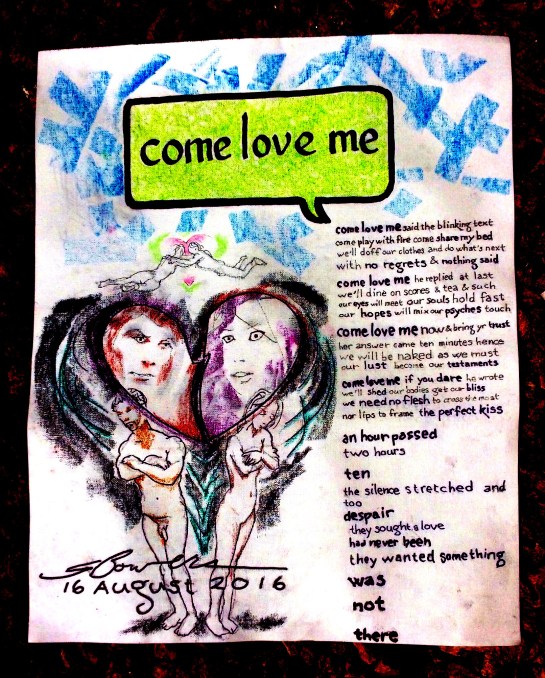
come love me
come love me said the blinking text
come play with fire come share my bed
we’ll doff our clothes and do what’s next
with no regrets and nothing said
come love me he replied at last
we’ll dine on scones & tea & such
our eyes will meet our souls hold fast
our hope will mix our psyches touch
come love me now & bring yr trust
her answer came ten minutes hence
we will be naked as we must
our lust become our sentiments
come love me if you dare he wrote
we’ll shed our bodies get our bliss
we need no flesh to cross the moat
nor lips to frame the perfect kiss
and hour passed
two hours
ten
the silence s t r e t c h e d and
too
despair
they sought a love
had never been
they wanted something
was
not
there
*****
Tragic that these two near-lovers could have gone both ways, with the tiniest leap of imagination, and pleased each other immensely on alternate days. But both were so fixated on getting things done a certain way that it became a battle of wills. I have found again and again that if a battle of wills, and not continual accommodation/compromise, sets the tone for a relationship, that relationship is doomed. I wrote all this to sort it out. I don’t really think that such a text exchange could take place, any more than I think it is natural for people to suddenly burst into song, as in anything that calls itself a Musical or an Opera. They are fables, and so is this; but a fable, such as this, is often a quest for a greater, or underlying, truth.
Let us now put the image in focus . . .


 One with Clay, Image and Text