under your skin or in your account/former is tissue and latter amount/getting them means to be hit in a fight/getting it means you can have steak tonight
one is edema and one is a sum/we could keep rambling but that would be dumb
under your skin or in your account/former is tissue and latter amount/getting them means to be hit in a fight/getting it means you can have steak tonight
one is edema and one is a sum/we could keep rambling but that would be dumb
matters of the cardiac muscle
inspired and influenced by Shawn L. Bird
humans have three kinds of muscle:
smooth,
skeletal,
and cardiac.
special striation
keeps us alive.
we have attributed more
to this squeeze&release
than the scalpel reveals.
it reacts
to our emotions
and our vitality.
it is only natural
that our predecessors
put the “heart”
before the “course”
and gave it our souls.
it is also convenient
for us to reposit
all our emotional chickens
into this pulsemaking
latticed
basket.
when will we grow up?
when will we accurately
reflect reality
with our semisensical
words
and fairy-tale
phrases?
a search of the non-heart
reveals
no answers there.
we cannot but conclude
that we are
all
heart.
This blog post is written in sadness and dedicated to my stepfather, Martin L. Stoneman, who is in hospice and not expected to live much longer. Like Marty, the post is quirky and focused on linguistics.
The first joke I ever heard, circa 1960, was not quite a joke: “Guess what?” “What?” “THAT’S what!!”
Years later the “joke” had evolved: “Guess what?” “What?” “CHICKEN BUTT!”
Young children find this funny, referring as it does to hindquarters. Why butt-related referrals are funny is easier for human beings to understand than it is to verbalize. My own answer is that it’s related to that aspect of humanity that impinges on what is considered private or scandalous or both–but I’m already wrong. I understand but hash up an explanation.
I have an addition to the Guess What/Chicken Butt canon. It is not funny but has the value of repurposing. (Sidebar: “repurposing” is a recent Flavor of the Month new usage…) If a kid ever Guess What/Chicken Butts me, my reply shall be “Wax wroth, Chicken Broth!”
This is sure to baffle the kid. It does a lot in four words that are much the same as the ones that he (or she) used. It rhymes; it uses language that though correct is becoming archaic, it anthropomorphizes a food product produced by poultry-slaughtering creatures, and such a product, given a soul, might well feel wroth indeed toward the slaughterers; it does more:
It extends the song of humanity.
Ever wonder how jokes invented and told by kids in a playground can zip across the country in a matter of weeks, and quickly become part of the tapestry of culture? As this is written, January 30, 2014, the latest fad/quirks of the language include phrases like “at the end of the day…” and “I know–right?” that are semantically tenuous yet serve the purpose of making the conversants a micro-community. It’s a dynamic language, in a dynamic Universe, and part of the joy of living, the song of humanity, is hearing a new form of speech and learning to use it. So my answer to the question of why kid-jokes propagate so quickly is that, common-speechwise, they are exciting and addictive, being not just more of the same.
Too bad Marty isn’t writing this. He spent a huge chunk of his life on linguistics, and a subchunk thereof on discussing linguistics with your humble blog-poster, his stepson. I hope I get the opportunity to read this to him. It will demonstrate the impact he’s had on the song of humanity.
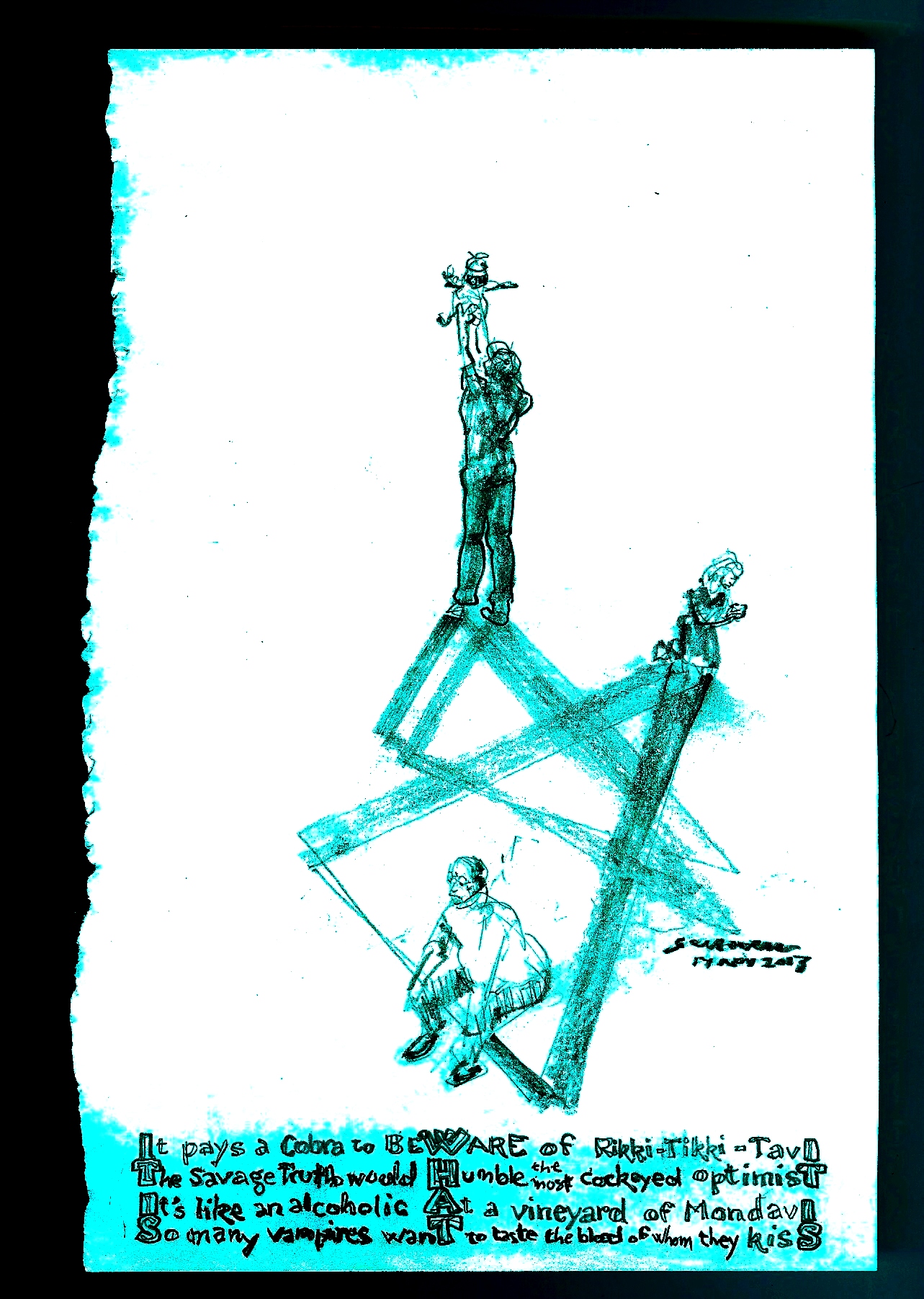
Ayn Rand must be turning over in her grave. A long time ago, she proclaimed that A equals A. Now people everywhere are saying “It is what it is,” and not giving Ayn any credit. (Nor, to my knowledge, did John Prine tip his hat to Rand when he put “You are what you are, and you ain’t what you ain’t” in his lyrics to “Dear Abby.”)
“It is what it is” is a semantically empty phrase that usually (in this neck of the woods, anyway) connotes that something not-great but unchangeable exists. As Robert Heinlein was wont to say, “You can’t argue with the weather.”
So why use it for an acrostic? Well, ten years from now it will remind me of the way people were talking ten years ago. (Fifty years ago, kids my age were calling Cool stuff Boss. Cool survived; Boss died.) Also, the end-letters work out fairly well for acrosticization, and enabled a reference to Rikki-Tikki-Tavi, heroic mongoose of the Kipling oeuvre, as well as the Robert Mondavi vineyards, which I was privileged to visit in the mid-80s, enjoying their five-course meal accompanied by five different wines.
Here are the words to the triple acrostic:
It pays a Cobra to BEWARE of Rikki-Tikki-Tavi
The savage Truth would humble the most cock-eyed optimist
It’s like an alcoholic at a vineyard of Mondavi
So many vampires want to taste the blood of whom they kiss
 One with Clay, Image and Text