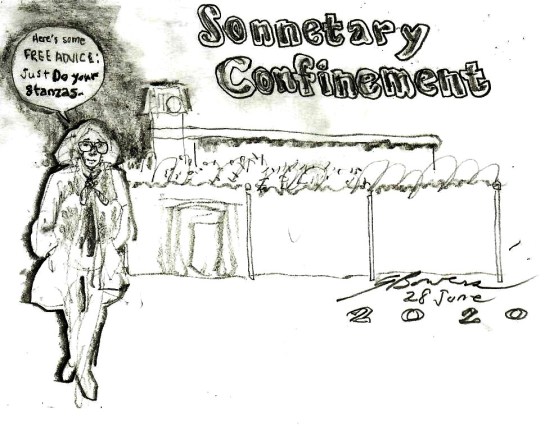
Sonnetary Confinement
Sometimes people with more words than they know what to do with will array some of their words into rhyming matrices of fourteen lines of iambic pentameter. Those matrices are called sonnets.
William Shakespeare’s name is on more than a hundred sonnets. In one of his most famous, Sonnet XXIX, the first four lines are
When, in disgrace with fortune and men’s eyes,
I all alone beweep my outcast state
And trouble deaf heaven with my bootless cries
And look upon myself and curse my fate,
These lines introduce the reader to the narrator, who lacks either monetary or good-luck fortune, and is not highly regarded by his peers. He is unhappy enough to cry to Heaven about it in Line 3.
Line 3 presents problems to the Obsessive-Compulsive Disorder sonneteer. The meter is off; there is an extra syllable in there. And there’s a logical contradiction: if Heaven is deaf, why would It be troubled by the narrator’s cries?
Shakespeare isn’t around to defend himself or explain his choices. Simply tking out the word “deaf” would solve both problems:
And TROUBle HEAVen WITH my BOOTless CRIES has perfect scansion, and Heaven can hear the narrator and be troubled. At least, that’s true in 2020. There is some evidence that in Elizabethan times the word “heaven” was pronounced as if it were one syllable. Poems exist that include the contraction “heav’n.”
If we treat it that way, the original Line 3 becomes
And TROUBle DEAF heav’n WITH my BOOTless CRIES,
And the stress on DEAF has a nifty implication of raised volume, as if Heaven is deaf in the sense of “hard of hearing,” and so the narrator has to amp up his wailing to be heard, which is troubling indeed. But even though Heaven hears, there is no response: the narrator says his cries are “bootless,” which (I trust) means Ineffective.
All of which leads me to posit that Shakespeare felt free to escape the Sonnetary Confinement of the strict sonnet form, and compel the reader to feel the narrator’s chaotic pain. For there can be no doubt that Shakespeare broke rules to suit his content. If the right word for the situation didn’t exist, Shakespeare would invent it on the spot. (Even the common and so-useful word “bump” is said to be Shakespeare’s invention.)
Shakespeare wrote entire plays in iambic pentameter. But
be not ye too impresséd, reader mine.
poul anderson, the fantasist, once wrote
a book festooned with such, to prove the point
it’s easy once you get the hang of it.
And speaking of “hang,” Shakespeare entertained not only with story, but also with wretched, vulgar puns. One example of hundreds may be found in Othello with a snide character known as the Clown asking some bad musicians if they are playing with wind instruments. They say they are, and the Clown responds with “Thereby hangs a tail,” meaning that their playing is as bad as flatulence. But the musicians hear not “tail” but “tale” and so are unoffended.
Whoops! The midnight deadline has come. I need to stop writing and hit the hay. “Hit the hay” is idiomatic for “go to bed, there to sleep.” Had I time, I would have expanded on the place Vulgarity has in literature, crafted some random lines to demonstrate that an entire mundane day may be reported in iambic pentameter, and concluded with a strict-form sonnet that nevertheless transcends “confinement” via playfulness and universality. Something for both of us to look forward to, O Reader!
 One with Clay, Image and Text