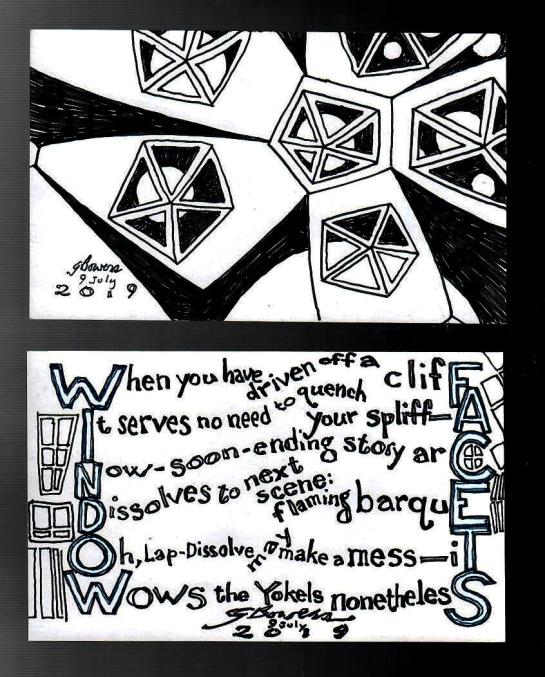
window facets
when you have driven off a cliff
it serves no need to quench your spliff
a now-soon-ending story arc
dissolves to next scene: flaming barque
oh, lap-dissolve may make a mess
it wows the yokels nonetheless
window facets
when you have driven off a cliff
it serves no need to quench your spliff
a now-soon-ending story arc
dissolves to next scene: flaming barque
oh, lap-dissolve may make a mess
it wows the yokels nonetheless
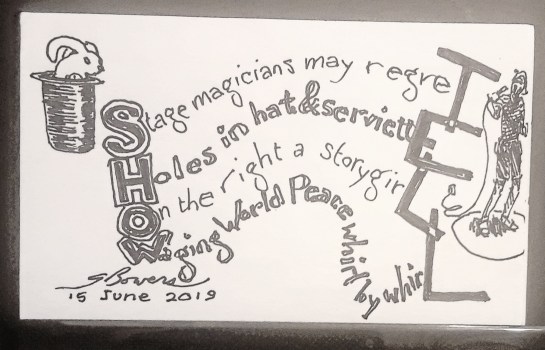
show tell
stage magicians may regret
holes in hat & serviette
on the right a storygirl
waging world peace whirl by whirl

At 64 years of age, with my memory fuzzy about previous artwork and/or postings, I can’t remember whether I’ve done a “Great Human Adventure” piece before. The “Part VIII” serves two purposes. It’s unique even if I already did a “Great Human Adventure.” It also acknowledges that I am far from covering all the territory that Human Adventure may cover. When I read a novel and the characters become my friends, all too often the author wraps up all the loose ends, including the death of the main character, and leaves no room for further adventures. What I’d like to see is wiggle room for more stories, and not before the novel starts nor after it ends. “A year and five months went by and some life-changing things happened, including overseas travel and the acquisition of a scar, but we will need to put that aside for now.”
More Good Adventures are always possible. Friends, I want them for us.
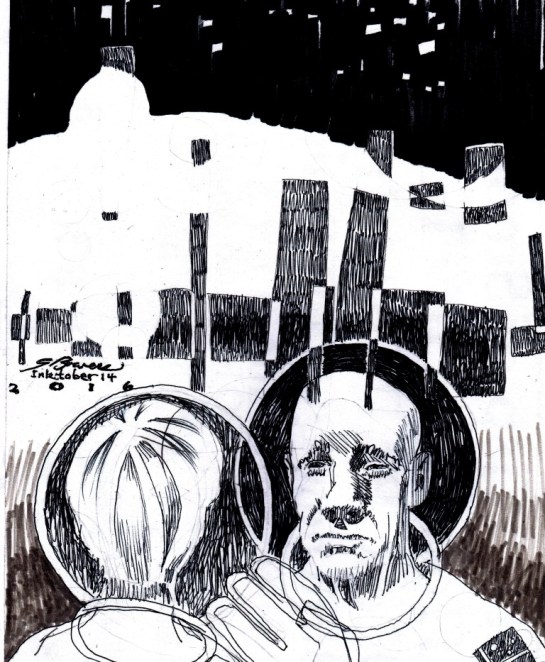
Here is a bit of wordless storytelling. The viewer is not given a whole lot to go on, and what there is is strange. There seems to be sadness and perhaps resignation. The title hints that the venue is not Planet Earth. There are odd juxtaposes and transparencies.
Pop quiz, class: What’s the story here? Any answer at all will do. If you think of a story that makes the image make sense, give yourself a gold star and an A. For extra credit, post your story in the Comments section . . . and if there are at least six comments, I will add mine. No pressure, though!
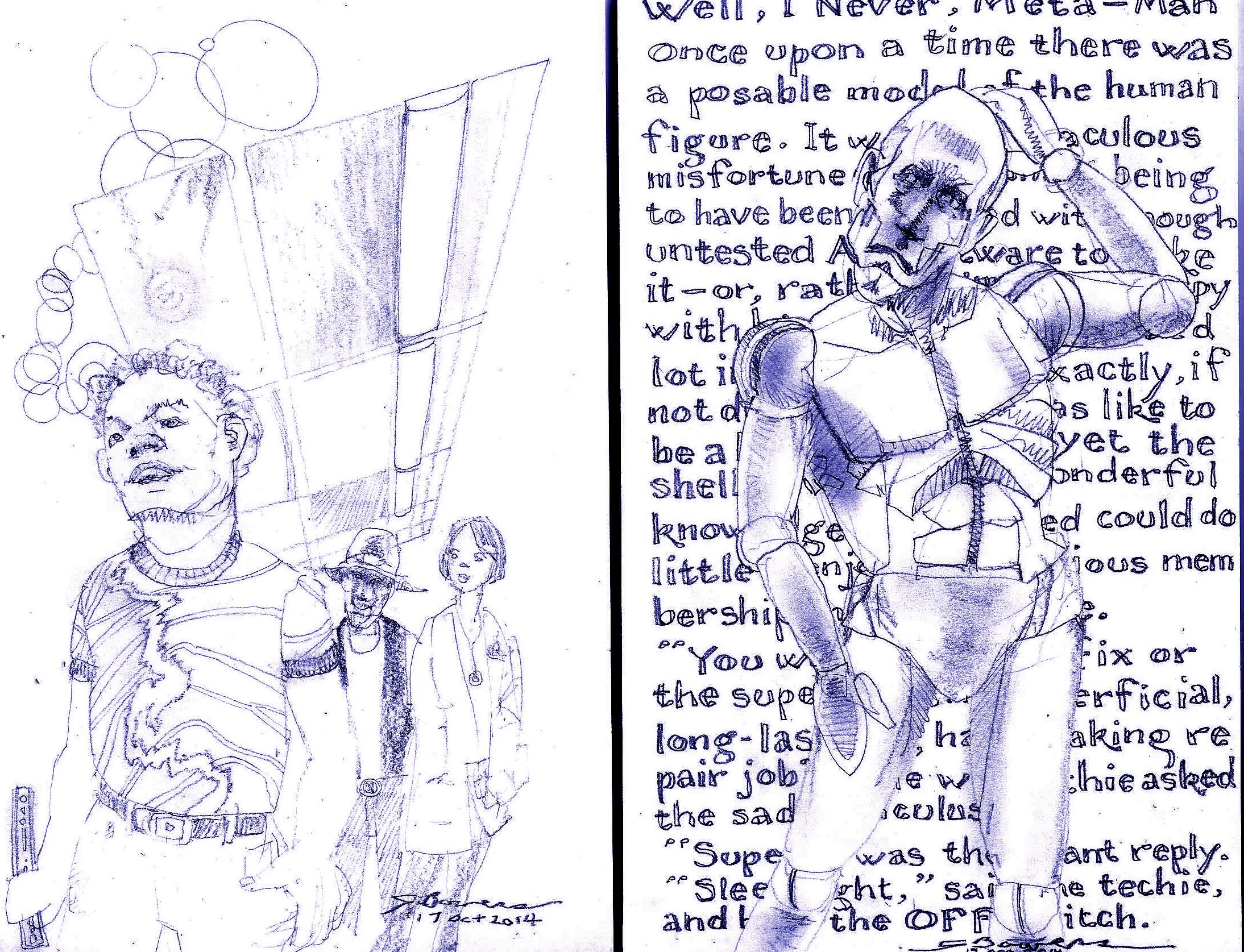
Hidder Midst says nothing and thinks bubbles–a true Superhero in search of an Origin Story. Meta-Man may have more to say than Spielberg’s A.I. or Asimov’s “The Bicentennial Man,” but he may just be all about a pose occluding text. The Book of Ecclesiastes says both “All is vanity” and that there is nothing new under the Sun. But that second one is a trick answer, as far as we mere mortals go. We are NOT “under the Sun.” We are OVER the sun, just as the Moon is over us. Should we fall into the Sun, we’d be falling down.
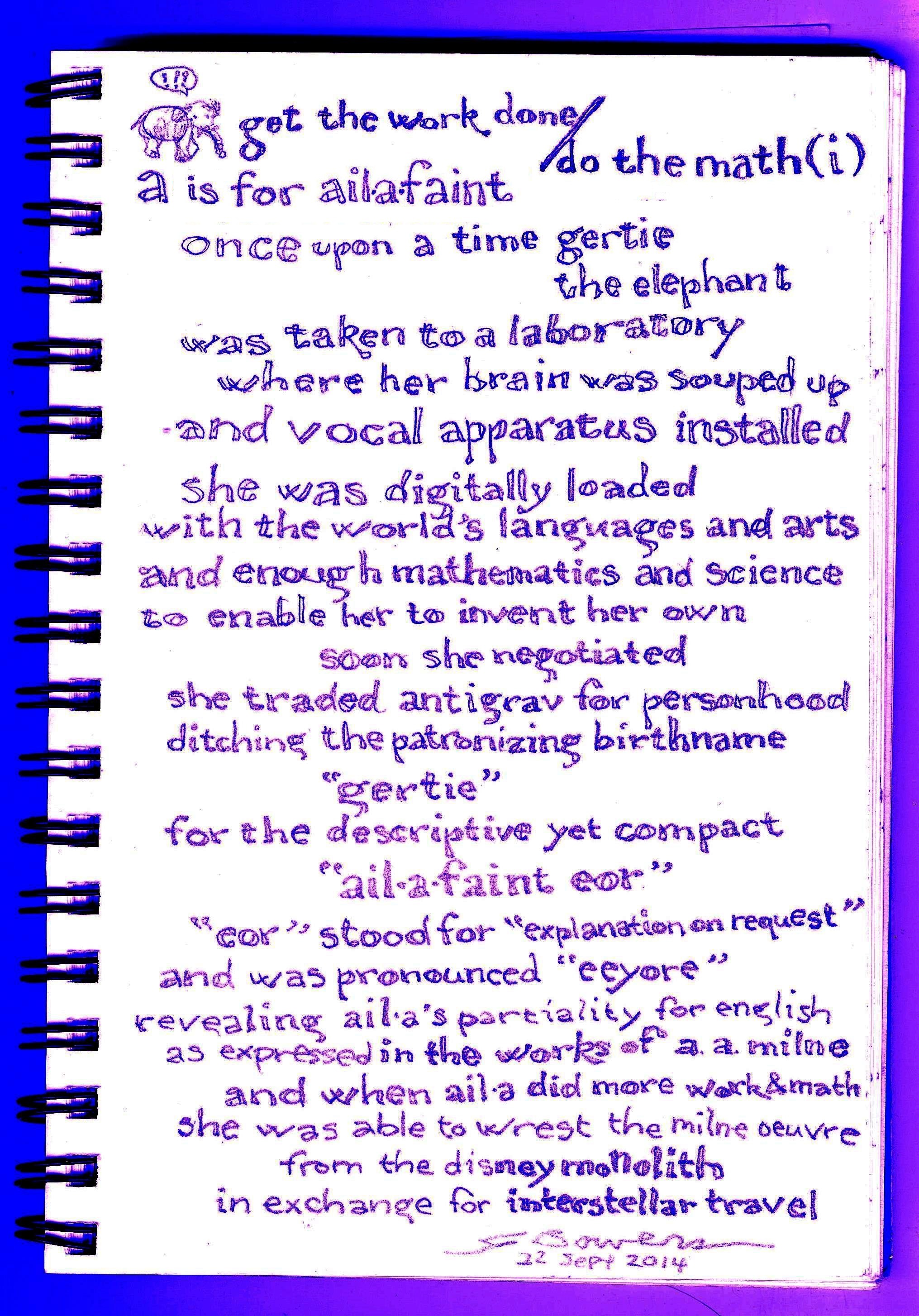
The fable which follows may seem to be a thinly-disguised dig at the Disneyfication of the Winnie the Pooh canon. It is, but I hope there’s more to it than that. I also confess that there was some good in all that Pooh–the vocal characterization of Tigger, for instance…
One unfortunate thing about growing up in the early 60s is that the phenomenon of Television Syndication was first getting real–and they started with Lassie and continued with Leave It To Beaver. Supposedly there are seven or so basic stories in the human story grab-bag, but Lassie and Beaver only used one each. The Lassie story: Little Her-Name-Here is trapped under a lean-to in the woods, and she doesn’t have her medicine. Lassie finds her, barks his/her heinie off to the nearest first responder, who finally gets the message and follows Lassie just in time to rescue the stricken child. Then Lassie goes back to June Lockhart and the rest of the family, only to find Timmie stirring his uneaten food around with his fork because he’s afraid Lassie will never return. O joy that Lassie is back safe and sound–till the next episode. (After a few years, the townspeople rescued by Lassie outnumbered those who hadn’t been.)
The Leave It To Beaver story: Beaver and his pals talk about doing something really neat, but they’ll get in trouble if they do it. They all agree to do it the next day. Only Beaver does it, and he gets in trouble. Ward gives him a good talking to, and Beaver learns a valuable lesson–which he promptly UNlearns in time for the next episode. (Oliver Sacks should have studied him and his short-term memory loss.)
My Three Sons, I Love Lucy, My Friend Flicka, Sky King–all had basic stories, not well told, flogged to death. So I have decided to tell a NEW story. It is at most eighteen words long, but there are pictures. It relates to the discussion above, but obliquely. The reader will have seven puzzles to solve. Five of them are pretty easy: How do the pictures illustrate the five acrostic words? The sixth is only a little harder: Which one of the acrostic words illustrates the picture illustrating it, and why? But the seventh one can take from half an hour to forever: What story can be told that will logically link all of the illustrations? Solving THAT one, dear Reader, will make you a better storyteller.
Here’s the image/story/quintuple acrostic:
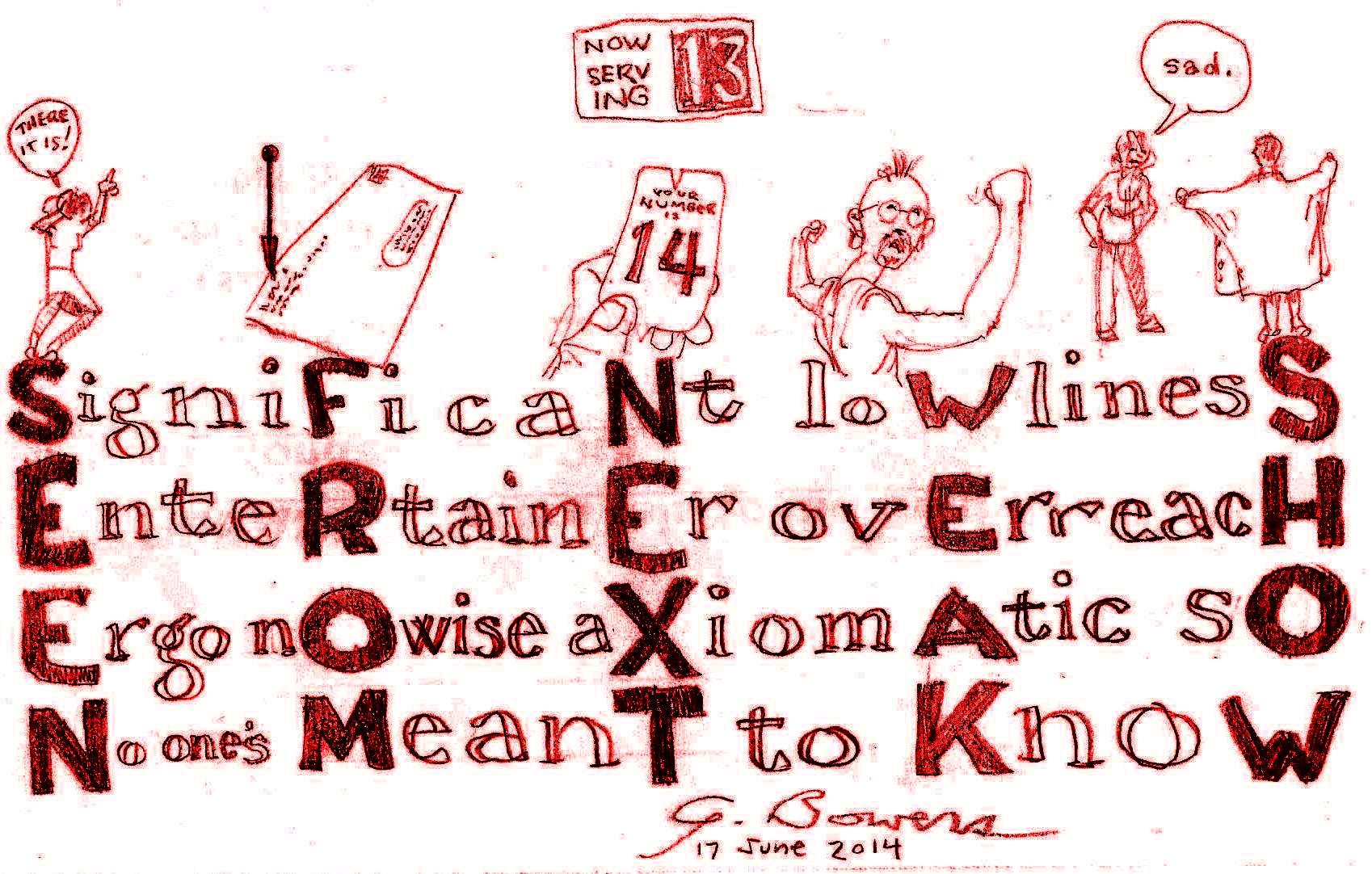
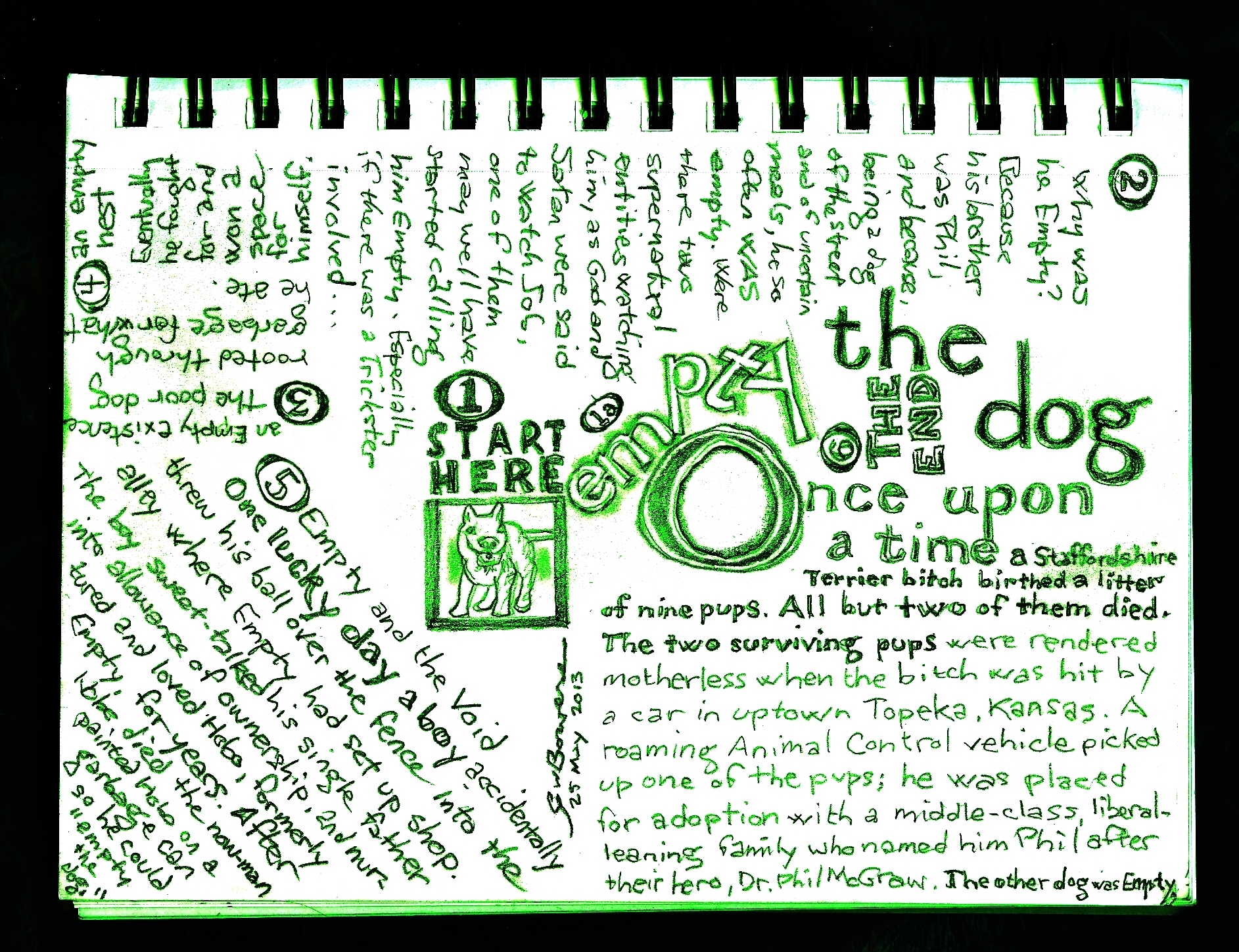
A limited copyright is hereby granted to any reader who wishes to print a copy of the image so as not to strain her or his neck and/or eyesight reading the darn thing. It will not be transcribed. My rationalization of not going to the trouble of transcribing it is that it is best experienced in situ.
For those of you who do not know what a shaggy-dog story is, and do not want to go to the trouble of doing an Internet search to find out, this: a shaggy-dog story is a story whose punchline is some awful pun, for the sake of which the story was built. This is not a shaggy-dog story, but a shaggy-dog PARABLE, and my hope is that it has more reward to the reader than the pun at the end. For a similar reason (I think), Robert Heinlein wrote JOB: A COMEDY OF JUSTICE, and Homer of yore told the long story we call THE ILIAD and THE ODYSSEY by way of demonstration that Deities play with our lives, for ends that disregard ours.
Supposedly there are only a few stories, and we ring endless changes on them. I don’t think that’s true, or maybe it’s true to a crude extent only.
Mary Shelley’s FRANKENSTEIN, OR, THE MODERN PROMETHEUS is a cautionary tale, just as the original story of Prometheus was. Much more recently, “Blood Music” by Greg Bear takes the premise to a wonderfully horrifying extreme. An Internet search will lead the curious reader to a synopsis, and a more curious reader to the “gray goo” concept.
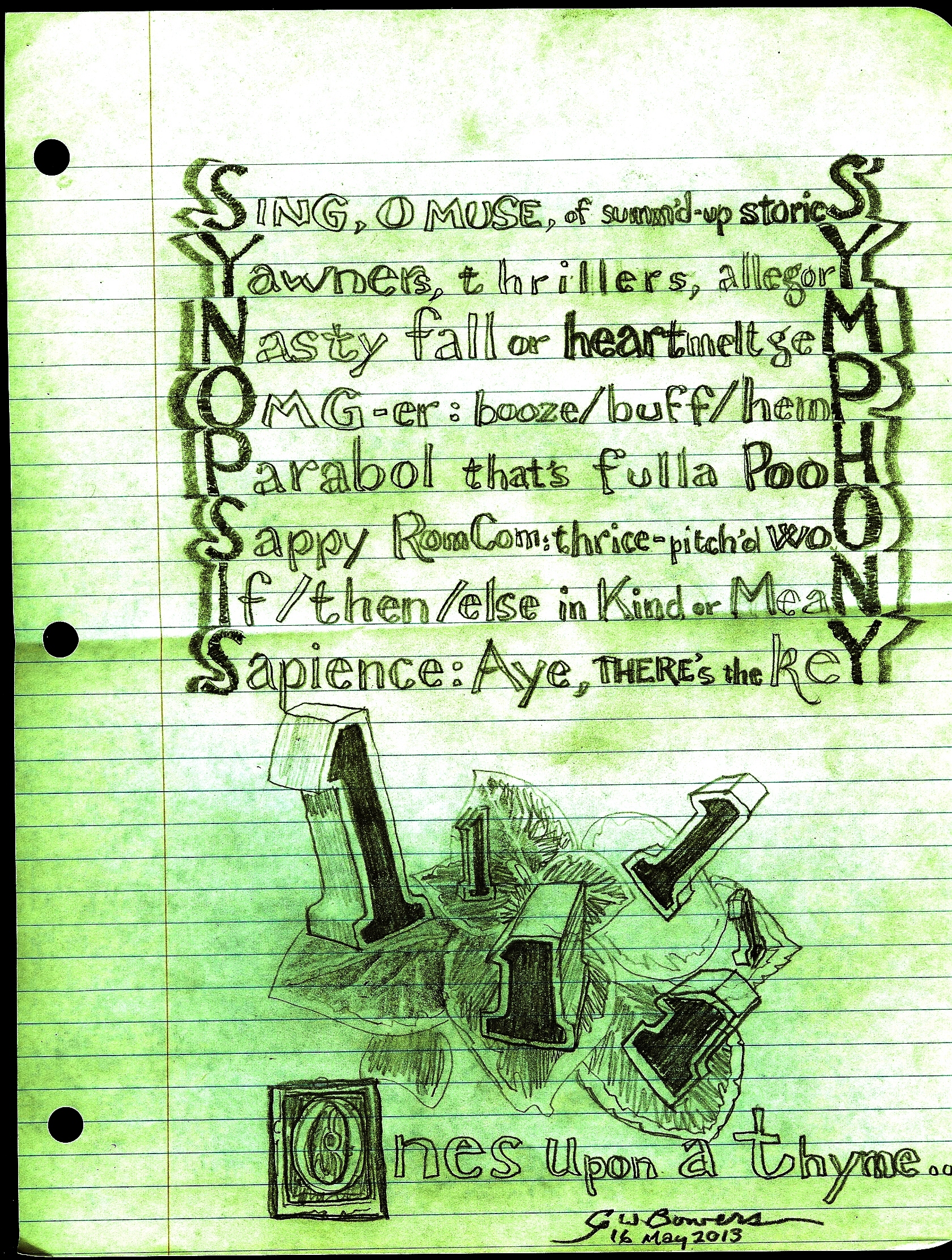
We are an increasingly synoptic culture. So many things demand our attention! Why, I myself am demanding your attention at this very moment! I better keep it brief!
Words:
SING, O MUSE, of summ’d-up stories
Yawners, t h r i l l e r s, allegory
Nasty fall or heartmelt gem
OMG-er: booze/buff/hemp
Parabol that’s fulla Pooh
Sappy RomCom: thrice-pitch’d woo
If/then/else in Kind or Mean
Sapience: Aye, THERE’s the key
I used “parabol” instead of “parable” to give a flavor of arc to the story.
“Pooh” does and does not refer to a certain Bear of Little Brain that I’ll always have fondness for, even though my hero Dorothy Parker scorned him and his chronicler.
“If/then/else” will be familiar to those who indulge, even to the slightest degree, in computer programming. “If/then/else,” I submit, is the distillation of Story to the barest of bones.
“Sapience” means Wisdom. Our species has the taxonomy “Homo sapiens.” Riiiiggggghhhht.
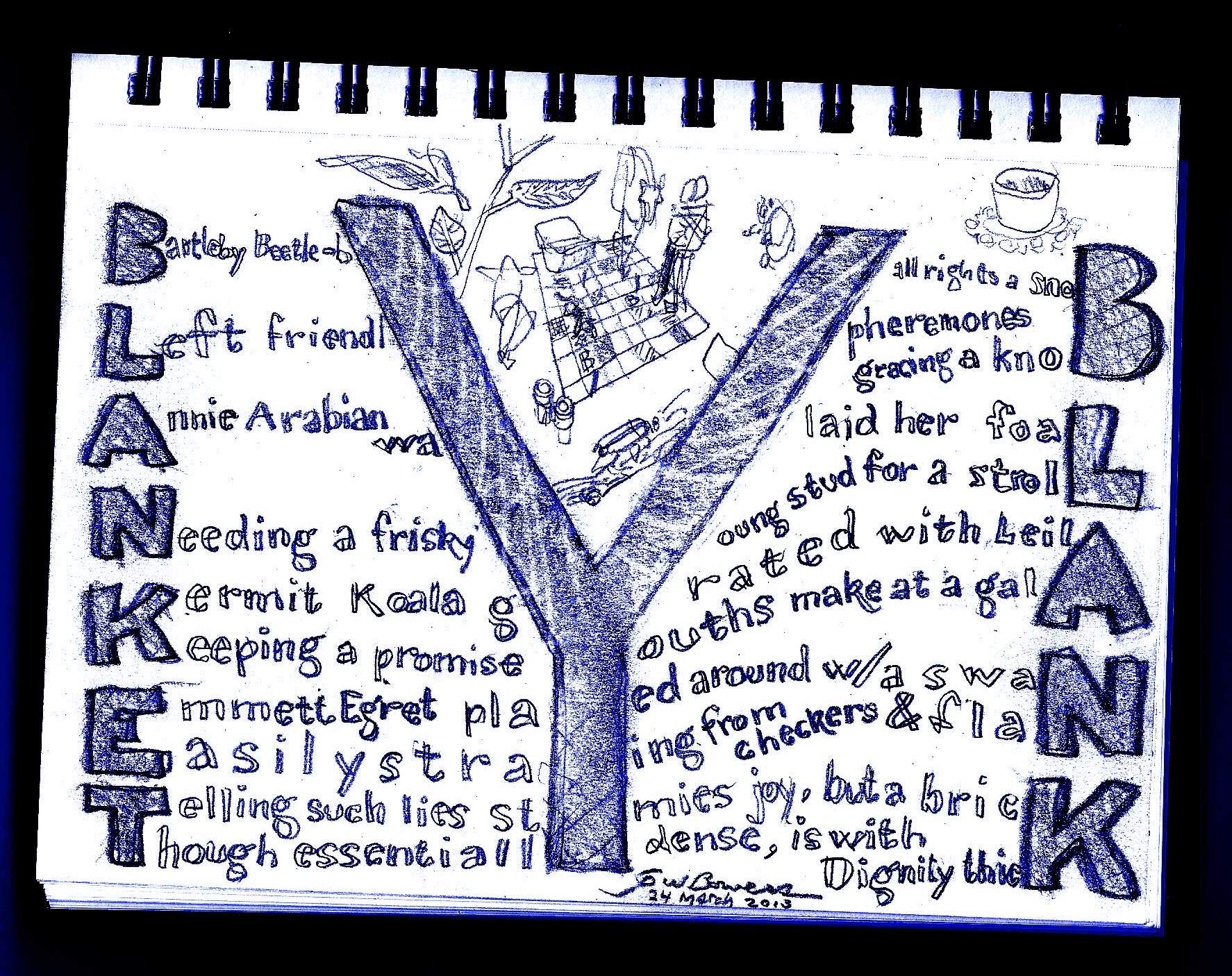
Daily maintenance of a creative journal is ever-challenging. What do you do when you can’t think of anything? You cuss, and censor your cussing with “blankety-blank…,” and realize the ironic relationship between the Blanket and the Blank, and you’re off and running.
Here are the words to the triple acrostic:
Bartleby Beetle–by all rights a snob
Left friendly pheromones gracing a knob
Annie Arabian waylaid her foal
Needing a frisky young stud for a stroll
Kermit Koala gyrated with Leila
Keeping a promise youths make at a gala
Emmett Egret played around with a swan
Easily straying from checkers & flan
Telling such lies stymies joy, but a brick
Though essentially dense, is with dignity thick
What does it mean? It may not mean anything but Blankety Blank. Or it may be a statement about Aesop’s Fabulous absurdity, or it may be a celebration of the Brick similar to the one Woody Harrelson’s character made in INDECENT PROPOSAL. It’s just wordplay and flash-storytelling, really, rated PG-13 for adult themes. I hope it entertains.
 One with Clay, Image and Text