Addiction and Angst go with Zero and Zapped: A to Z
Becoming a high-voltage journey through love’s urgency
Connecting a daughter a lawsuit some roadblocks that vex
Delivering pain then relief from the opposite sex. W
E watch as the narrating damsel’s distressed POV
Fast-forwards to new love and new need; in her you see you
Get tangled as drug use holds daughter as hostage and yet
Hope’s there, always peeking and promising no more regrets
In dealing with grief and pursuit of joy, grieving pursuer
Just skin-of-teeth holds it together, and not PDQ
Knapsacking her grief for a time to get comfort and sleep
Lift, calibrate–back to the fray–fraidy-cats, welcome in–O
May Heaven have mercy and Luminousness ever limn.
***”
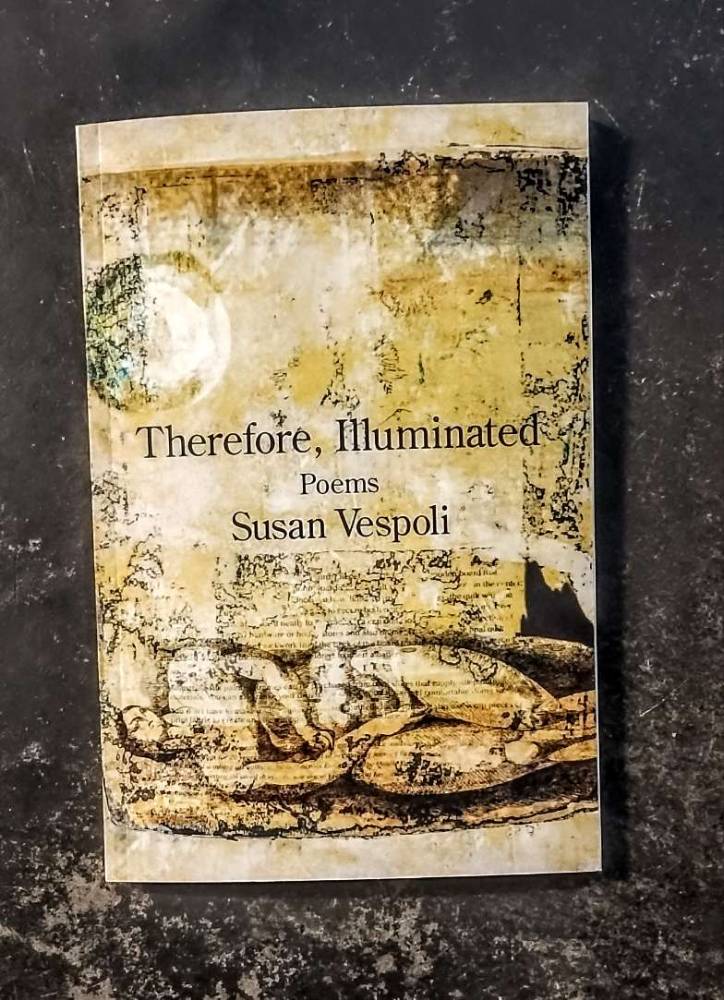
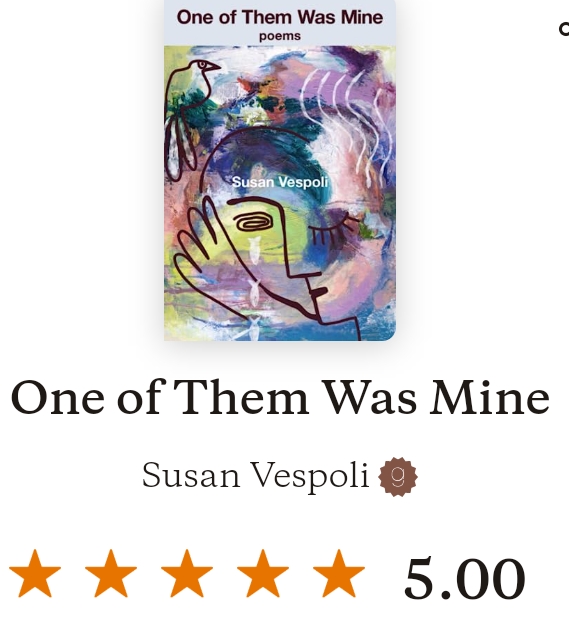
Afterword: My superbly talented poet friend Susan Vespoli sent me a copy of her new book Therefore, Illuminated. It is a continuation of One of Them was Mine, which told in voltaic verse of her unhoused, struggling son’s last few hours of life, and his death by handgun by a (now former) police officer who was later judged to be acting “out of policy.” We learn of the trial and grueling machinations that follow Vespoli’s wrongful death suit; of her daughter in the grip of drugs and depression, who paradoxically views being unhoused and drugged-up as “freedom” and has Vespoli walk a tightrope of helping without enabling; of a search through eHarmony for connection, and finding such with a tall, thin man who gives her, and her journey, much-needed relief and joy; and finally the coinciding of the delivery of the wrongful-death settlement check with a solar eclipse, as if the Universe was writing a poem of its own with a punchline of stunning metaphor.
Friends, I hope you will find Ms. Vespoli’s book on Amazon or via Kelsey Books, her publisher. It tells her compelling journey with brilliant verse, with some in the Abecedarian form as I used above with less grace than she wields.
Here is the review I posted on Goodreads. I intend to post it on Amazon as well but this far there are technical difficulties…
Special thanks to my Israeli friend Davida Chazan, who as The Chocolate Lady is a book reviewer herself. I asked for her advice and she gave me good counsel.
Note/Warning: The police violence explicitly described in this review may be triggering to some.
Susan Vespoli lost her son Adam on March 12, 2022. Donnell Lindo, who at the time was a police officer for the City of Phoenix, saw Adam get into the police cruiser that Lindo had left unlocked, and he drew his gun while running toward the vehicle and fired three shots through the window. The cruiser ended up crashing against a tree. Adam was pulled from the car, and CPR was administered, but in vain.
Vespoli is on record as claiming that her writing is necessary to her sanity. It is no surprise, then, that this most tragic and wrenching of life events spurred a flurry of writing; and that’s how this book came to be.
As it happens, Vespoli has been trained to be a teacher in a timed-prompt writing process called Wild Writing. This new book of hers contains some of the wildest, most primal writing she has ever done, an improbable mesh of open-wound emotion and the precise, crystalline structure and word choice available to a poet who has been working hard on her craft for years.
In her poem “After I Read Poems About Addiction in My Family,” she tells of a woman who attended her reading and then demanded, “What makes you think it’s okay to write and share these kinds of poems?” She riposted the woman’s aggression with
“Because I believe in telling the truth with love and I believe we’re as sick as our secrets and I believe burying your story can kill you and I believe that writing it out can heal.”
Those four lines, so elegantly different as conversation versus poetry, even though the words are the same, exemplify Vespoli’s wild/quiet skill. The first line ends with “telling the truth” and line 2 begins “with love.” A lesser poet would have ended the first line with “telling the truth with love.” But Vespoli knows that her reader will microscopically pause between lines. She uses that pause for a crucial emphasis on the telling of truth. Lest we imagine that is coincidental, she ends line 3 with “burying your story can kill” instead of “burying your story can kill you.” She achieves deeper meaning with that well-chosen line break, one that is eerily apt to the police violence we have had unearthed more and more in recent times. Had the bus cam not recorded that crucial few seconds between Adam’s approach and entry into the police cruiser and then-Officer Lindo’s discharging his firearm at point blank range, the account Lindo gave, claiming he felt his life was in imminent danger, and the absurdity of the description given to media by the police that Adam was trying to steal the cruiser, might have been the accepted narrative of record. But Adam’s death viewed from the impartiality of the bus cam gives such a depth to the pair of text messages Adam had sent to his mother, the first a mere matter of weeks before his death, and the second in 2021:
“I think god has another plan for my life.” “I want to share it with the world someday and I believe that is part of my purpose.”
Consequences related to Adam’s death by violence include the ending of Donnell Lindo’s career as a police officer; the Phoenix Police Department soliciting public input on their policy related to the use of deadly force; and the creation of this astonishing volume that is excellent poetry, but so much more. Vespoli has made a portrait of her beloved son that reveals him as a caring, struggling, vulnerable human being with love in his heart and a journey that we see was derailed tragically. Vespoli takes the book’s title from this that she said in an author’s statement:
“Every homeless person you pass on the street or in the park is someone’s beloved kid. One of them was mine.”
Please add this valuable book to your library. Vespoli is donating any profits it accrues to The National Coalition for the Homeless, Mothers Against Police Brutality, and other advocacy groups. And reading the gripping poems will break your heart in the best possible way.
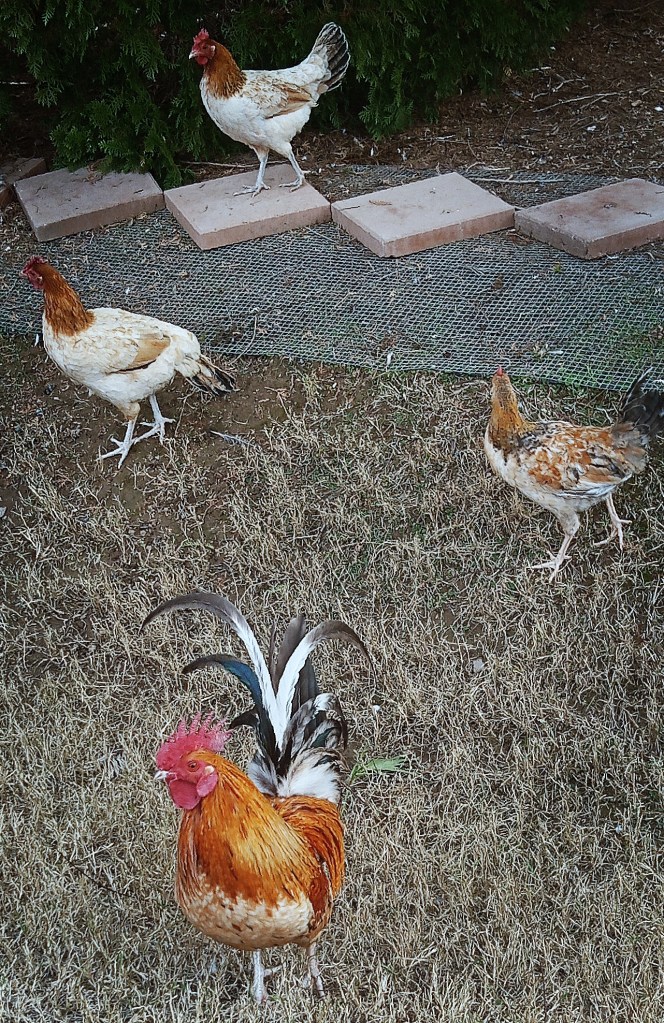
there is a place to stroll in my neighborhood that i think of as the Chicken District simply because chickens abound and stroll like i do. once
a lady was leading a troupe of chicks to safety off the asphalt of Earll Drive and i called from down the street “aha! NOW i know why The Chicken Crossed The Road!” and she laughed and declared herself the Crazy Chicken Lady.
today was another saunter in the District but then in a group of four i saw a specimen with some feathers that were the strawberry blonde described by my poet friend Susan V in her heartstopping poem “Chicken” that was really about her son and the processing of her anxiety and grief about him– a golden hen magically appeared and then disappeared but the reader must decide if the bird was real or manifested by a grieving mother to step down the high voltage of her helplessness in watching her son’s life take its tragic turns.
when i saw that strawberry blonde my friend and her poem magically popped into my suddenly unlulled thoughts and it became not a coincidence but a needed component of life on earth that Tragic and Magic rhyme.
chickens cross roads lay eggs become fricasseed pick out dough in breadpans peck and scratch and look askance and reveal glory and downfall and the bond that shared grief creates.
Afterword: Susan’s poem “Chicken” may be found in her outstanding collection Blame It on the Serpent, available via Amazon.
My forays into self-publishing began in the Spring of 2008. I created a Word document and stuck scans of my acrostic pages into it, and then inserted some conversational text that transcribed and annotated the illustrations/poems. That little chapbook was called The Tutti-Frutti Bird of Benign Insanity. I think I sold about 7 copies.
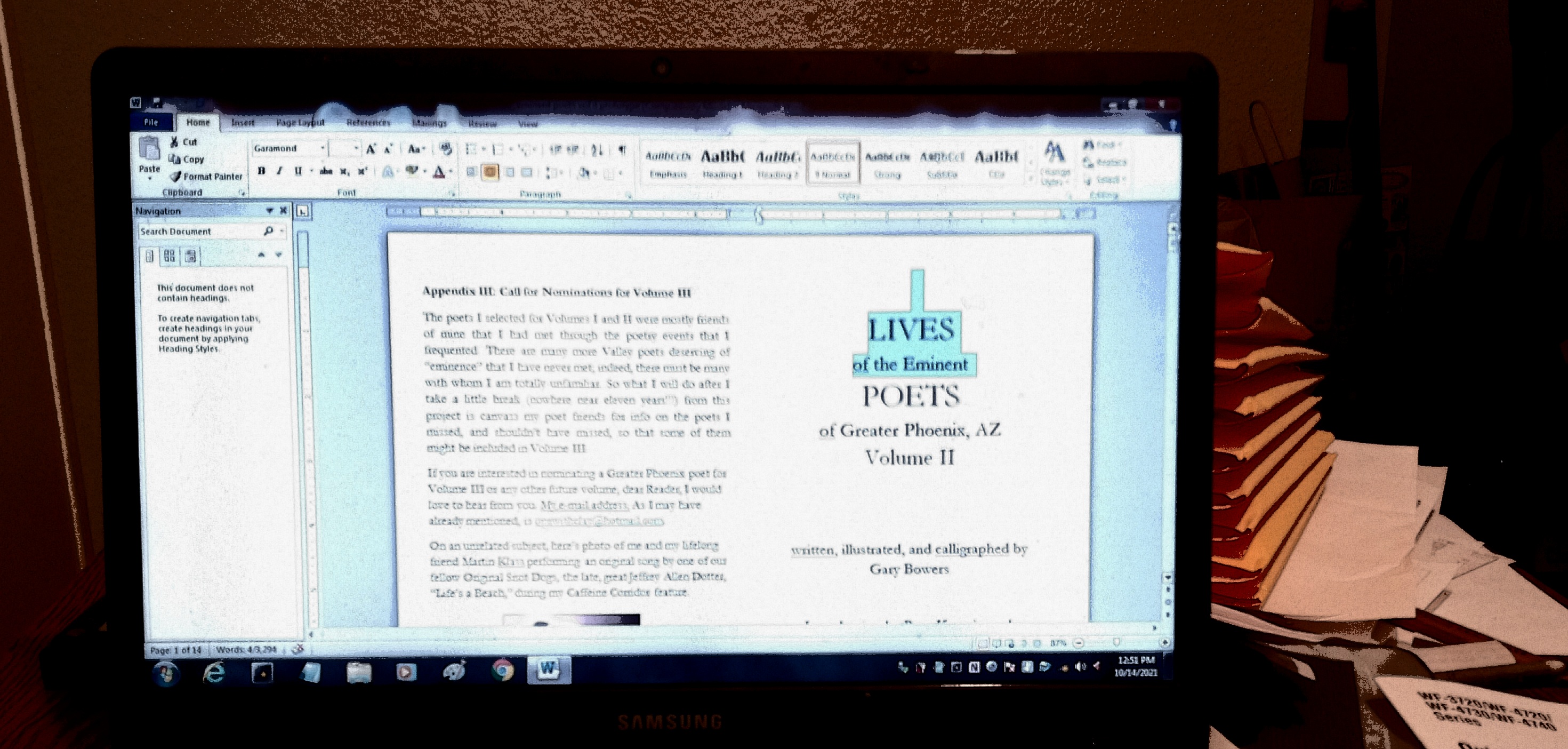
In 2010 I gathered the portraits I had done of outstanding local poets and put them into a chapbook which I called LIVES of the Eminent Poets of Greater Phoenix, AZ, Vol I. I did a print run of 50 copies, and some time later I was the MC of a special event celebrating my new publication, and many of the poets in my book came and performed. My objective was to showcase them because I felt they were underappreciated, and I think I fulfilled my intention.
My next intention was to produce a Volume II, and I thought a year would be plenty of time to do a second volume’s worth of more poets. I wanted to publish Vol. II on August 30, 2011, the anniversary of Vol. I. Alas, 2011 was a disastrously disruptive year, including the finalization of my divorce on December 19. I was knocked off my routine and my trajectory. I continued to do poet portraits but I didn’t organize them.
Doesn’t matter. I’m back on track again, with some help from my friends Susan Vespoli and Russ Kazmierczak. Susan helped me get Vol. II out of Limboland, and Russ at my request wrote an Introduction second to none. Russ also gave me a variable-length stapler that took my bindery efforts from the Stone Age to Cool Jazz.
Today I decided to run ten copies of Vol II and keep track of my printer’s ink levels to see how long I’d be likely to go before I needed another $120 cartridges pack for my new printer. Here are the levels before and after the 10-copy print run.
Looks like I’ll be running low on Magenta about 40 copies from now. Black and Cyan got hit, too, but Yellow wasn’t much affected. Intuition/guesswork tells me that printer ink is costing me about a dollar a copy.
I’m asking $9 US for an unsigned copy, $10 for a signed copy, with free shipping/handling anywhere in the US. (I’ll send a copy internationally on request, but I will have to change extra for shipping/handling in that case.) My mailing envelopes cost about $8.75 for a 12-pack–figure 80 cents per. Postage right now is $1.56. The light card stock I use for the cover is about $25 per ream, or a nickel per Vol II copy. The copy paper cost is about 6 cents per Vol. II copy. And it was almost exactly one hour from when I started printing to when I tucked the collated, folded, and stapled tenth copy into its mailing envelope. So we have $1.00 plus $0.80 plus $1.56 plus $0.11 cents for a total of $3.47 materials cost, yielding a gross profit of $5.53 for unsigned, or $6.53 for signed.
In a perfect world, then, my hour’s work would return to me somewhere between 55 and 65 US dollars.
Ah, but it is not a perfect world. I haven’t addressed a single envelope, nor signed a single copy, nor taken them to a mailbox. And what about tax? Tax in Arizona is pretty near 10 percent, so if this enterprise goes beyond about $400 gross sales, more or less (informal opinion from a CPA friend of mine who will go unnamed), there goes a dollar a copy. And if sales go into the ozone, which, based on experience, has about the same chance as a snowball in Hell, why then I’d need to set up a sole proprietorship or an LLC. A good problem to have, to be sure, but, Friends, you know something? I’m not in it to get rich. The IMMENSE, HUGE value I get from doing stuff like this is in the thrill of Creation and the ambrosia of Approbation. I have already gotten 90% of that sort of Profit and I am content. 🙂
I have been blessed to know a good many Susans in my life. One, a fuel truck driver, hiked Havasupai with me. One, a six-foot lawyer, had the assertiveness of a runaway locomotive. One, a sculptor, sold over ten grand’s worth of her wares in a single day. One, a department chair, decided to explore reducing the toxicity of the hydrocarbon-laden printing medium Intaglio. There are others, but we have a lot to cover here, because while there’s not a lazy Susan in the bunch, I bring to your attention Susan Vespoli, the unlaziest Susan of them all.
Susan is a poet. She’s also a teacher. She’s lived in Guam and in a cabin in the woods in Arizona. She’s loved and lost and lost and won and fought cancer and won some more and fixed up a house and sold a school. She has a website with the unforgettable domain name susanvespoli.com, where you will find out much more about her in her remarkable essay “Autobiography in Eight Hairstyles.” She has a Taylor Swiftian propensity for going into detail about past relationships, but in this hairstyle odyssey she nails down the best reason possible for doing so: “More lethal than bad food, bad drink, and bad exercise habits, more toxic than chemical exposure, is the act of not owning your thoughts or speaking your mind.”
And that is what makes her writings so valuable. She is showing you cinéma vérité with her poetry. You must believe it because it is immediate and it is real. Pardon the bluntness, but she’s not fucking around. She has been there and now you are going to be there too, no euphemism, no denial. No dancing. (She has said “I can’t dance.”)
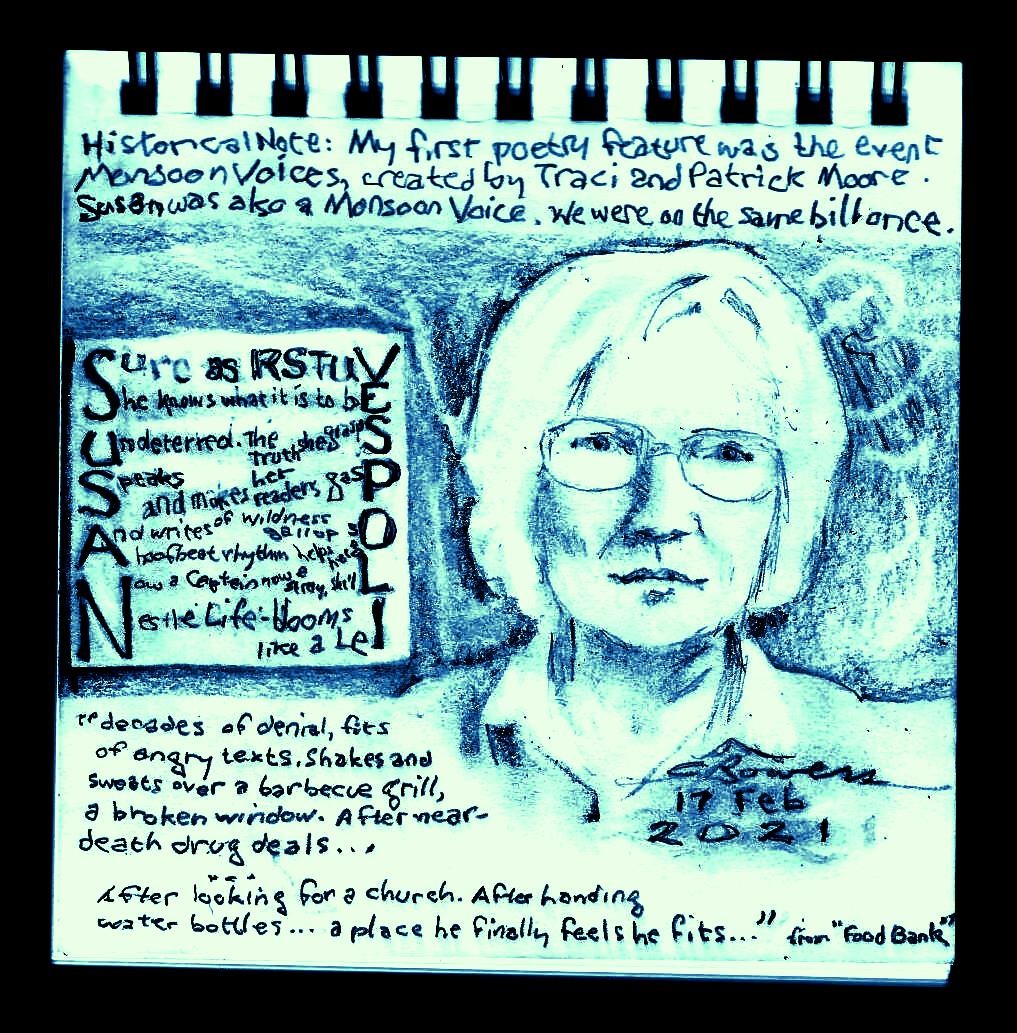
So it was she who reawakened my desire to resume my “Eminent Poets of Greater Phoenix” project. Volume I was published in 2010. I did about two dozen poet/acrostic/portrait pages since then but never lashed them together into Volume II. Now I want to.
So, to rewet my feet, I have done the first one in over a year, thus:
Susan Vespoli
Sure as RSTUV She knows what it is to Be Undeterred. The Truth she grasps Speaks and makes her readers gasp And Writes of Wildness gallop so A hoofbeat rhythm helps her go Now a Captain, now a Stray, she’ll Nestle Life-blooms like a Lei
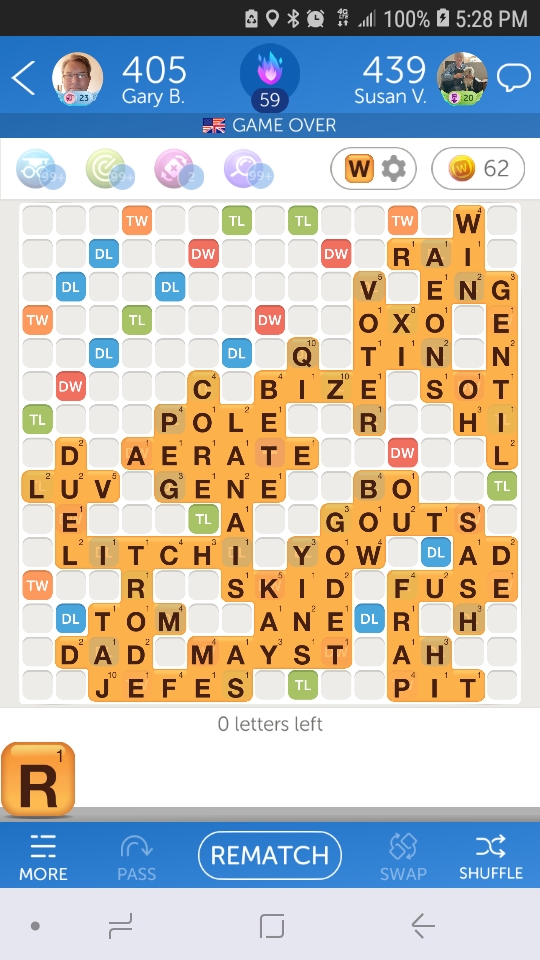
One more thing: She recently trounced me in Words With Friends, not for the first time, nor the fifth. Then in the next game she lobbed me a watermelon-sized Home Run pitch, using the word INNER so that I could make WINNER or DINNER or TINNER or some other, and get a triple-word score. I suspect she’s trying to let me win one. Hey, she’s an all-caps POET; she knows what she’s doing.
Not to be falsely modest; so am I. I flirt with her a little sometimes with some of the words I use–why not? It’s fun, and I’m harmless. In the game I show below, the one she got me good in, she played DUEL and I crossed it with LUV. If you’re going to Duel, do it with Luv. 🙂
On Facebook I have just finished the third of five takes of a series called “ah, humanness.” This two-word humdinger of a phrase showed up in a comment by my poet friend Susan Vespoli a few days ago. It has been stuck in my head ever since. Some of that is due to Eugene G. O’Neill, an American playwright of the 20th Century.
In Drama class in high school we were required to portray roles from classic plays of our choosing. At home were books of decades past bequeathed to my mother by our unrelated-by-blood Aunt Peg, and there were several plays by Eugene O’Neill among them. So in class I became both Driscoll and Yank for Yank’s death scene in Bound East for Cardiff, and I got a rave review from Miss Ornstein (later Mrs. Frye) for my Eben Cabot in Desire Under the Elms. But one of O’Neill’s Dramatis Personae that would have fit me like my skin was Richard, pretentious and melodramatic schoolboy son of newspaper publisher Nat Miller, in perhaps the only well-known comedy penned by O’Neill, a charming slice of Americana called…Ah, Wilderness!
The title is derived, of course, from the famous Quatrain XII by Hakim Omar Khayyám, as translated by Edward FitzGerald, poet and contemporary of William Makepeace Thackeray and Alfred, Lord Tennyson. It goes something like this:
A Book of Verses underneath the Bough, A Loaf of Bread, a Jug of Wine, and Thou Beside me singing in the Wilderness– Ah, Wilderness were Paradise enow!
I say “something like this” because there were at least five editions of FitzGerald’s translation, and he fiddled with the translations between editions, and the one above seems to be the popular version. But you will find that the Jug is a Flask sometimes, and sometimes it precedes the Loaf of Bread. There’s also the fact that FitzGerald, partly to cleave to the Quatrain form with its rhyme scheme aaba, did a free translation, wandering from a direct translation for the sake of liveliness and pith. Here for comparison is a more literal translation done by Edward Heron-Allen, an English scholar who was born only two years before Edward FitzGerald died:
I desire a little ruby wine and a book of verses, Just enough to keep me alive, and half a loaf is needful; And then, that I and thou should sit in a desolate place Is better than the kingdom of a sultan.
I’m going with FitzGerald, who for my money gives Khayyám more Zing, and yet retains his core content. Of course, it’s a stretch to turn a “desolate place” into a “wilderness.”
Ah, Wilderness. Ah, Desolate Place.
Ah, Humanness. Just a little free-translative twist…
The Poetry that springs from whence we’ve wended, The Warp, the Woof, the Fabric rent and mended, The words with friends, the text exchange, a phrase– Ah, Humanness, this Poet I’ve befriended!
So I have resolved to write a Rubáiyát of my own. FitzGerald’s later editions contained more than 100, but fewer than 200, quatrains, a selection from the more than 1200 attributed to Khayyám. I will do at least 200. It may take a few days, but my confidence that I can do it at all is based on the send-up I did long ago on Algernon Swinburne’s “Garden of Proserpine” and its 112 lines; my “The Compost of Alginate Windburn” had 136 lines, among them these:
We are not sure of value And zest is not demure When winning a new pal, you Must sell and grin and lure; And lust, grown vaguely cryptic Ensorcels us in diptych Then stings our face with styptic Once shaven shearly sure.
Swinburne’s form, with its penultimate-lines triplet, is more complex by far than Khayyám’s quatrains. I knocked off the “Ah, Humanness” quatrain in less than 10 minutes. I figure a 30-hour workweek will be sufficient for my Rubáiyát, but we’ll see.
As the title of this post indicates, I’ll be assuming the ridiculous nom de plume of Ghary Khayyáhowyadūn [Gary. Hi ya, how ya doin.] for this endeavor. If I stumble into something better than slapstick-whither-thou-goest for this thing–and I earnestly HOPE to, believe me–so much the better. Stay tuned, Friends!
I missed Caffeine Corridor tonight. Fell into an exhausted sleep soon after I got home and woke up too late to get there on time, and with necessary laundry to do besides. Alas, I missed my fellow former Monsoon Voice, Susan Vespoli, whose poetic scapes can be so pellucidly magical.
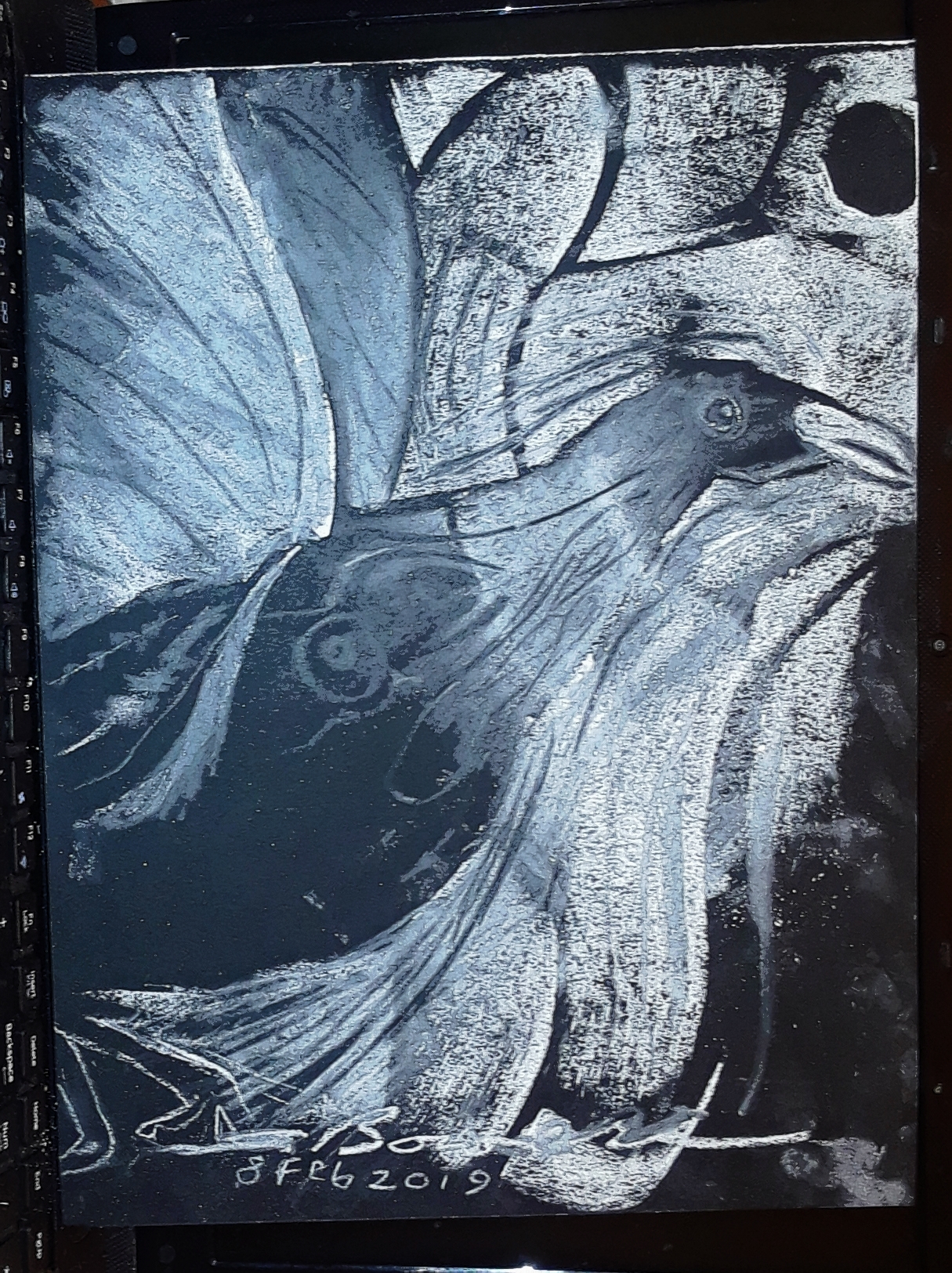
Under “house arrest” while laundry was cycling, I took chalk in hand and did this mood reflector.


 One with Clay, Image and Text