
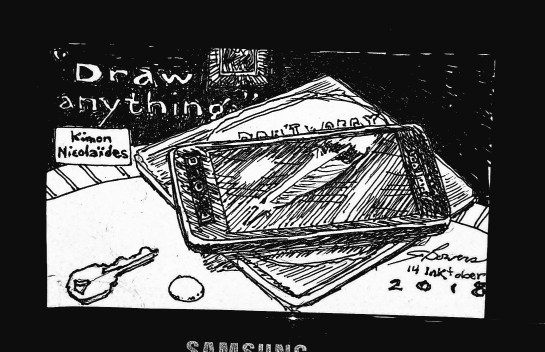
Long ago the artist Kimon Nicolaides wrote a book called The Natural Way to Draw. It has something to offer for artists at any level. And one piece of advice in the book is “Draw anything.” If you are willing to draw ANYTHING, from a stain on cement to the Andromeda Galaxy to a bent big toe and the toe next to it, and you actually DO draw those things, and anything else, but especially subject matter that is indimidating to you, perhaps a vase with the reflection of half the room it is in, or a cityscape with dozens of buildings in it, or an electric pencil sharpener with the brand name on it (see above), then you will be a more fearless, more powerful artist.
Another piece of valuable advice that Nicolaides dispensed was put sternly in all caps in the Introduction, where he described the best way to use the book. First he said that it’s all very well to look at other people’s drawing, and read about how to draw. but the most important thing to do is after you do some of that. “THEN SIT DOWN AND DRAW.” The best way to learn how to draw is to DRAW, find out what you did, DRAW some more, look at it after putting it aside for a while, DRAW and keep your strengths and weaknesses in mind, DRAW DRAW DRAW DRAW DRAW. Take it as an article of faith that keeping at it makes you better.
The best advice I ever got about my own drawing, as I’ve mentioned several times in this blog, was on a slip of paper with my portfolio, which was critiqued by outstanding art teacher Darlene Goto. SLOW DOWN! she wrote. I am still trying to take that advice, 48 years after she gave it to me. I will say that though it almost always benefits a drawing to be mindful and deliberate while making it, there are some special times when the ease and flow of the drawing are so transcendental that the best thing to do is let go of the reins and go Full Speed Ahead. But those special moments don’t occur very often. They do tend to occur more often when drawing daily and often, though, so DRAW DRAW DRAW DRAW DRAW.
(Or PAINT PAINT PAINT PAINT PAINT, if painting is your thing. Another bit of advice: Try Everything. As many media as you can handle and/or afford. A cheap way to get into Sculpture is with big bars of Ivory soap, or a salt block obtained at a feed store, or armature wire. A little-kid’s watercolor set costs very little, yet you will learn a lot from it if you put in the hours. (As soon as you can, buy some decent brushes though, and upgrade from multimedia paper to a good watercolor paper.) Try markers, colored pencils, chalk, gouache, India ink, Sumi-e ink–or just follow your instincts. Find something you enjoy using.)
Put your work on display, even if you think it’s unworthy of view.
Join drawing groups on social media Look at stuff your friends have done. Soon you’ll go from “How did THEY do THAT??” to “Bet I will be able to do that some day” to “I can do better than that.” But it is no one’s place to be scornful. It is everyone’s place to learn and to encourage others.
Here are two contradictory pieces of advice: “Have fun!” and “DON’T Have Fun.” Most of the time it is good to enjoy what you are doing. Sometimes you must do things for the sake of the image that are difficult or tedious to do. It can be frustrating to get something just right, and there is the pitfall of overworking the life out of a drawing. Sometimes the greatest value is not in the drawing itself, but the lesson the drawing provided.
That’s enough advice! NOW SIT DOWN AND DRAW. 🙂
 One with Clay, Image and Text