A few months and a seeming hundred years ago, I was living in Cottonwood, Arizona, and working at the front desk at Sedona Winds Independent Living Retirement Community in the Village of Oak Creek. Every 3-to-11 shift I worked part of my job was to create a new menu for the next day. When the dining room closed for the day I’d remove that day’s menus from the menu holders and then place the next day’s menus in the holders. We recycled some of the menus as scrap paper. Many of my posted images on this blog were created on the backs of those menu scraps.
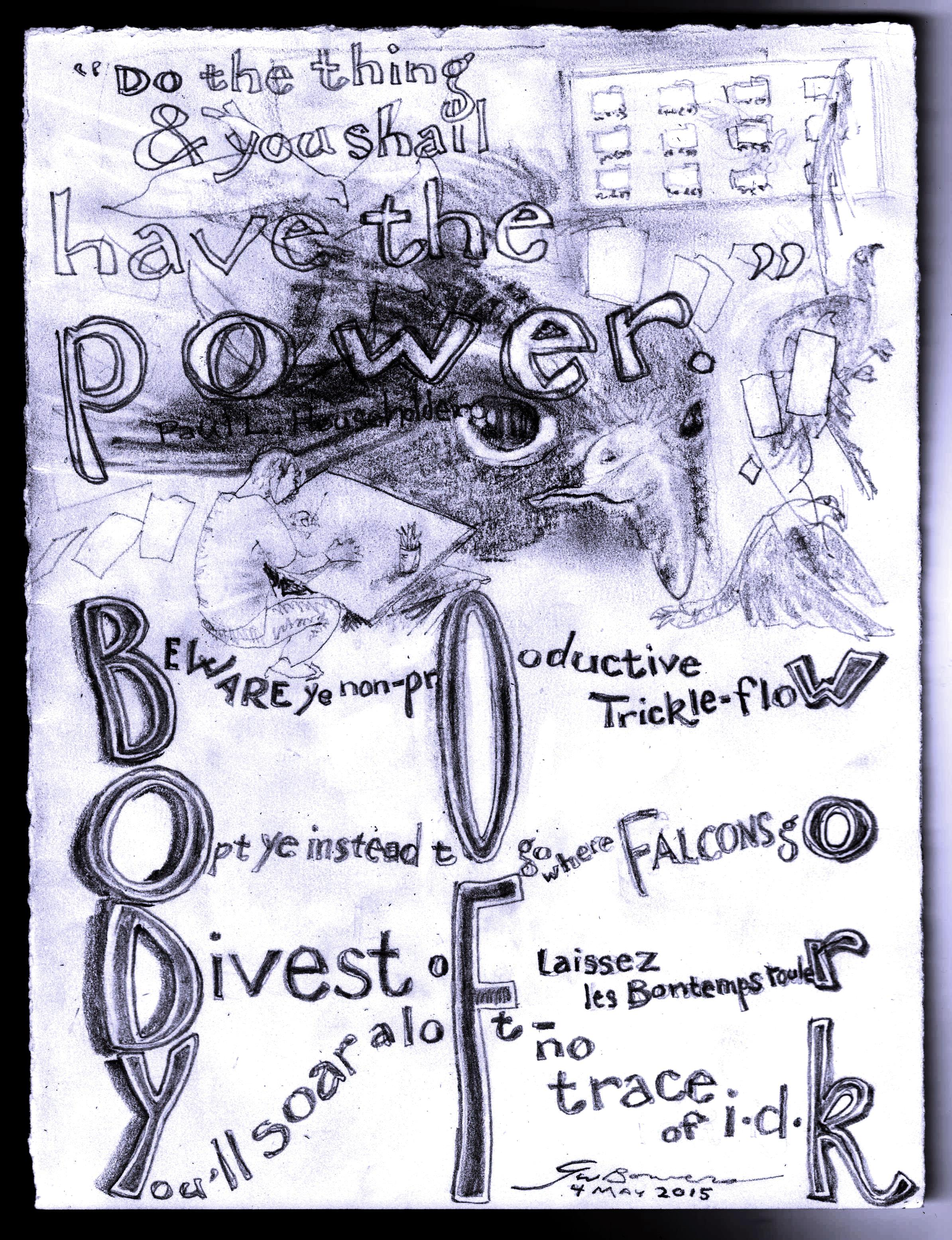
One such remained unfinished at the time of my departure from Sedona Winds and subsequently from Cottonwood. I remember it had a swirly, flowing backdrop and some of a triple-acrostic poem entitled “Body of Work.” I thought of it as perhaps 80% finished and in need of a bit more structured image and a good punchline/last line for the poem.
After I finished the Pat McMahon page, I thought “Body of Work” would be a good one to finish. Alas, I have not been able to find it, though I looked every place it could possibly be. (Of course that’s not true, and I’ll probably smack my forehead with my hand when it turns up.) Lacking the original, I set about making another one. The above result bears almost no similarity to the original, nor should it–I’m different now, and have hundreds of hours more pencil work under my belt. The spirit is probably similar, though. It is an admonition to Produce. Not for the first time on this blog, I’ll print Thomas Carlyle’s famous quotation:
Produce! Produce! Were it but the pitifullest infinitesimal fraction of a Product, produce it, in God’s name! ’Tis the utmost thou hast in thee: out with it, then. Up, up! Whatsoever thy hand findeth to do, do it with thy whole might. Work while it is called To-day: for the Night cometh, wherein no man can work.
My grandfather, Paul L. Householder, gives us the other quotation, the one on my image: “Do the thing and you shall have the power.” Daydreams are good only to the extent that they raise yearning to the level of a need to accomplish. Soon or late the daydream must end and work be performed to make the daydream real.
At sixty years of age, my memory is starting to decay. My left elbow thinks it needs oil a la the Tin Woodsman, and my linework, I being left-handed, gets the occasional elbow yip sending my line askew. My eyesight is astigmatic enough to give me two full moons for the price of one. But I will Produce until my night cometh.
 One with Clay, Image and Text