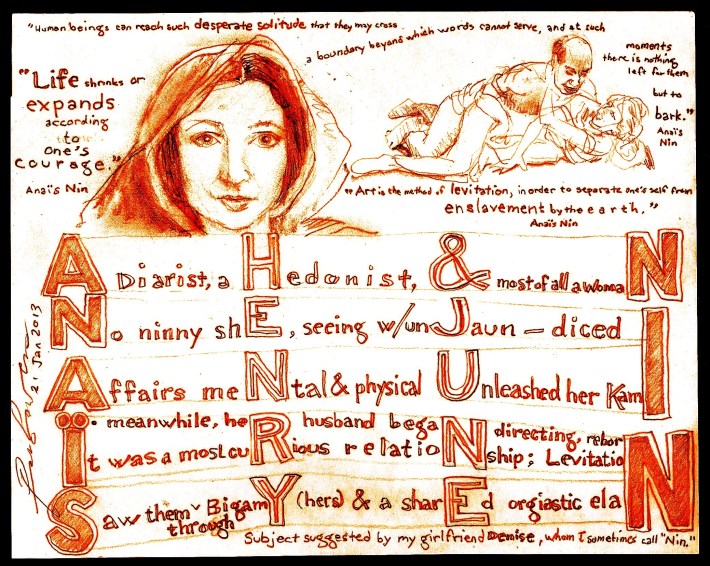
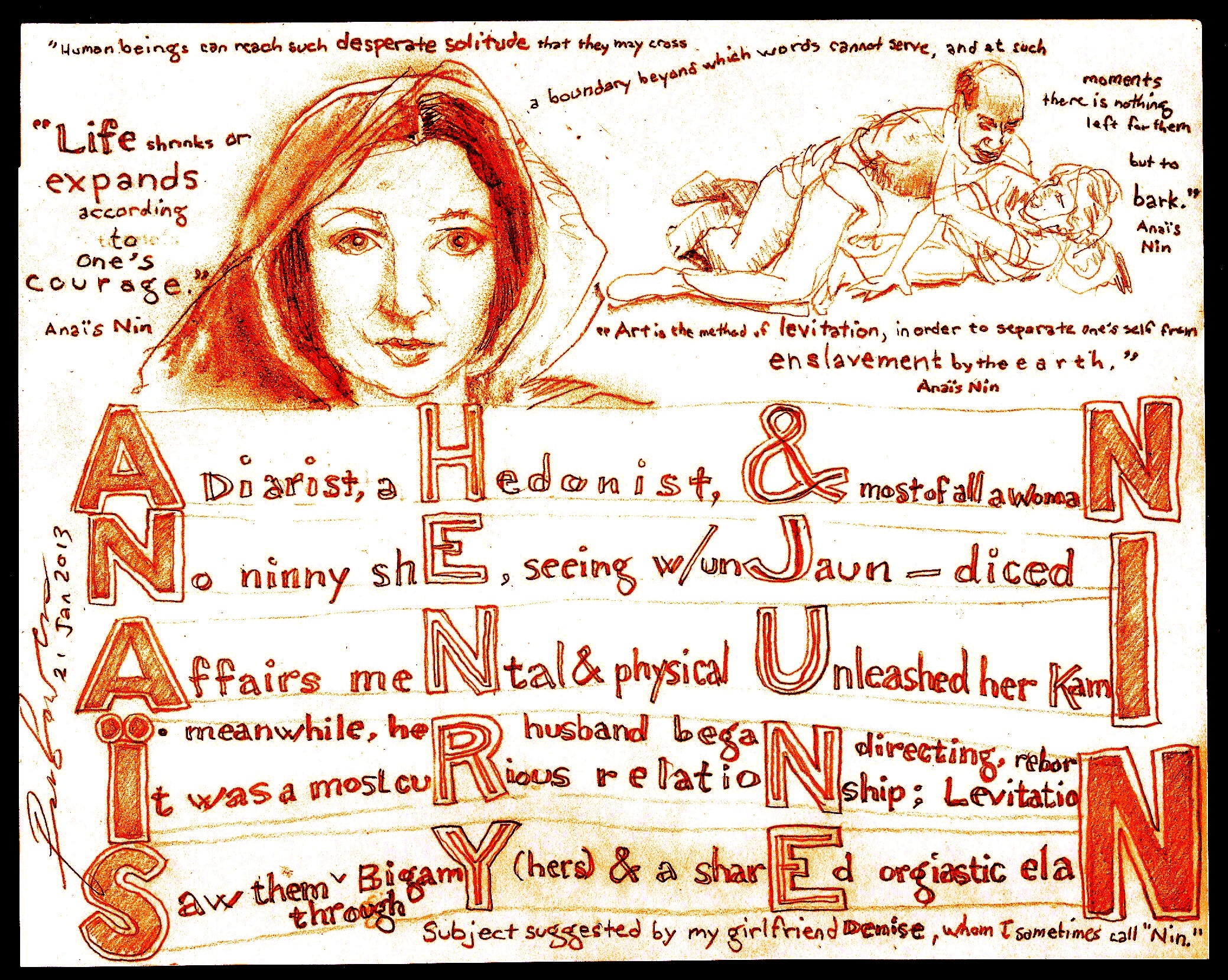
Two days ago, having just finished a journal page, I told my girlfriend I wanted to do a portrait page of someone I hadn’t “paged” before. She suggested Anaïs Nin, perhaps because I’d been affectionately calling her “Nin” (why? Long story) off and on for more than a year.
What a terrific, and challenging, subject for acrostic poetry! The biggest challenge would be to find a word that begins with an umlauted i, i.e. ï. A capital ï, i.e. Ï, never “occurs in nature” since the umlaut in ï is that peculiar species of umlaut known as a diaeresis, which is a diacritical mark that indicates a new syllable. Since the first letter of a word starts a new syllable by definition, the diaeresis isn’t needed and wouldn’t work. What to do? –Well, heck and gee-whiz, what if I treated those two pesky dots not as an umlaut, but as two-thirds of an ellipsis, i.e. .. ? Then I could put an extra line in that began with an ellipsis–problem solved. (One of the things I LOVE about acrostic poetry is the challenges it creates. Solving odd problems like these forces creative solutions.)
That wasn’t the first problem, though. The first problem was, before I got to the acrostic poetry, I had begun the illustration. My illustration featured nudity in the form of a nude, reclining Henry Miller and June Mansfield. I drew, both with them and with Ms. Nin, not from a photo source, but from imagination; and my imagination used not real life but actresses and actor from the film Henry & June, which I’d seen only once, and that about twenty years ago. Consequently the full-faced Nin looked less like Anaïs Nin and more like Maria de Medeiros, though not much like either (I most definitely do NOT have a “photographic memory”). But the bigger problem was the nudity. Though it is not a violation of WordPress terms & conditions to include nudity, it is frowned upon on certain other sites where I might wish to post my page. I HATE censorship, but I solved this problem by self-censoring.
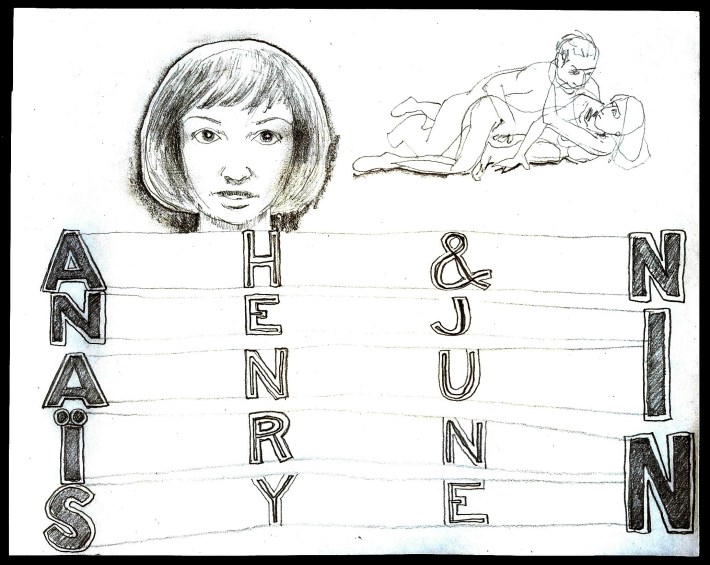
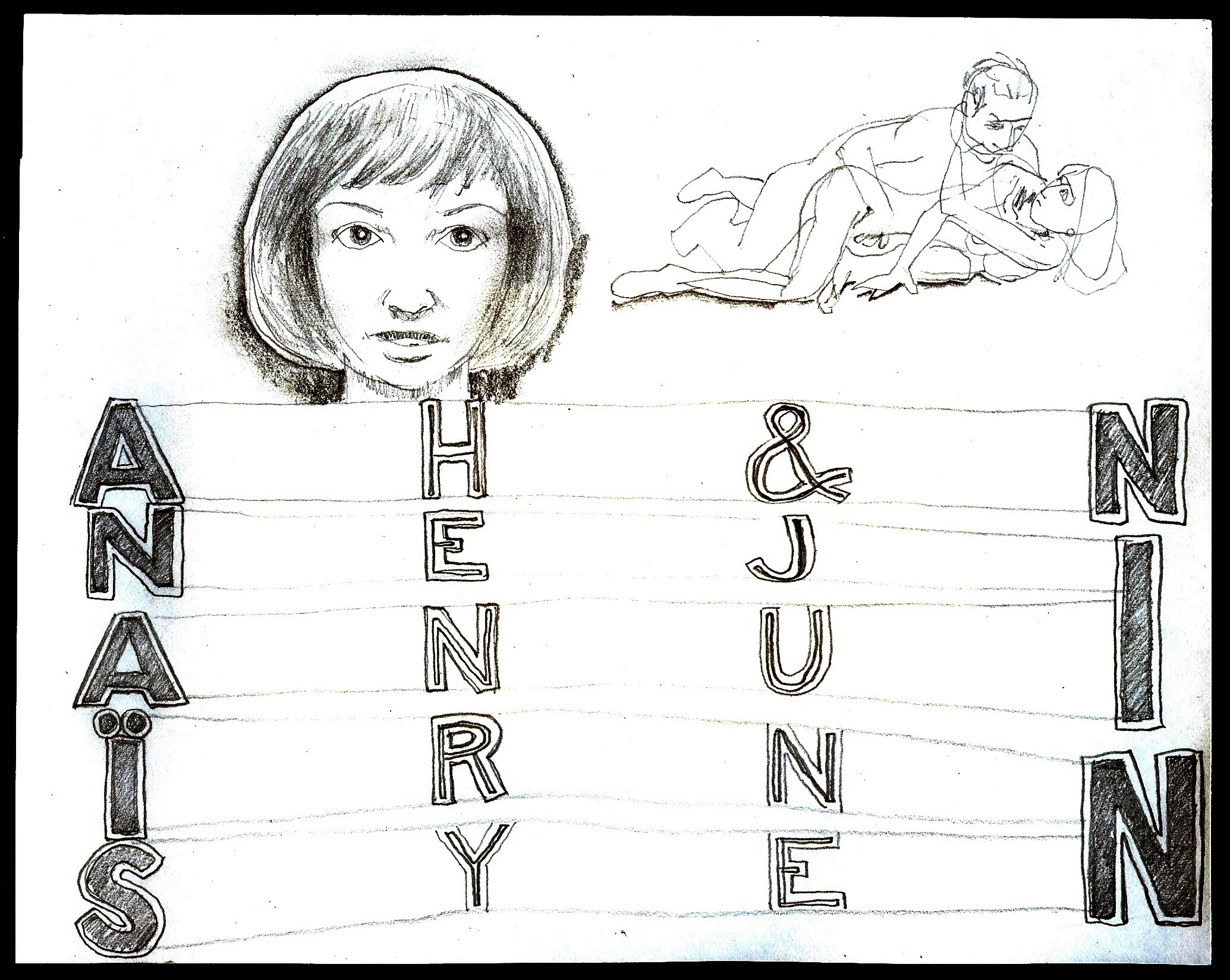
Before I did the portrait fix-ups and the clothing of the nudes, though, I scanned the work in progress. I leave you with that image:
 One with Clay, Image and Text