Archive

Tag Archives: William Shakespeare

well, my mr. coffee died quietly two days ago/the on switch simply wouldn’t light up nor activate when pressed/so i being unhandy and incapable of repair slash resurrection called the time of death/and have emptied the reservoir and will give it an improper nonburial

and now I have a new coffeemaker/and have read the instructions/learning thereby that the manufacturers of this charming device/define five ounces as “one cup of coffee”/so i will get about two decent-sized cups per pot/which is ok

and I have just now followed the instructions/of first washing the pot with warm soapy water and rinsing/and next running a brew cycle without coffee/so as to clean its innards

and when i ran it/i learned that the new machine sounds like it dies an agonizing death by copd/as it yields the last fraction of an ounce of superheated water

its agony and final death-rattle sigh/worthy of shakespeare/who famously said

“Cowards die many times before their deaths;/The valiant never taste of death but once.”

may my new fellow-coward coffee machine/die a thousand histrionic deaths/before it really and truly and once and for all and irreparably/dies

National Poetry Writing Month 2023, day 7

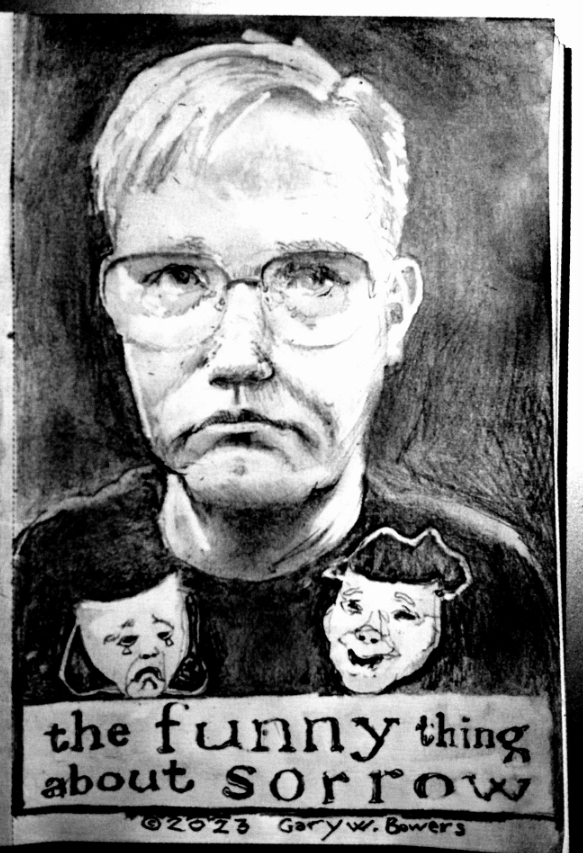
the funny thing about sorrow

sorrow visits us all our lives
for a weekend here
and three years there
and at least a little every single minute

but it can make you laugh
as with a funeral
where the best friend of the deceased
tells funny stories
and the gathered are grateful
for laughter’s relief
and the brief escape
reliving ridiculous episodes

when you have a good cry
an ugly cry or a soft cry
it’s funny how it sometimes seems
you just had a bath or a baptism
and sins or street grit
seem to have been washed away

my mom helped my aunt zilpha cry in 1965
while kid-me watched from the next room
they were looking at letters from her brother
my grandfather
who’d been institutionalized
and died in 1963
funny how later that day
aunt zilpha was so cheery and aware

i have a little sorrow going on right now
and it’s funny how i am sort of celebrating
by not talking about it
but posting a new profile picture
with my sorrowful face on display

it is good to smile
but it is also good to cry
good to let friends know you’re not ok
but will be ok soon

and so it will be with you, my friend,
at certain times of loss,
or adverse circumstance

Shakespeare’s Falstaff said a funny thing:
“Who hath [honour]?
He who died o’ Wednesday.”

beware wednesday
says this joker
cracking wise
because sorrow

2022 0320 snap shot stage 3
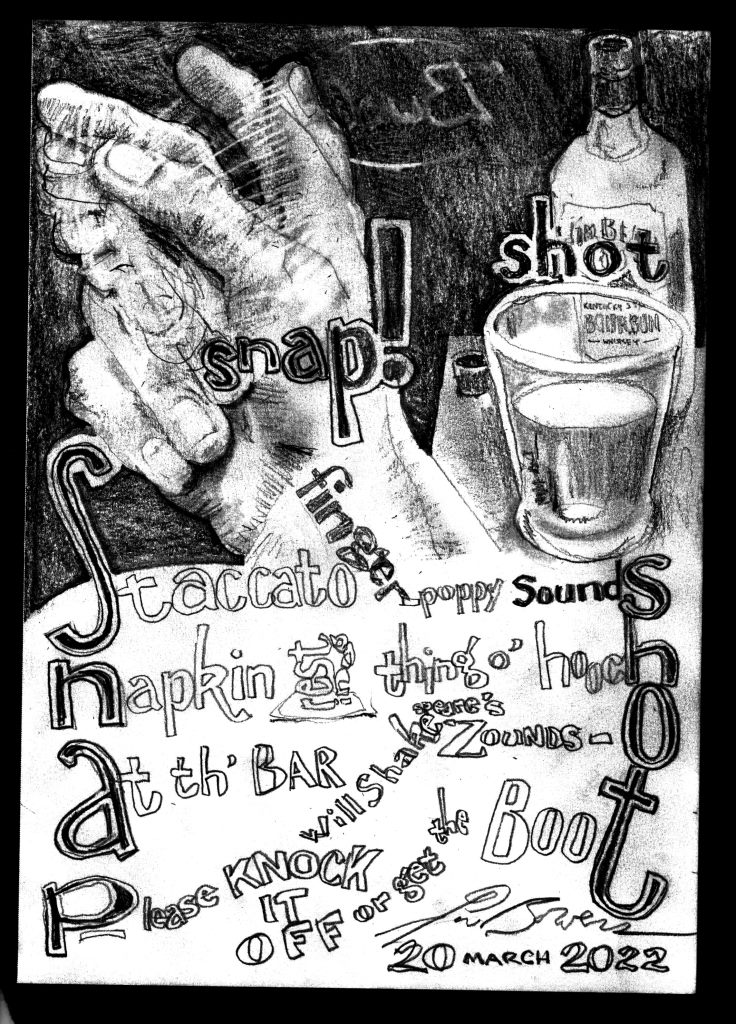
Here’s another and different yield from the “snap shot” acrosticon. This partakes of certain establishments that are licensed to sell alcoholic beverages. Here in the Southwestern United States of America we call them “bars.” Sometimes they are themed. A place with a lot of television screens channeled to sporting events is called a Sports Bar.  A place where patrons who wish to sing are given a microphone and the lyrics to the song they requested is called a Karaoke Bar. A place where silicone-enhanced young women do a pole-enhanced dance and progressively take off their clothing is called by many a Titty Bar, though I, who am no stranger to such places, prefer the term Strip Joint.

Such places exist to spice up people’s lives, so that they can be more rowdy or outlawish or looking-for-love or otherwise fantasy-indulgent than their everyday activities allow.

The “snap” of this acrostic is the snap of a finger. People snap their fingers at poetry events when the poet has said something eloquent or otherwise noteworthy. Jazz lovers may snap their fingers in sync with a beat. Sometimes a finger-snap accompanies a “Eureka!” moment when a person figures out something that had eluded them. And, recently and cinematically, in the Marvel Cinematic Universe, “The Snap” performed by whoever was wearing the gauntlet ensconcing the Infinity Stones enabled the snapper to reshape the Universe Itself.

In short, the Finger Snap has a rich and various connotation.

The Shot is also numinous. Almost all bars have shotglasses, into which spiritous liquors are poured. A Shot is the contents of a shotglass.

Well, enough exposition. If I want to have a Shot at holding your attention, I’d better make it Snappy. 🙂

snap shot

staccato finger-poppy sounds
napkin-resting thing o’ hooch
at th’ bar will shakespeare’s zounds — o
please knock it off or get the boot

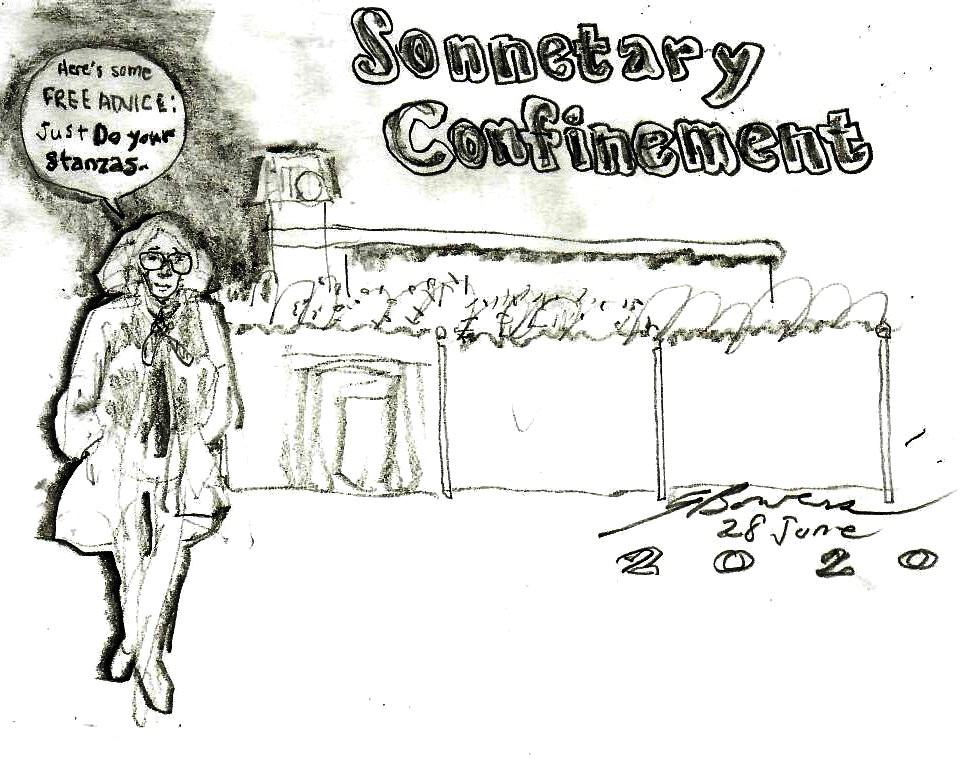
2020 0628 sonnetary confinement

Sonnetary Confinement

Sometimes people with more words than they know what to do with will array some of their words into rhyming matrices of fourteen lines of iambic pentameter. Those matrices are called sonnets.

William Shakespeare’s name is on more than a hundred sonnets. In one of his most famous, Sonnet XXIX, the first four lines are

When, in disgrace with fortune and men’s eyes,
I all alone beweep my outcast state
And trouble deaf heaven with my bootless cries
And look upon myself and curse my fate,

These lines introduce the reader to the narrator, who lacks either monetary or good-luck fortune, and is not highly regarded by his peers. He is unhappy enough to cry to Heaven about it in Line 3.

Line 3 presents problems to the Obsessive-Compulsive Disorder sonneteer. The meter is off; there is an extra syllable in there. And there’s a logical contradiction: if Heaven is deaf, why would It be troubled by the narrator’s cries?

Shakespeare isn’t around to defend himself or explain his choices. Simply tking out the word “deaf” would solve both problems:

And TROUBle HEAVen WITH my BOOTless CRIES has perfect scansion, and Heaven can hear the narrator and be troubled. At least, that’s true in 2020. There is some evidence that in Elizabethan times the word “heaven” was pronounced as if it were one syllable. Poems exist that include the contraction “heav’n.”

If we treat it that way, the original Line 3 becomes

And TROUBle DEAF heav’n WITH my BOOTless CRIES,

And the stress on DEAF has a nifty implication of raised volume, as if Heaven is deaf in the sense of “hard of hearing,” and so the narrator has to amp up his wailing to be heard, which is troubling indeed. But even though Heaven hears, there is no response: the narrator says his cries are “bootless,” which (I trust) means Ineffective.

All of which leads me to posit that Shakespeare felt free to escape the Sonnetary Confinement of the strict sonnet form, and compel the reader to feel the narrator’s chaotic pain. For there can be no doubt that Shakespeare broke rules to suit his content. If the right word for the situation didn’t exist, Shakespeare would invent it on the spot. (Even the common and so-useful word “bump” is said to be Shakespeare’s invention.)

Shakespeare wrote entire plays in iambic pentameter. But

be not ye too impresséd, reader mine.
poul anderson, the fantasist, once wrote
a book festooned with such, to prove the point
it’s easy once you get the hang of it.

And speaking of “hang,” Shakespeare entertained not only with story, but also with wretched, vulgar puns. One example of hundreds may be found in Othello with a snide character known as the Clown asking some bad musicians if they are playing with wind instruments. They say they are, and the Clown responds with “Thereby hangs a tail,” meaning that their playing is as bad as flatulence. But the musicians hear not “tail” but “tale” and so are unoffended.

Whoops! The midnight deadline has come. I need to stop writing and hit the hay. “Hit the hay” is idiomatic for “go to bed, there to sleep.” Had I time, I would have expanded on the place Vulgarity has in literature, crafted some random lines to demonstrate that an entire mundane day may be reported in iambic pentameter, and concluded with a strict-form sonnet that nevertheless transcends “confinement” via playfulness and universality. Something for both of us to look forward to, O Reader!

In Facebook is a poetry group called Poets All Call. My friend Joe posts a weekly challenge for the group. This weekend, he said he was out of ideas and invited us to write about the weather. I responded with “weather tizz no blur,” posted the poem on the group’s page, and then decided to add it to this blog, with notes following.

weather tizz no blur

wither on the vine we do
whithersoever we travel
why the whereas makes it so
waysayers try to unravel
we the thereuponned may ponder
wangle and wheedle and wage
when the river becomes absconder
wuthering highs disengage

but soft
are sheets
and sunshine’s welcomer
zenith and trough notwithstanding
when there’s cessation of storms
we shed sloth
seeking
an
outcome
outlanding.

*****

The title riffs on the “whether ’tis nobler…” phrase in Shakespeare’s famous Hamlet soliloquy. Hamlet is wondering whether or not he should fight against all his problems, or pack it in and end his life. I do have a penchant for punning–so did Shakespeare–but this pun served the additional purpose of relating Whether with Weather. Weather drives our Whethers. If it’s cold and rainy, we act differently than if it is warm and sunny. “weather tizz no blur” is a focused (no blur) look at the bottom vagaries (tizz as in Tizzy) of weather, both externally with atmospherics and internally with mood and decision.

I wanted to make the poem analogous to weather, so I made the first stanza a bit like a steady rain, with the starting sounds of each line bearing a similarity that toward the end of the stanza breaks up a bit. The challenge became the buildup of a meaningful passage, and my intuition led me to some legalese, what with “whithersoever” and “whereas” and “thereupon,” language found in contracts and proclamations, serving the dual purpose of being as droning as steady rain, and enabling specificity.

The second stanza differs from the first in the way that good weather follows bad, and the analogy disappears and becomes content, reviewing what we do when weather clears.

Friends, I hope your own inside-weather is pleasant and gently energetic, right as rain. 🙂

Image

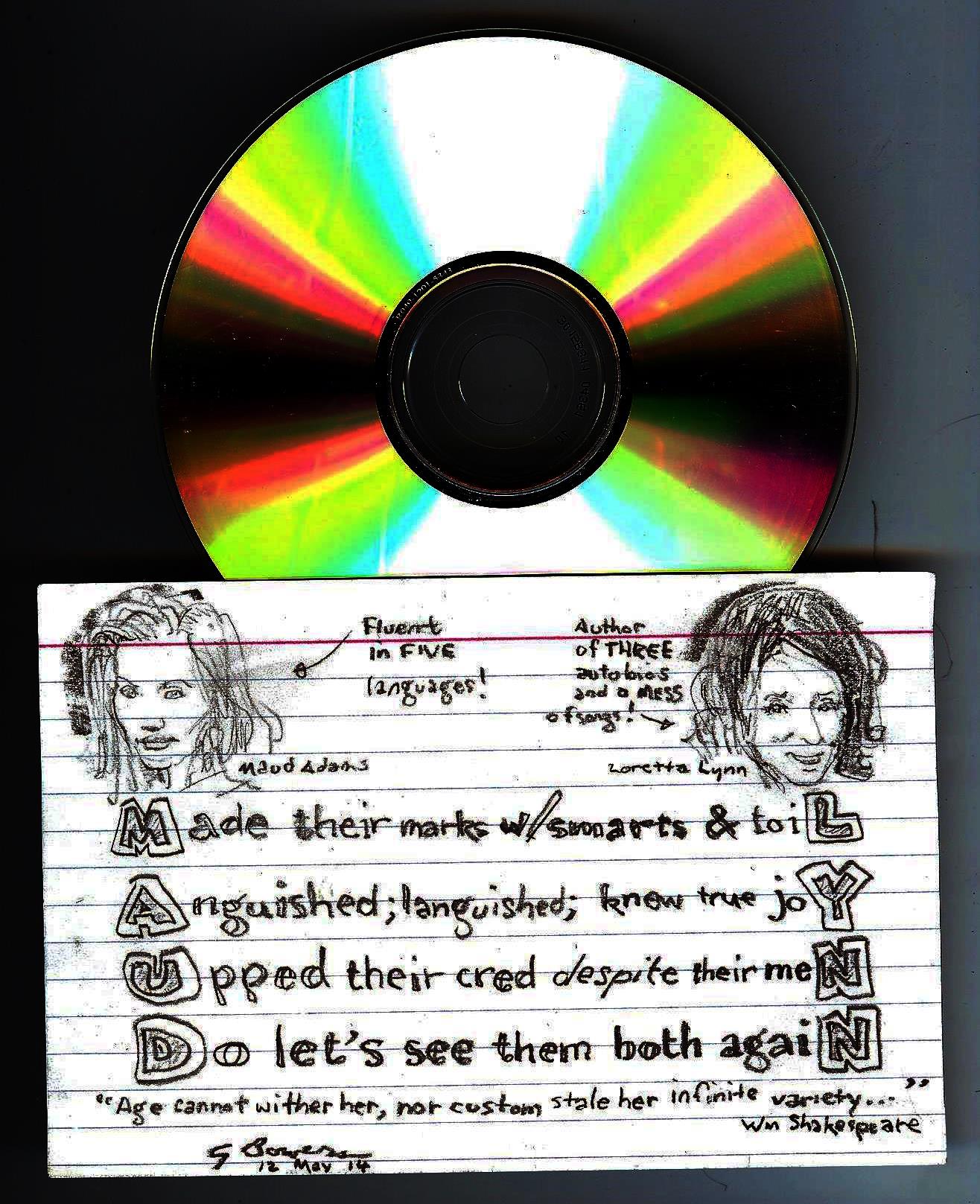
Last week my friend Bob Kabchef created a feature called Maudlin Monday in the poet’s group we both are in, and I joked that I was working on a dual portrait of Maud Adams and Loretta Lynn for Maud/Lynn Monday, but it would take some time. This week my friend Genevieve Lumbert, another member of our group, reminded us: “POP CALL TO MAUDLIN MONDAY ARCADE.” (Arcade was Bob’s username in the now defunct seniors social site Eons, where we all met.) Spurred by Gen’s nudge, I did the above. Since the index card is a little beat up, it didn’t lay on the scanner flatly, and so I put a CD-R atop it, remembering that there’s a cool prismatic effect when you scan a disk.

Words:

Made their marks with smarts and toil
Anguished; languished; knew true joy
Upped their cred despite their men
Do let’s see them both again

The Shakespeare quote is apt for these two ladies, and for several of the ladies in our poet’s group Poets All Call, including its originator, Socorro Olsen, and Genevieve, and my Sweetheart, Denise.

Image

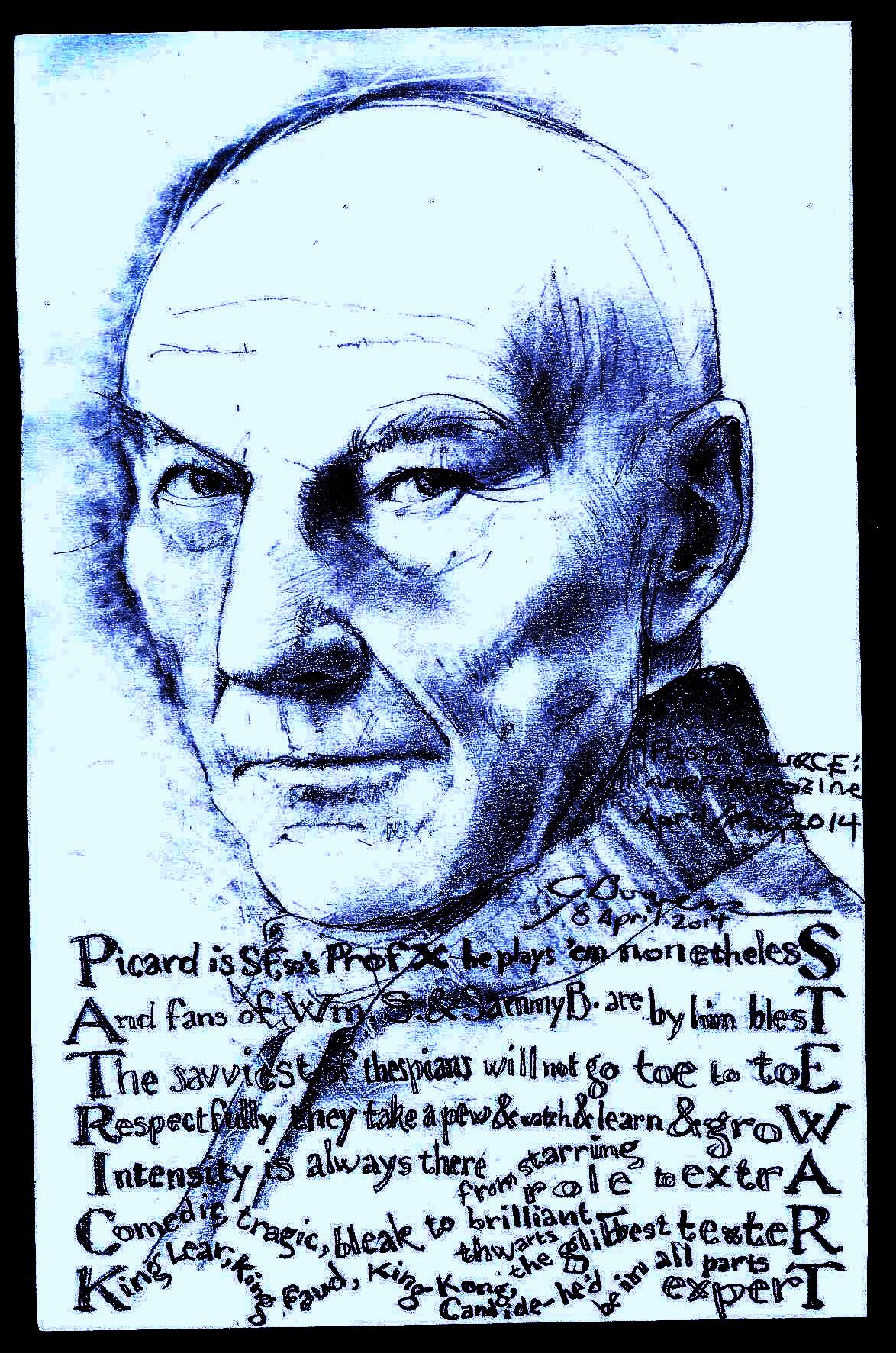
Here is the “finished” portrait and eponymous acrostic of Patrick Stewart. Something was lost in the finishing: freshness/likeness. Something was gained: the words that solved the poeticization.

Here are the words:

Picard is SF, so’s Prof X–he plays ’em nonetheless
And fans of Wm. S. and Sammy B. are by him blest
The savviest of thespians will not go toe to toe
Respectfully they take a pew & watch & learn & grow
Intensity is always there from starring role to extra
Comedic, tragic, bleak to brilliant thwarts the glibbest texter
King Lear, King Faud, King Kong, Candide–he’d be in all parts expert

Image

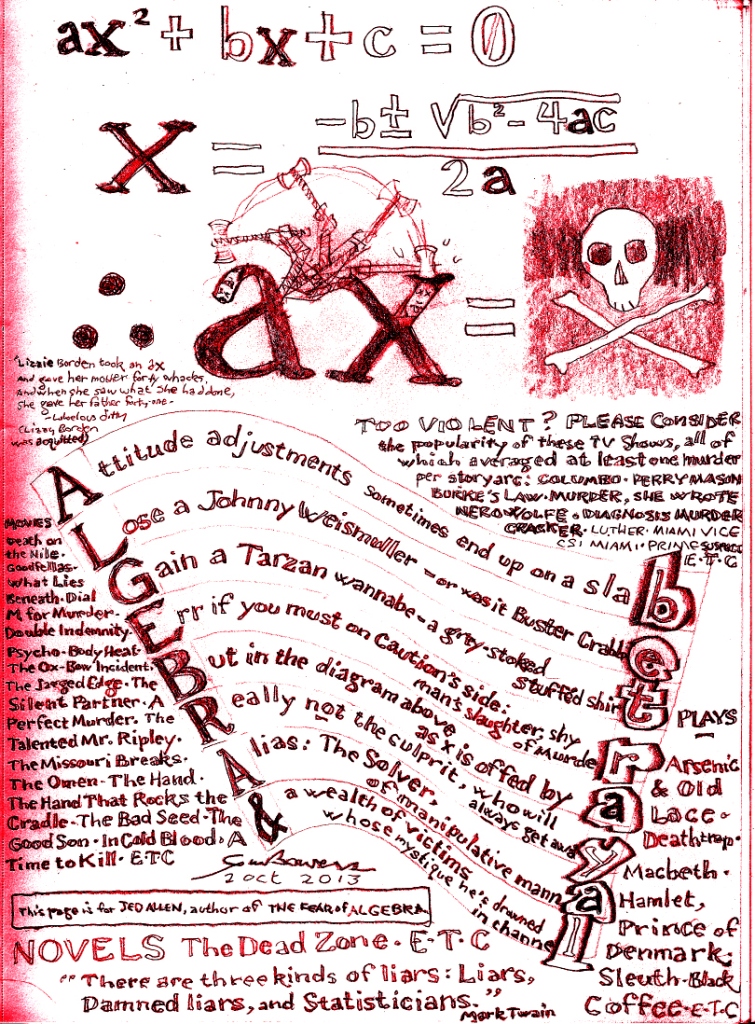
The page begins with the Quadratic Formula, which, in my younger and more phony-baloney days, I tried to impress my then-girlfriend, next-wife, the former Joni Froehling, by deriving, via the “completing the square” trick and other manipulation. She is no longer married to me, and who can blame her?

A masterful Valley of the Sun poet, Jed Allen, gave me a copy of his awe-inspiring chapbook THE FEAR OF ALGEBRA in appreciation of my reading of his poem “Zero Yard” at the Caffeine Corridor poetry event more than a year ago. Ever since, I have wanted to return the favor, and with this page I hope I have.

The words to the acrostic:

Attitude adjustments sometimes end up on a slab
Lose a Johnny Weismuller–or was it Buster Crabbe
Gain a Tarzan wannabe–a grey-stoked stufféd shirt
Err if you must on Caution’s side: man’s slaughter, shy of Murder
But in the diagram above as x is offed by a
Really not the culprit, who will always get away
Alias: The Solver, of manipulative manna
& a wealth of victims whose mystique is drowned in channel

The theme and meaning of the poem and its related ancillary material are left as an exercise for the student. Ironic hint: spelling out a solution murders Mystery. [enigmatic smile; fade to black]