Lonership
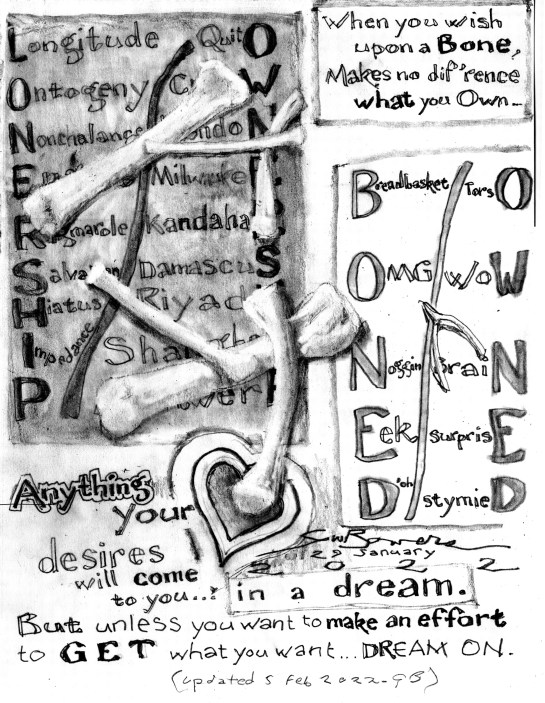
A few days ago, on Facebook, I posted a photo of some chicken bones I had arranged in a pattern similar to the ones drawn above. I spoke about an art class I’d had long ago whose teacher, Darlene Goto, had me doing bone drawings. People inferred that my photo was not a photo but a drawing I’d made, and they were impressed by the photorealism. Despite my assertion that it was a photo, the notion that it was a drawing persisted. So here I’ve done a drawing, and when people see it on Facebook, they will know how different my drawings of bones look from my photos of bones.
As for the words, they serve to meet a challenge I set myself, using the acrostics “Lonership/Ownership” and “Boned/Owned.” Both acrostics are two sets of two words per line. With the first, the words on the left are nouns, describing something variable. (The bottom word “P” may be found in the dictionary as “the sixteenth letter of the alphabet,” but in mathematics P means Pressure.) The words on the right are specific cities.
The “Boned/Owned” acrostic has colloquial or slang words on the left, and what those words might be interpreted to mean on the right.
Does that seem silly? It does to me, now; but when I was constructing these arrays, I looked at them as exercises that may make me a better acrostic poet. It’s also like a Ouija board in that maybe, just maybe, certain words come out a certain way for a reason, if only to better understand our own motivations.
The acrostics themselves are more straightforward. If you are in a state of Lonership, you completely own your behavior and your circumstances. If you are unhappy with either, the more you own them, the more you are in a position to improve them. As for “Boned/Owned,” I acquired the chicken bones I photoed and drew from a chicken that I bought and ate. I owned the chicken carcass, and so own my carnivorousness, my callousness in lack of empathy for the chicken, my enhanced nutritional health as a result of eating that chicken, and all intellectual property, including the page above, that I derive from the use of the chicken bones as subject matter.
Lastly, the parody of “When You Wish Upon a Star,” so familiar to watchers of Walt Disney’s Sunday TV show when I was growing up, was done both to fill space and as an oblique protest/statement. It is not enough to wish for something without action. But there is substance to a saying I remember from reading What Color Is Your Parachute? in 1991, when I was out of work and seeking guidance on how to find some. “Pray, as if it were all up to God, then work, as if it were all up to you.” No matter what I believe or disbelieve, I have found that piece of advice invaluable.
 One with Clay, Image and Text