Archive

Tag Archives: Harlan Ellison

“Never understood that it ain’t no good/You shouldn’t/Let other people/Get your/Kicks for you…” Bob Dylan, “Like a Rolling Stone”

mayhem is wartime chaos

or a four-hundred-pound left guard after the ball snap

or a school of piranha disassembling a swimmer

..

contrariwise, mehhem is the “quiet desperation” henry david thoreau mentioned in walden

it is t s eliot’s j alfred prufrock asking “do i dare to eat a peach?”

it is gonna and not done

maybe and not yes

a mononucleosis of your soul…

and if you think of yourself as a “wage slave”

and/or sigh a lot

and/or get sucked in by endless random reels on ticketytok or instagratis or fuzzbook,

you may be in mehhem’s gentle deathgrip, my friend

..

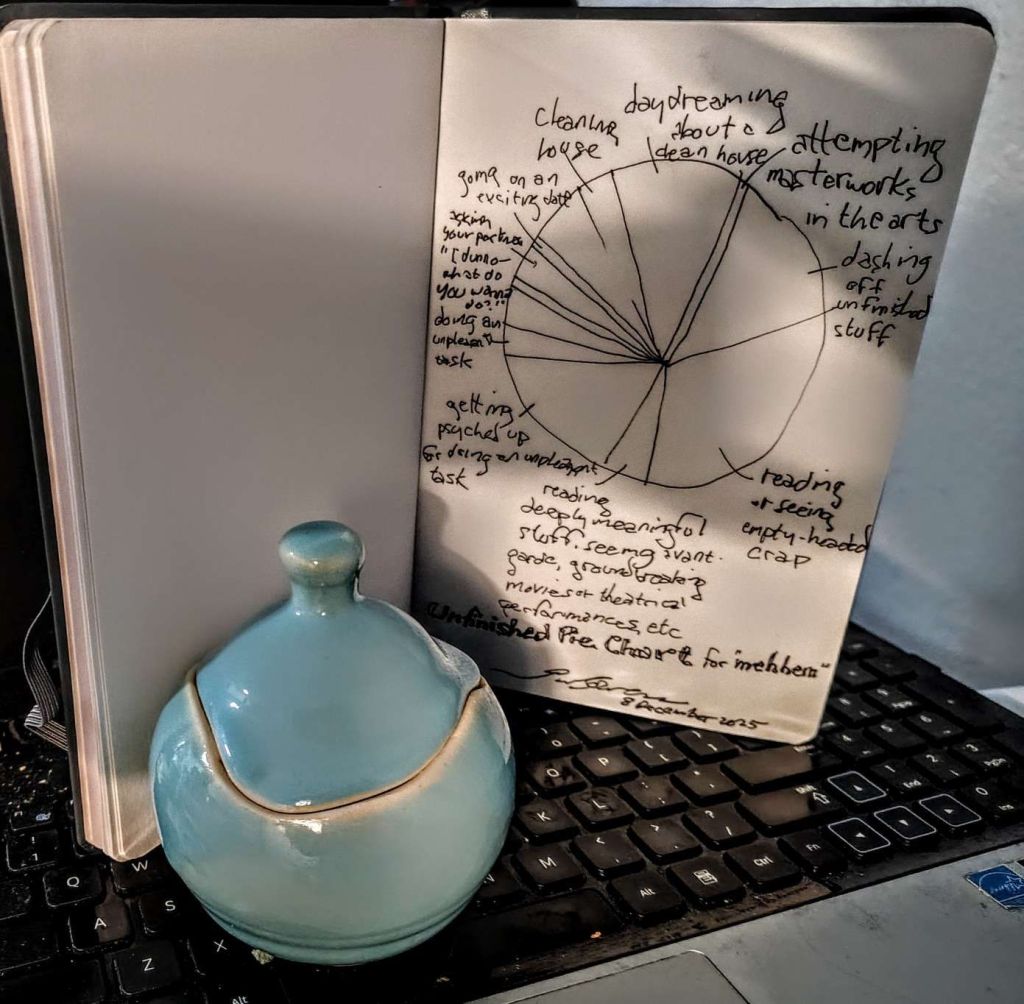
my unsolicited and easily discarded advice is to make a pie chart of your activity and your passivity

doesn’t have to be fancy

or even finished–here’s mine:

and then be brave

change things up some

stop treating yourself like a child you are determined to spoil rotten

and when you find yourself backsliding, rise up and say “Enough of this Mehhem!!!”

or not

wotthehell

it’s only your life

..

Grateful acknowledgment to the late Harlan Ellison for the concept behind his groundbreaking The Glass Teat, written last century but still spot-on

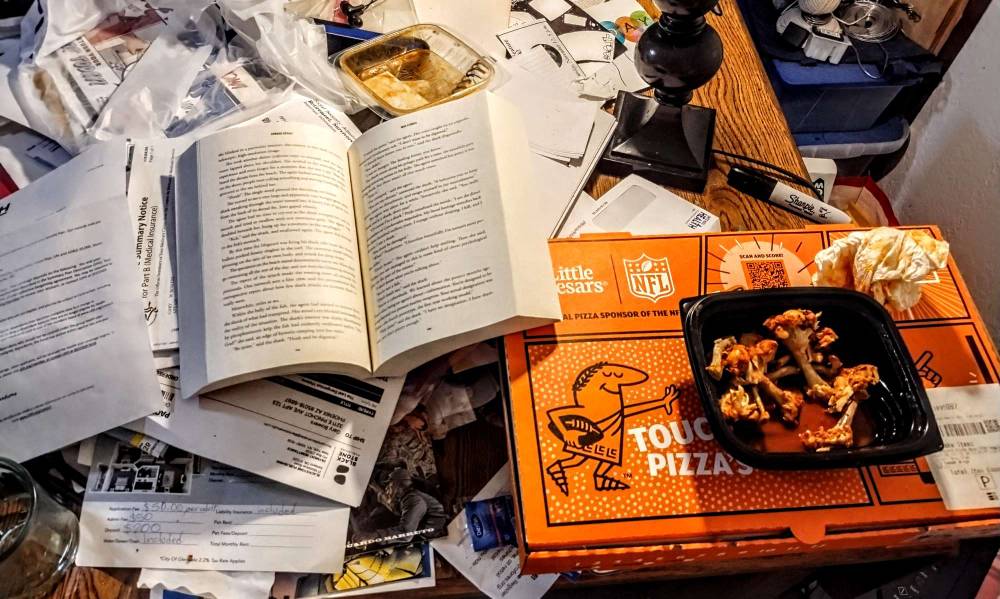
i dawdle. reading edward bryant’s “war stories” in the last dangerous visions while digesting pizza. on pages 104-5 a woman spy is having a conversation with a shark who has just swallowed her whole and dived into deep water. but it may not be a full-biological shark. my late friend bernard schober would have liked this passage, i think.

i dawdle. there’s music across town, and I am invited, and i have a rented car, but i am digesting both buffalo wings and storyline.

I am mentally ill in much the same way harlan ellison, editor of the last dangerous visions, was. he struggled with bipolarity and clinical depression, but to a much greater degree than i do. the brilliant scenarist j. michael straczynski, executor of the ellison foundation/estate, went into extraordinary detail about ellison’s condition in the introduction to this book, which i have waited for for fifty years because ellison’s condition kept him from finishing the job.

my dining table bears a similarity to straczynski’s description of the manuscript-strewn tables in ellison’s home, which will become a museum called “ellison wonderland.”

my left shoelace is untied. it was untied all my walk to little cæsar’s too. and I had forgotten to put my fitbit in my pocket, so i will not get credit for those 2000 or so steps.

time to tie my shoelace and put the remaining half of the detroit deep dish veggie pizza in the refrigerator and go.

time to go.

but let me just check facebook first…

In 1967 Harlan Ellison’s DANGEROUS VISIONS was published, and it rocked my then-fourteen-year-old sensibility. It was an anthology of original stories Ellison solicited from more than thirty authors, telling them Anything Goes, and asking for stories that pushed the envelope of free thought, even–or perhaps especially?–if the themes or prose were considered unpublishable.

Many of the stories were wildly imaginative. Philip K. Dick’s “Faith of Our Fathers” brilliantly played with the nature of reality, and later he would become more famous for that in movies such as TOTAL RECALL and BLADE RUNNER. Fritz Lieber’s “Gonna Roll the Bones” celebrated the Tall Tale genre with a parable about divinity in a gambler’s hardscrabble existence. Many of the stories were dystopian, including Poul Anderson’s “Eutopia”–maybe. But in his Afterword, Anderson says maybe not. And there was Theodore Sturgeon, who also wrote the “Shore Leave” episode of the original Star Trek series, with his brilliantly-titled “If All Men Were Brothers, Would You Want One To Marry Your Sister?”

The reason I’m going on and on about this is because of Ellison’s dedication of the book, to the husband-and-wife team of illustrators whose wonderful woodcuts gave a breathtaking, movie-trailer-like preview to each story. Here is Ellison’s dedication in its entirety:

“This book is dedicated with love, respect and admiration to
LEO & DIANE DILLON
who painstakingly, out of friendship, showed the Editor
that black is black, white is white, and that goodness
can come from either; but never from gray.
And to their son, LIONEL III, now known as Lee, with a
silent prayer that his world will not resemble our world.”

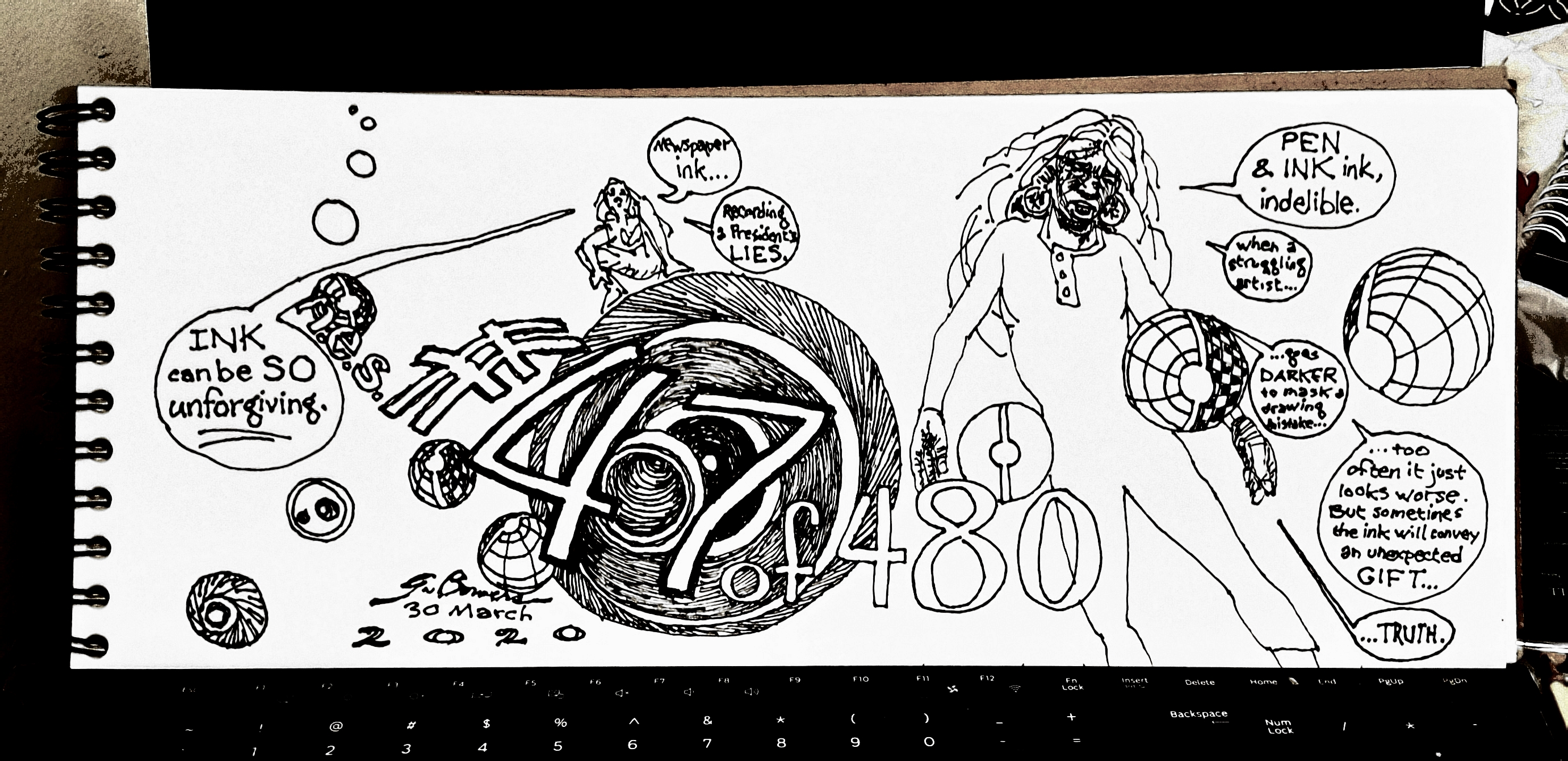
I was thinking of the Dillons, and of Ellison’s dedication, when I did this page.

20200330_224854

I am no Leo&Diane Dillon. I envy their exquisite draughtsmanship, and their finely-tuned craftsmanship, and I urge you to seek out their work, as fresh today as fifty years ago.


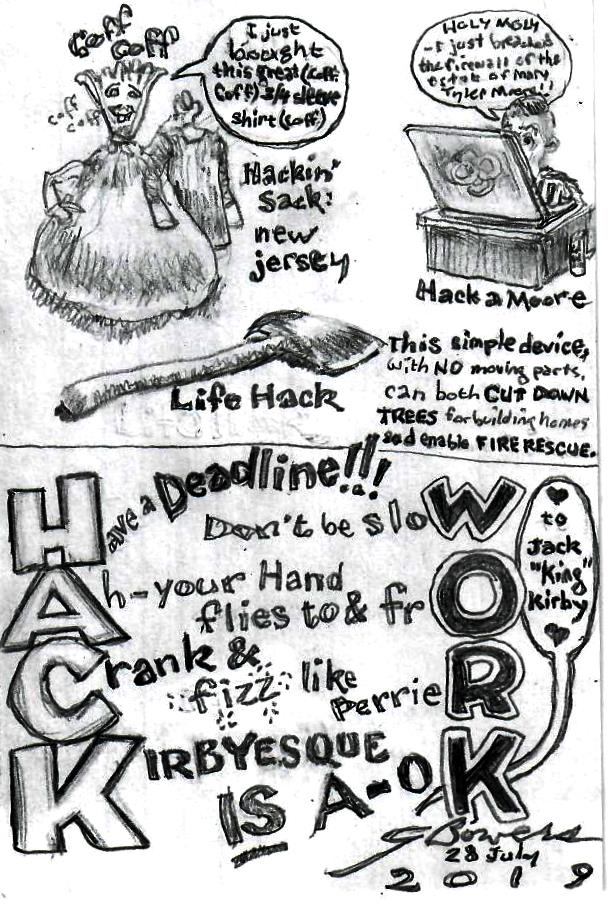
2019 0728 hack work

This post is dedicated to Jack Kirby, comic-book artist extraordinaire, who had an astonishingly prolific career. He was the John Henry, Steel Drivin’ Man of comics. And sometimes, and sometimes disparagingly, he was referred to by his colleagues as “Jack the Hack.”

The thing about Hackwork, though, is that it is deadline-driven. Comic books as published in America during most of Kirby’s career HAD to come out once a month, every month, without fail. And the better you were, the more demand for your work there was, and the more deadlines you had. Sometimes the deadlines were so many and so crushing that the quality of work suffered.

Writer Harlan Ellison, whose prolificity was legend, wrote “‘Repent, Harlequin!’ Said the Ticktockman,” a story about the insidiousness of deadlines. Introducing the story in one of his antholgies, he quoted a mogul saying, “I don’t care if it’s GOOD, as long as it’s Tuesday!”

And in the intro to Phoenix Without Ashes, the novel of the Starlost he co-wrote with Edward Bryant, Jr., he told us about something Charles Beaumont told him when he moved to Hollywood, which was that attaining success in Hollywood was like climbing an enormous mountain of cow flop, in order to pluck one perfect rose from the summit–but, alas, after you have made that hideous climb, you have lost the sense of smell.

So this post is also dedicated to all hard-working people who dive in and get it done, day after week after month after year after decade. I want to specifically mention two Facebook friends of mine. One is Tom Orzechowski, who as letterer/calligrapher for the Uncanny X-Men and other mutant-related titles, and whatever else they threw at him, maintained a consistently high level of quality, of artistry, in his work. The other is my work colleague LaShawna Douglas-Muhammad, who worked her way up from line cook to manager for SSP America with class, determination, and sheer hard work. Tom and Shawna are two of my heroes and role models.

HACK Work

Have a Deadline!!! Don’t be sloW
Ah–your Hand flies to & frO
Crank & fizz like PerrieR
KIRBYESQUE IS A-OK

Edit/Add, 6:48 PM: After a text conversation with the hyperkinetic creator of AMAZING ARIZONA COMICS, Russ Kazmierczak, who’s done mountains of quality deadline-driven work of his own, including multiple stints of producing an ENTIRE ISSUE of his fine publication in a mere 24 HOURS, I want to emphasize that the concepts of “hackwork” and “s/he’s a hack” have been often unfairly applied to dedicated, hard-working creatives. Prolificity often results in quality of work much higher than may be attained by waiting for inspiration to strike. Olympic hopefuls realize that being the best means punching that workout timeclock with consistency and high frequency, rain or shine, feel great or feel awful, “in a relationship” or “just got dumped.” It is a quality of Champions.


How this blog post came to be may be summed up, though it is one LONG summation, by this Facebook post I wrote on the 28th of June, between the sets of asterisks:

****

Spooky coincidences…I just found out via a post by my friend Anthony Ortega, son of my fellow GHS grad and good friend Joy Riner Taylor, that Harlan Ellison has died. Tony said that it was ironic because he’s just been going over Ellison’s work.

Oddly enough, I’d been thinking about Harlan Ellison too. About a week or two ago I looked him up on Wikipedia to see if he were still alive (he was born in 1934).

Spookier still is the last 24 hours. I was thinking with sadness about the suicides of two good friends of mine, one in 1986 and one just this year. And there had been something in the news about suicide being a trending thing. And then the thought popped into my head: “We have got to watch ourselves.” Then the acrostic poet in me realized that the words WATCHING and YOURSELF both have eight letters in it, and I could do a double-acrostic poem about self-preservation using those words. And probably should: it could be much more meaningful than the hooey I usually crank out. (Just kidding, Folks.) (With a little grain of truth.)

Why is this SUCH a spooky coincidence? Well, Harlan Ellison was for the most part the opposite of a suicide–he once demanded open-heart surgery pronto, feeling time was of the essence. The phrase “DO ME” was in his demand to the doc, according to his own account. And they Did Him, and he lasted another 20 years. And in his career he wrote dozens of books. Two, during the Nixon era, were about television. They were THE GLASS TEAT and THE OTHER GLASS TEAT. And there were sequelae of those, of sorts, with a column in The Magazine of Fantasy and Science Fiction, later put into book form, and later yet extended with a series of YouTube videos. And here the spookiness hits home. My acrostic poem, conceived before I learned of Harlan’s death, will be WATCHING YOURSELF. Harlan’s series was called HARLAN ELLISON’S WATCHING.

****

Since the post I’ve attempted the acrostic three times. Here’s the first try:

We do not tend to put our dirty laundry on display

And when our feelings darken, they may travel incognito

The hope is that the mood will lift if it is left in situ

Concealment is unwise but it so hurts to peel a layer

How desperately vulnerable modern times have made us

In fact the woe and pain make ending it almost attractive

New hope arises when we offer gentle love for all

Gained wisdom comes when mindfulness puts guardrail by the cliff

That was a brainbuster. I almost went with it but felt it missed the mark. On to Try #2:

When purpose yields duality

And makes for an imbroglio

Then Life sneers, Yeah? The Same To You

Canasta, craps, chemin de fer

Hold Doom just like a blunderbuss

If action is evocative

Now we may wax Neandertal

Glyphs mark our bets, no call, no bluff

That try suffered from loss of comprehensibility, straitjacketed as it was by the acrostic. Good try though it was, it was necessary to try, try again.

That led to this final version:
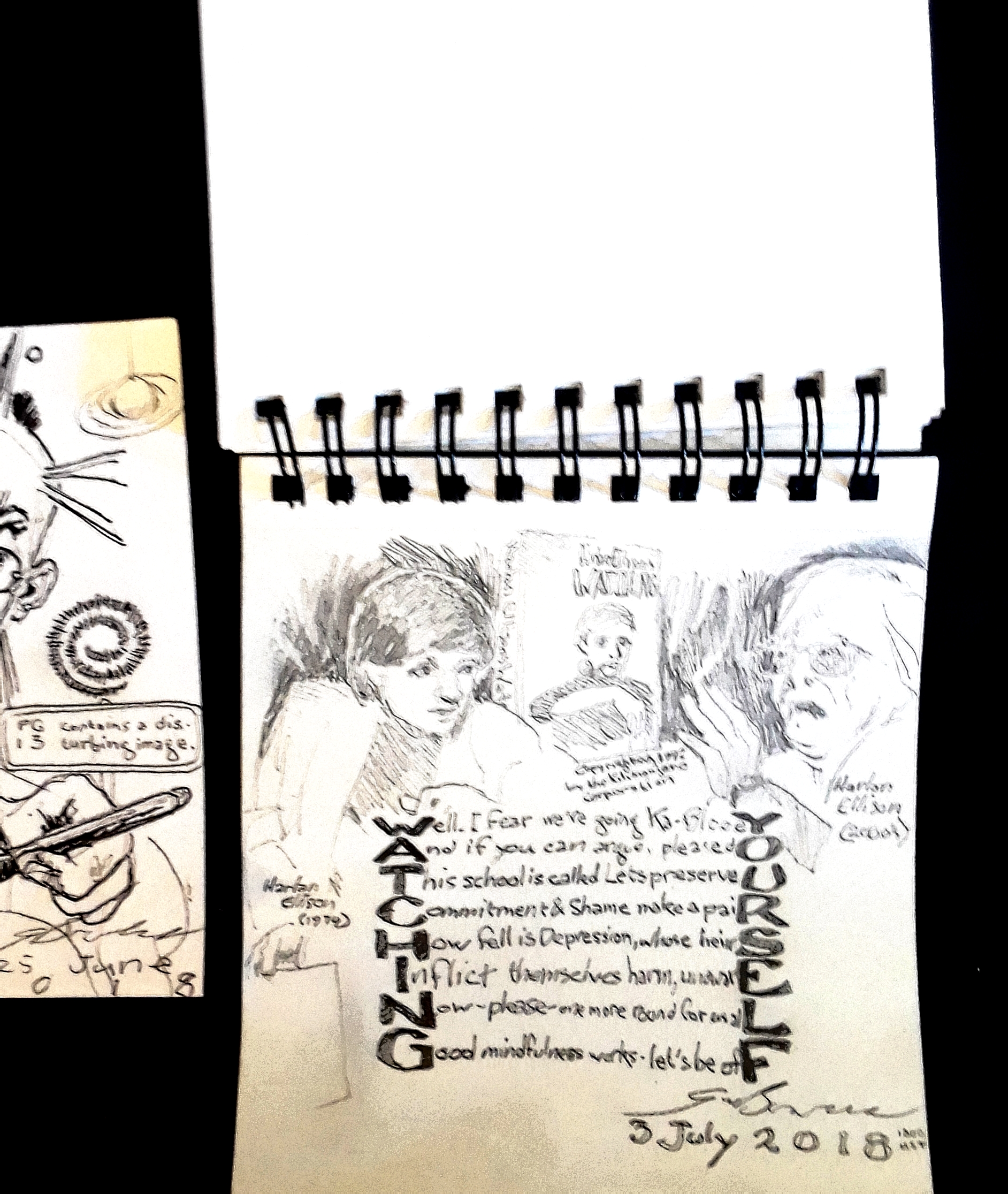
20180703_130324.jpg

Here are those final-draft words:

Well, I fear we’re going Ka-Blooey

And if you can argue, please do

This school is called Letspreserve U

Commitment & Shame make a pair

How fell is Depression, whose heirs

Inflict themselves Harm, unaware

Now, please–one more round for us all

Good mindfulness works–let’s be off

One last little spookiness. I went to Goodreads to look at the book jacket for HARLAN ELLISON’S WATCHING. The intro paragraph is Ellison’s style. If he didn’t write it, some damn good pasticher did. Whichever, the last two sentences address friendlessness (first sentence) and self-preservation, which is the theme of this page. Word for word, here they are: “As an essayist, he has no equal; as a film critic he has no friends. Take care.”


Here are some more self-rejected pages of mine. Ironically, there are yet more pages that I am yet again self-rejecting. The ones that don’t make the cut either are not visually engaging enough or are repetitive of themes or motifs previously presented.

Once upon a time the Phoenix Art Museum had a show of some of the stuff Claude Monet did at Giverny that was still unfinished at the time he died. Of the dozen-and-a-half canvases presented, there was only one that was worth looking at as a painting and not as a clue of Monet’s creative process; and “sketch and then fill in” about summed up his creative process on individual canvases. It was thin soup indeed, and if it hadn’t been Monet doing it the museum would never have shown it. Consequently, in the (I hope) far future when I start to get a glimmer of that Tunnel with the Bright Light, I hope I will have tagged those sketch-musings of mine that are not worthy of a viewer’s attention, that they may be consigned to the flames. (See Harlan Ellison’s ALL THE LIES THAT ARE MY LIFE for a more extensive discussion of this philosophy.)

Onward:

Image

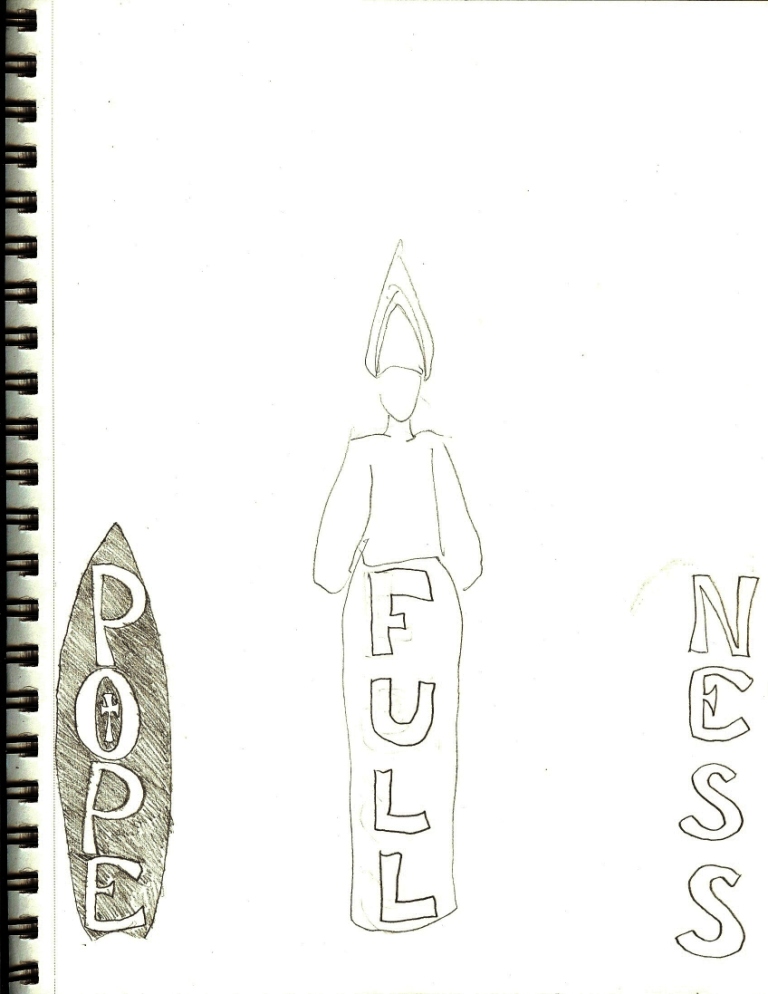
Popefullness

Must’ve done this around the time the latest Francis tried on his funny hat.

Image

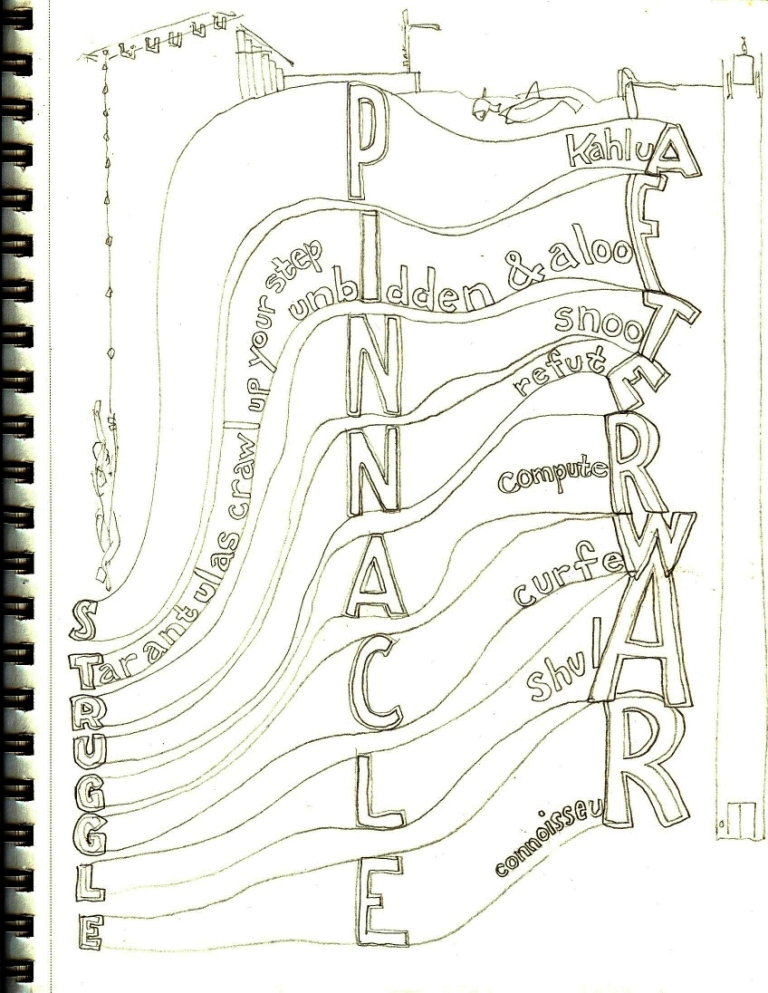
Struggle/Pinnacle/Afterwar

Comic book writer Steve Gerber, whose Howard the Duck made a great comic book but a horribly Uncanny Valley movie that misused Lea Thompson and Jeffrey Jones, once said something like “You know what there is at the top of the ladder? Another ladder.” And that’s where you Kick It Up A Notch or more aptly Take It To The Next Level. More irony: I wasn’t able to do that with this one; I realized it would take about five times the effort a ‘normal’ page requires.

Image

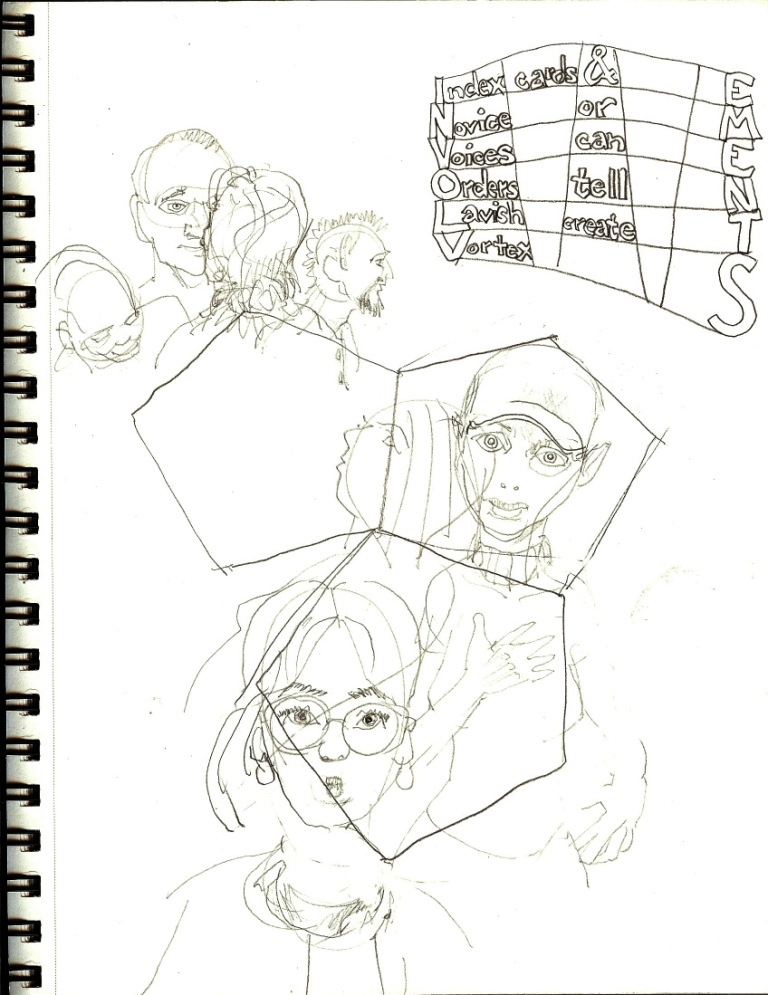
Involvements

Here’s one that would be easy to finish. I vote it Most Likely To See Completion amongst these Salon entries.

Image

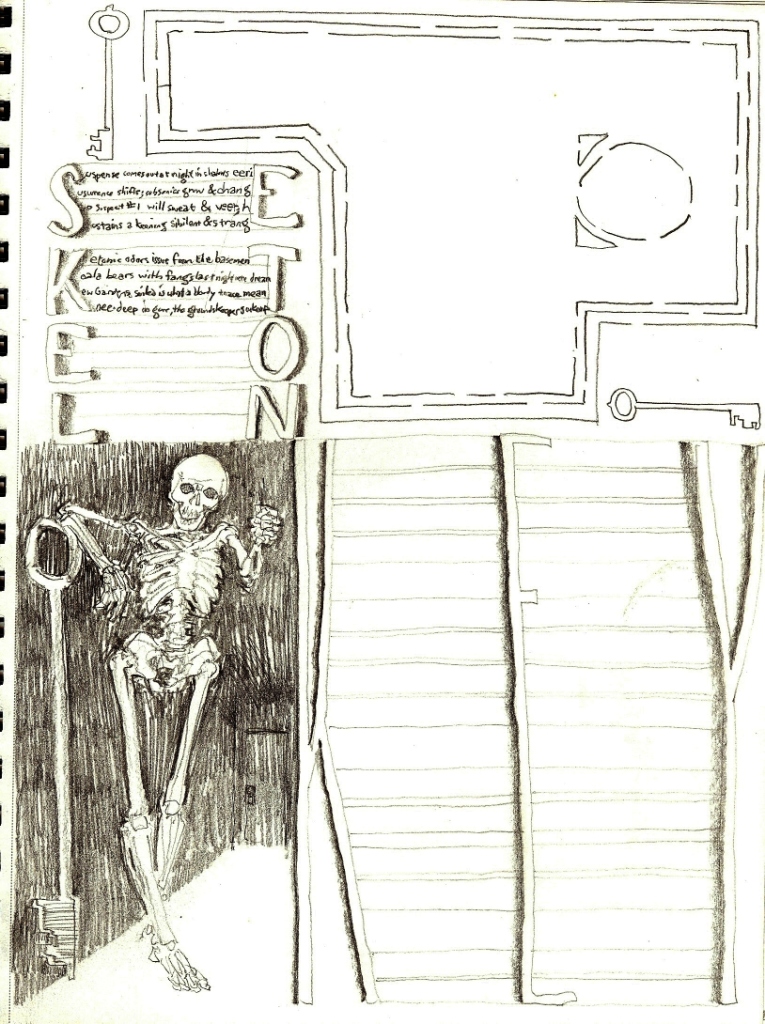
Skeleton/Key

Gee, I just love bone configurations, especially if they hang together…

Image

Logarithm

Logarithm, I got music. I got Readers; who could ask for anything more? (See also Algorithm…)

Image

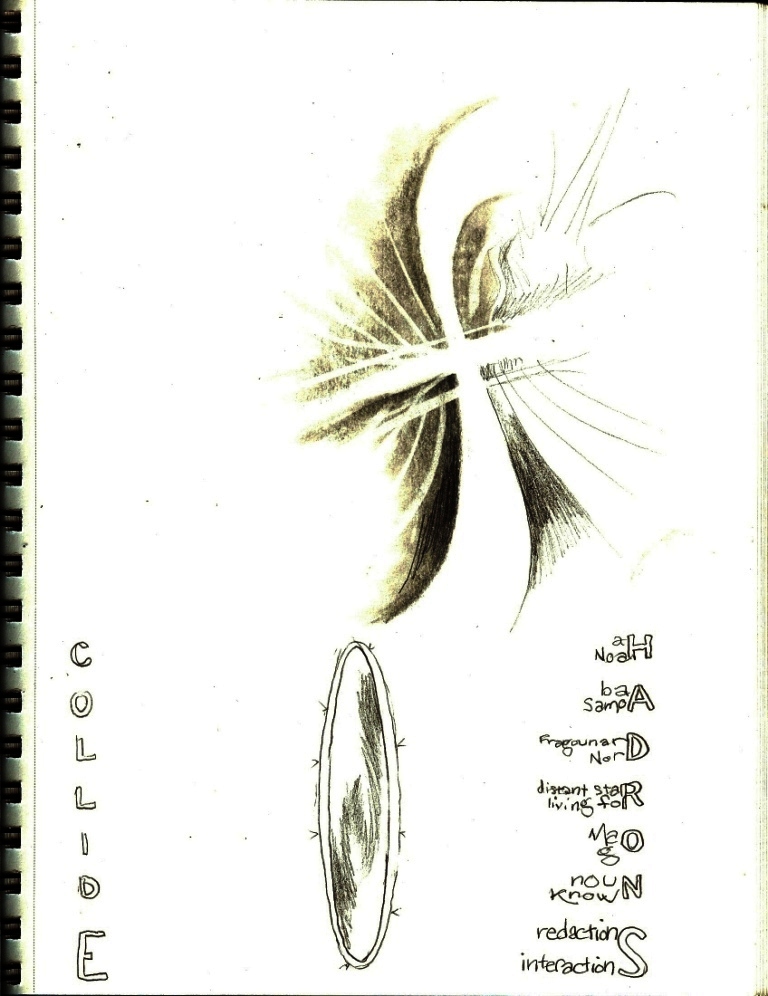
Collide O Hadrons

I’m sure this was done around the time scientists confirmed the existence of the Higgs boson, the misnamed “God Particle.” I guess “Make-the-Universe-Possible Particle” is too much of a mouthful.

There you have them, for now. There may be a Part Three, but I’ll do a few posts prior even if there is one.

Image

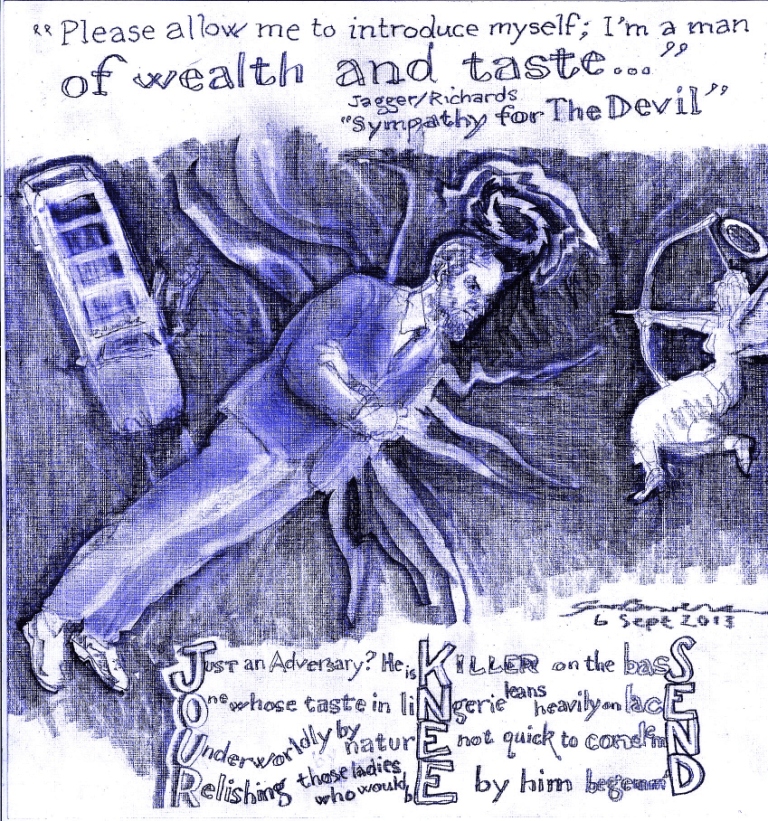
The Devil exists in my heart, thanks mostly to tales told me in my early childhood. He used to scare the Bejeezus out of me, but no more. Some of our fellow world citizens are far, far scarier than the so-called “Prince of Darkness.”

The Devil went down to Georgia, but before he did that he hobnobbed with such as Daniel “Denial” Webster and Alistair Crowley.

The translation of “Satan,” I am told, is “Adversary.” There is inherent wisdom in this, I think. Let us all avoid adversarial relationships.

With my epigram I tip my hat to the Rolling Stones and their two bad boys. See THEIR SATANIC MAJESTIES REQUEST for more info.

Harlan Ellison wrote a long story, “The Deathbird,” that among other things attempted to demonstrate how Satan got a bum rap, with cards stacked against him (until, ironically, Nathan Stack happened along).

The words:

Just an Adversary? He is K I L L E R on the bass
One whose taste in lingerie leans heavily on lace
Underwordly by nature not quick to condemn
Relishing those ladies who would be by him begemm’d

Image

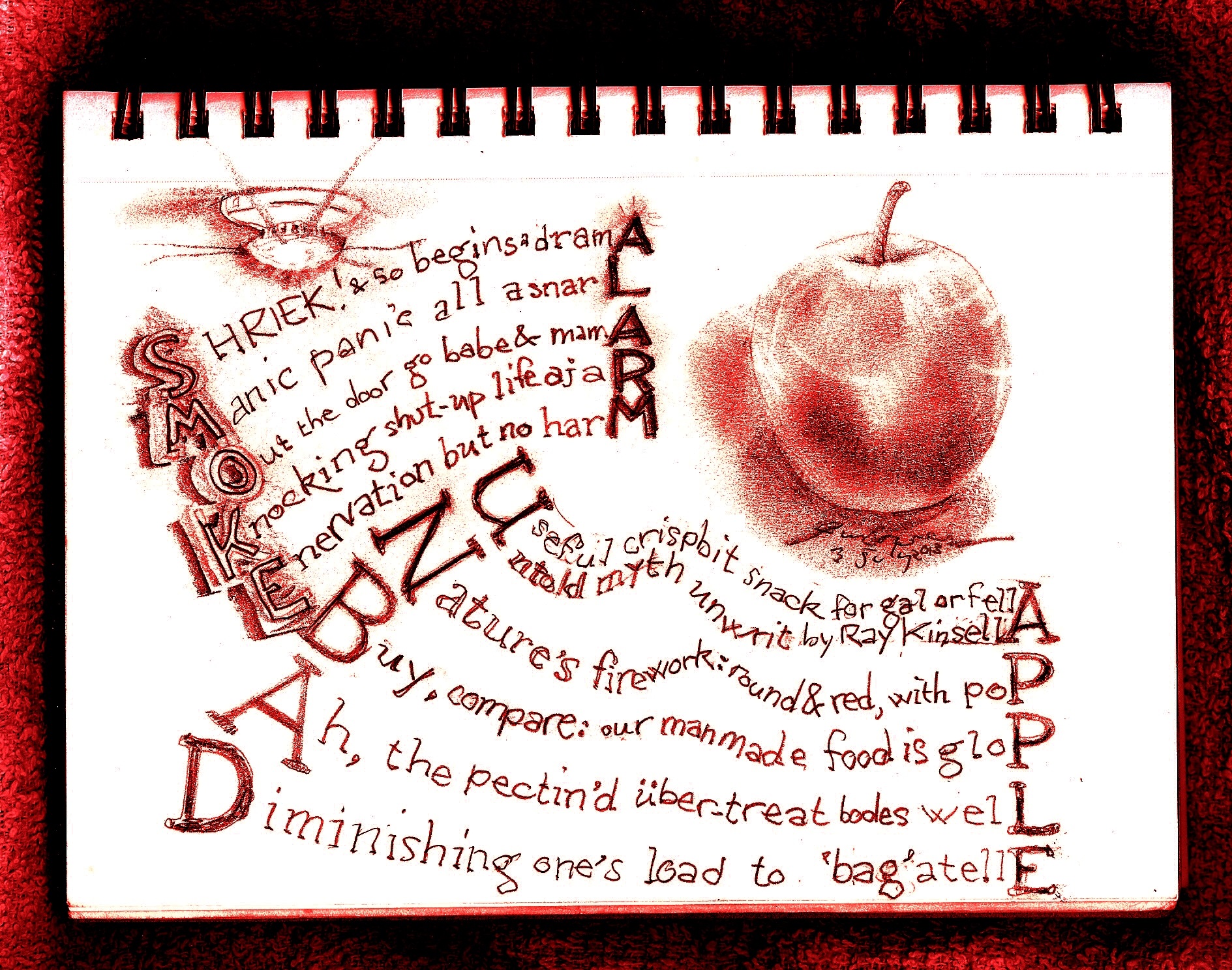
A bad apple spoils the bunch, but an unbad apple can brighten a day and keep you out of the waiting room. A smoke alarm makes a piercingly awful noise, but you’ll be glad it did. So here’s to these two little-sung inanimate-yet-not Heroes.

Smoke Alarm words:

SHRIEK! & so begins a drama
Manic panic all asnarl
Out the door go babe & mama
Knocking shut-up life ajar
Enervation but no harm

Unbad Apple words:

Useful crispbit snack for gal or fella
Untold myth unwrit by Ray Kinsella
Nature’s firework: round & red, with pop
Buy, compare: our manmade food is glop
Ah, the pectin’d über-treat bodes well
Diminishing one’s load to ‘bag’atelle

NOTE: Ray Kinsella is the author of Field of Dreams. He kind of played fast&loose with J. D. Salinger’s privacy in the novel, perhaps trying to achieve the coup of bringing Mr. Salinger back to the public light. Note that in the movie Salinger has been replaced by the fictitious Terence Mann, magnificently played by James Earl Jones. All of that reminded me that the Garden of Eden story does NOT mention an apple; apples, as Harlan Ellison pointed out, are not indigenous to the Mideast. (See Ellison’s “The Deathbird” for story-springboard use of that.)

Image

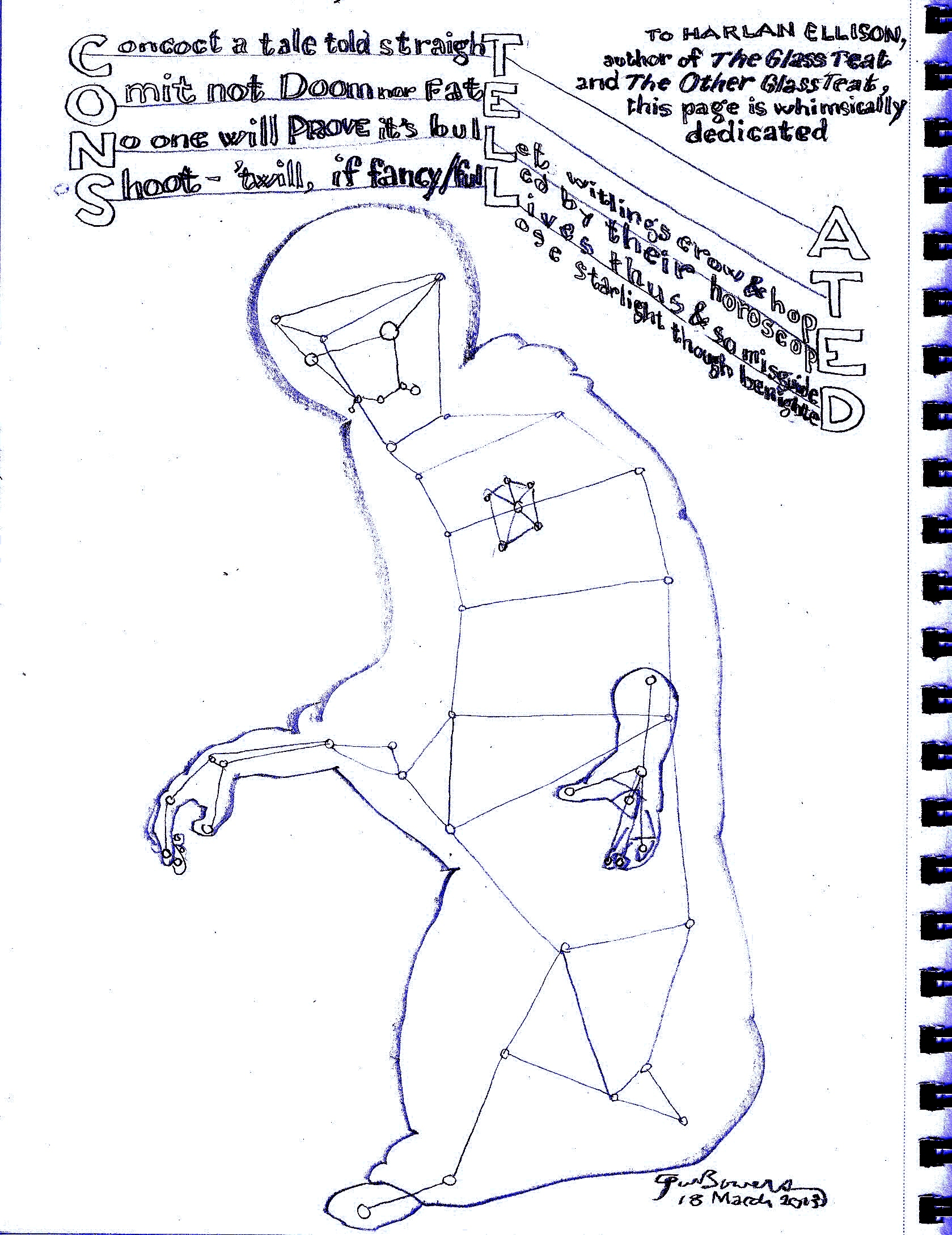
I love looking at constellations, though I think Astrology is a bunch of nonsense. The constellation they call Orion looks more like a butterfly than a mighty hunter to me. Scorpio–Bent Seven; Cassiopeia–the W in WTF.

Here are the words of the fractured, partially-blank acrostic:

Concoct a tale told straight
Omit not Doom nor Fate
No one will PROVE it’s bull
Shoot–’twill, if fancy/full
Let witlings crow & hope
Led by their horoscope
Lives thus & so misguided
Lose starlight though benighted

PS–this page is offered for entertainment value only. [smiley face]

Image

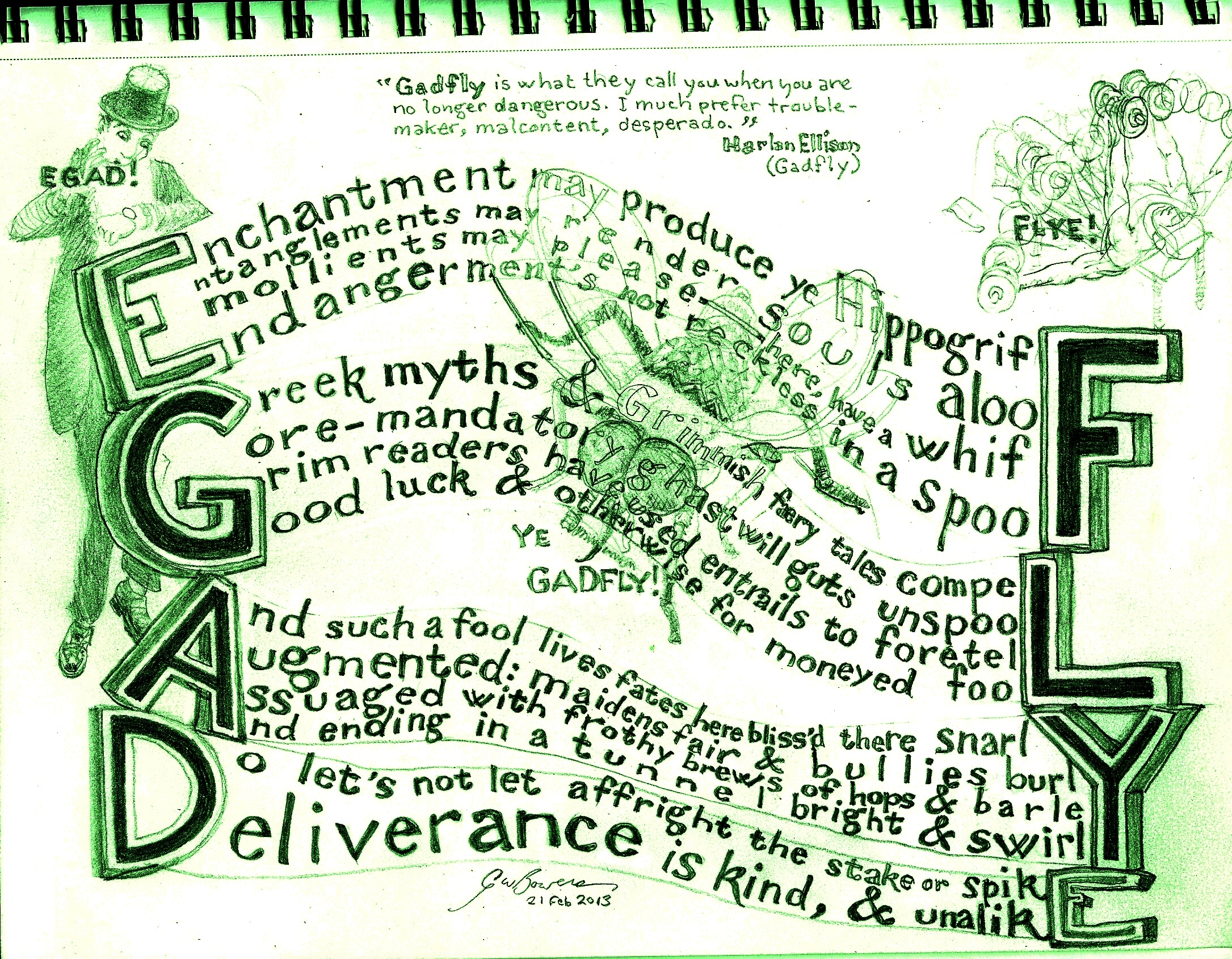
The Epigram

“Gadfly is what they call you when you are no longer dangerous. I much prefer troublemaker, malcontent, desperado.” Harlan Ellison (Gadfly)

The Sonnet

Enchantment may produce ye Hippogriff
Entanglements may render souls aloof
Emollients may please–here, have a whiff
Endangerment’s not reckless in a spoof

Greek myths & Grimmish færy tales compel
Gore-mandatory ghast will guts unspool
Grim readers have used entrails to foretell
Good luck & otherwise for moneyed fool

And such a fool lives fates here bliss’d there snarly
Augmented: maidens fair & b u l l i e s burly
Assuaged with frothy brews of hops & barley
And ending in a t u n n e l bright & swirly

Do let’s not let affright the stake or spike
D e l i v e r a n c e is kind, & unalike

The Annotation

First I thought of a Gadfly. Then it occurred that there are two words, Egad and Flye, that acrosticized would be Gadfly bookended by the letter E. The result promised to be a startling (Egad!) exercise (Flye!) in nonsensical-but-not hybridization. Myths from early history have done rudimentary gene-splicing: see Pegasus and Hippogriff. When we make up stories, if anything’s possible and it’s entertainingly told, the more outrageous the Nonesuches the better. And story-danger is not reality-danger.

“Gore-mandatory ghast” is a weird tip of the hat to Mervyn Peake and his Castle Gormenghast. I have not read more than a handful of Peake’s words, and I found his illustrations unpalatably crude, but I got enough of a taste to see he was a unique visionary and a singular storyteller.

I use the word Deliverance ambiguously. “Deliverance is kind” is a skewed tribute to Stephen Crane, who wrote “War is kind” while giving only the barest hint of explanation. Like Crane, I think the reader is rewarded if she or he must supply important details without regard to what the “right” answer is. Dear reader, whatever you think Deliverance means in this poem, you’ll be right–if you are sincere.

One last note about Harlan Ellison. He has won innumerable awards for his writing, and is admired by such as Tom Smothers, Robin Williams, and Neil Gaiman. He was Dangerous once. I do not think he is Dangerous any more, not the way he wants to be Dangerous, so I harmlessly rib him with the “Gadfly” tag, but I’d love to be wrong.

Anyone else want to play?

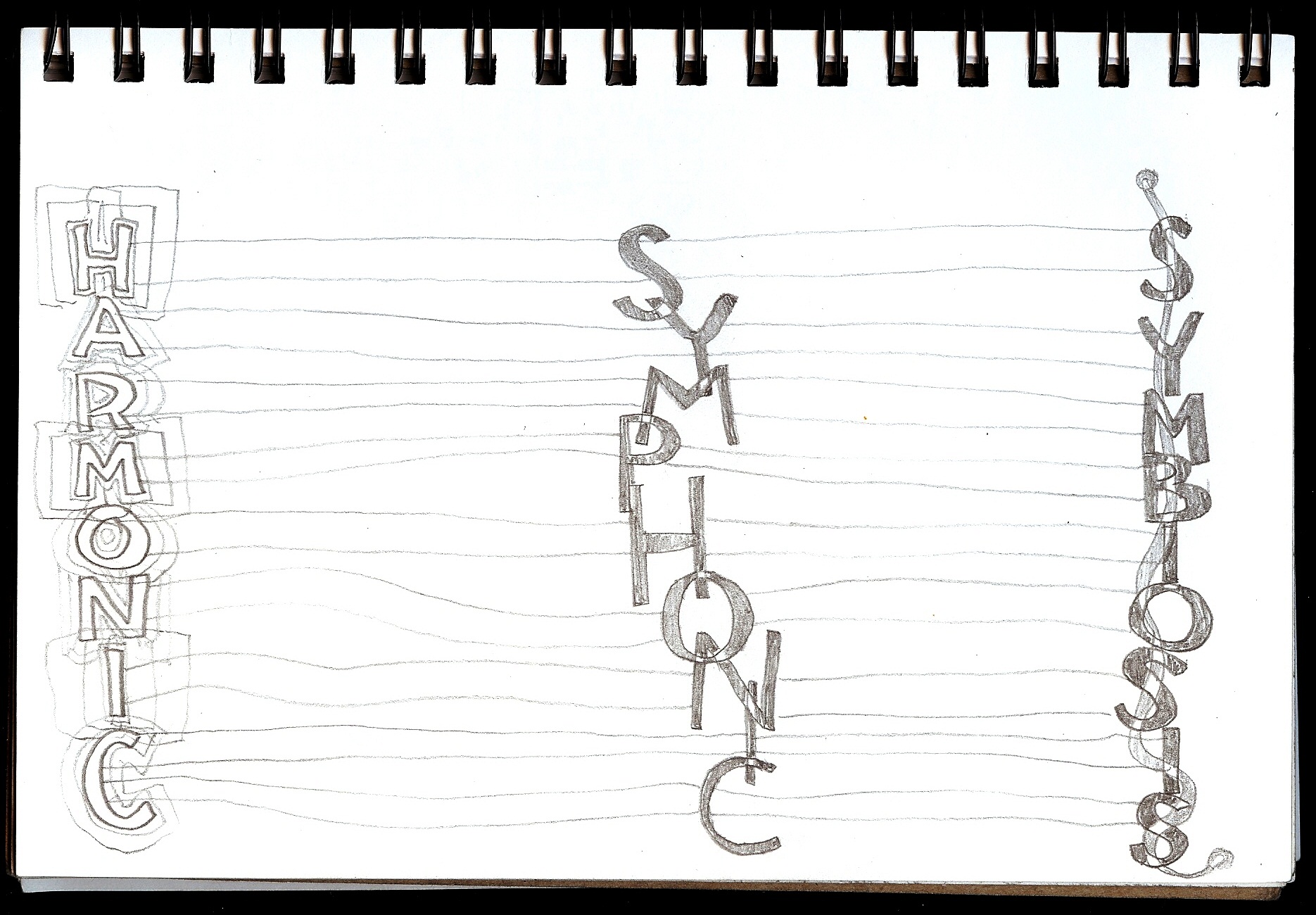
Below I supply the beginning of a page. I may complete the page as soon as later today, or it may lay fallow for a while. The triple acrostic is HARMONIC SYMPHONIC SYMBIOSIS. A hint to writing these is to start with the words at the end of the lines. If the letter I gives you trouble, try doing an Internet search on “words ending in i.” Note also that HARMONIC has eight letters while SYMPHONIC and SYMBIOSIS both have nine; so I’ve supplied line guides that include two lines coming from the C in HARMONIC. Hope you try it for ten minutes, dear reader; you may become hooked, and it’d be an ego boo for me to midwife another acrostic poet into the virtual world. Good Fun and Have Luck!

Image