Archive

Tag Archives: poetry

your noodle is a wonderland
of fixt intent and reminisce
of journeys by the lump and strand
and newfound hope and longlost bliss

so treat your noodle with respect
and seek new treasures for its store
be caring kind and circumspect
and own your deeds and go for more

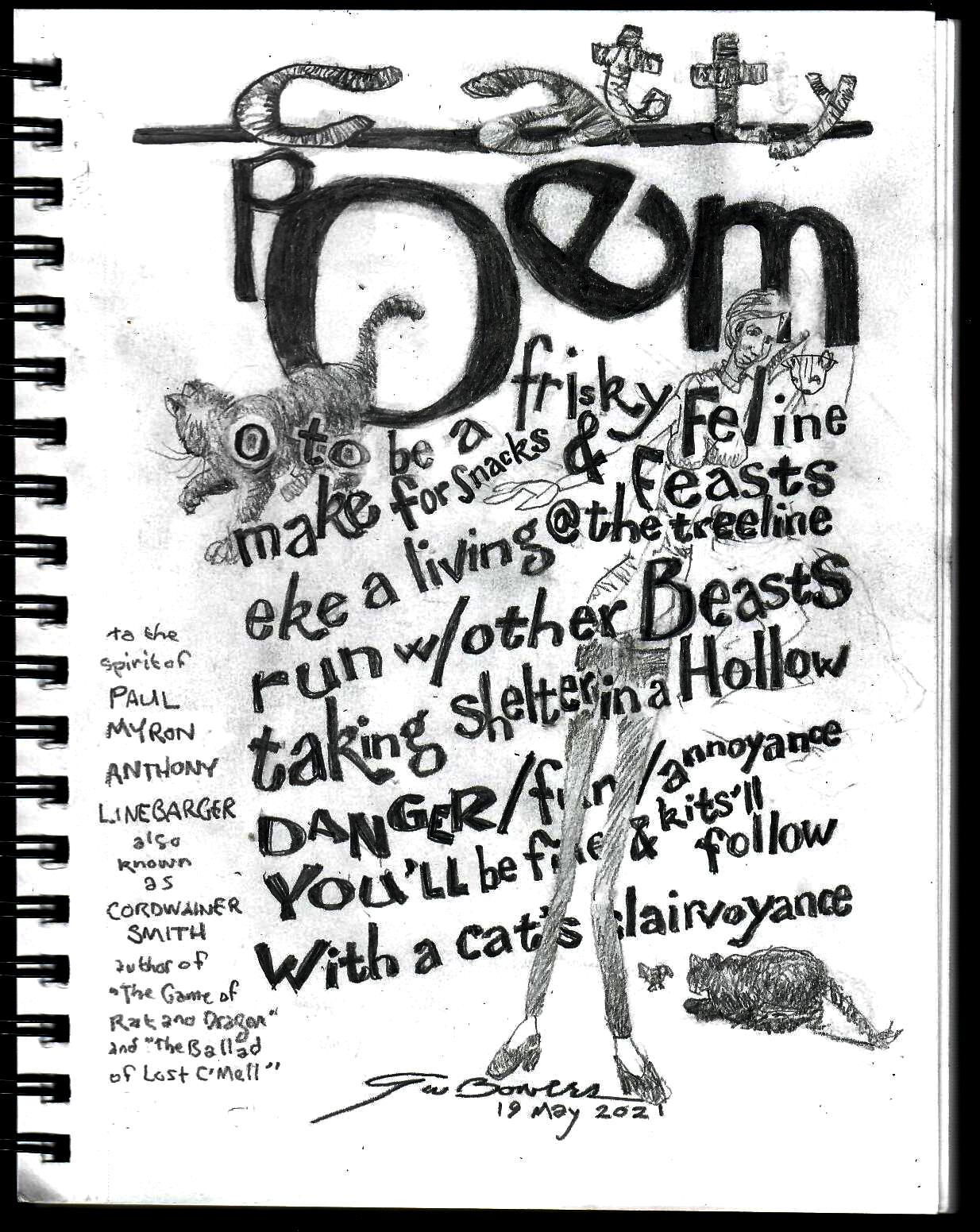
2021 0519 catty poem

catty poem

o to be a frisky feline
make for snacks and feasts
eke a living at the treeline
run with other beasts
taking shelter in a hollow
danger/fun/annoyance
you’ll be fine and kits’ll follow
with a cat’s clairvoyance

Some people are Dog people, some Cat people. I consider myself both.

The man the world knew as Cordwainer Smith was a Cat person. He had a cat named Cat Melanie who inspired his iconic character C’mell, who by appearances was a human being but was in fact one of the Underpeople, derived from cat DNA.

If you’ve never read a Cordwainer Smith story, “The Ballad of Lost C’mell” is available in PDF form. If you are a Cat person I think you will enjoy it. Cat person or not, I think you will find a sense of wonder and magic in Smith’s fables.

IMG_20210315_185700_592

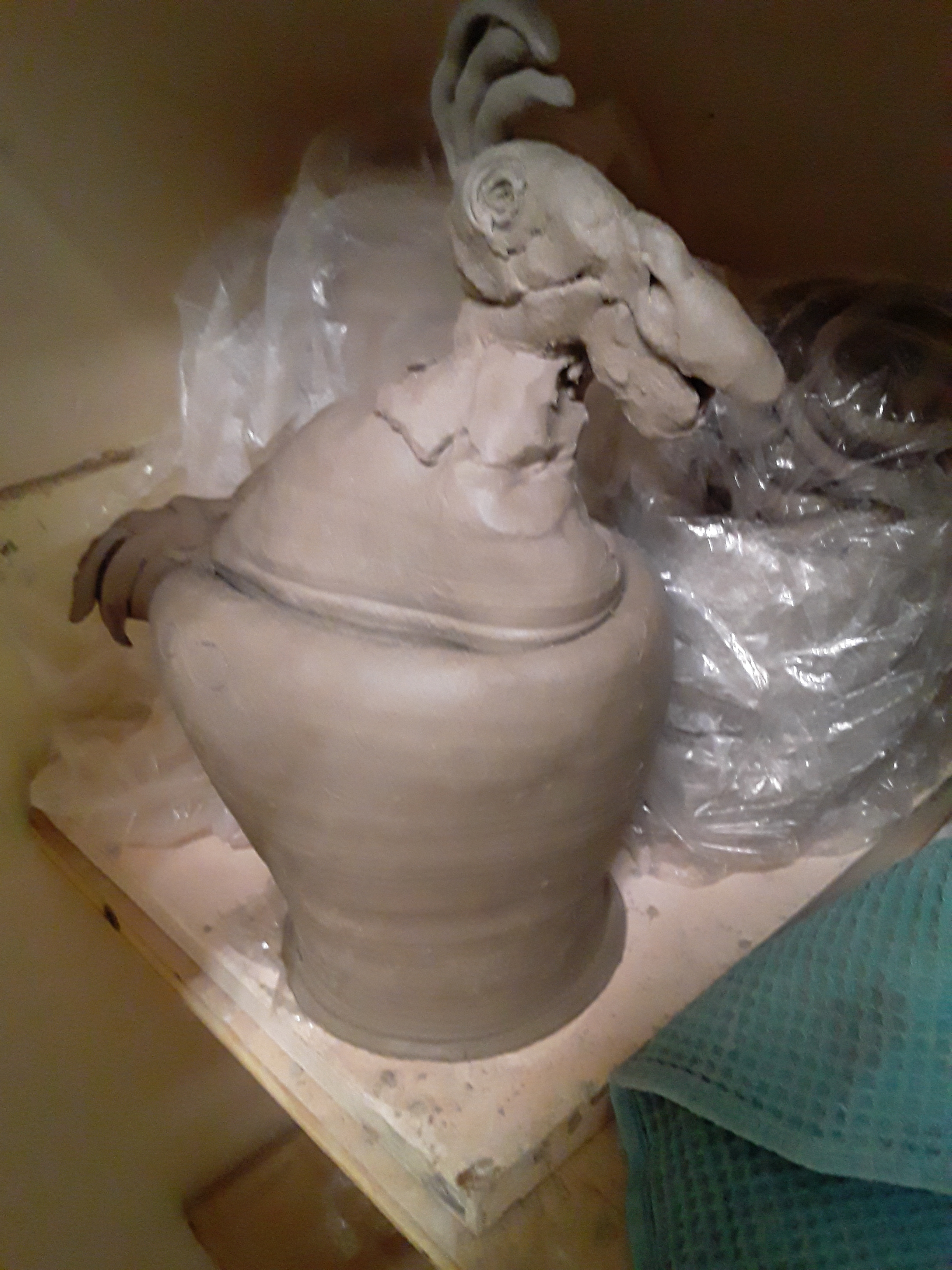
feat o clay

storebought clay comes in 25lb bags
two bags fit within a 50lb box
forty boxes make a one-ton pallet
and it is cheaper by the ton
but let’s start with what one bag can do

20210315_202546

a quarter of a bag yields an exotic heretofore nonexistent bird
a tenth of a bag might give you a cereal bowl or a small teapot
devoting all 25lb of the bag to one shape might be the life-sized head and shoulders
of a couple of human beings
the same 25lb might depict a village in ultraminiature

2021 0316 vase

“feet of clay” is idiomatic for fallible
but perform a feat o clay
and you become upliftable

2021 0316 closed form

commune
attune
become
one
with
clay

20210303_090112

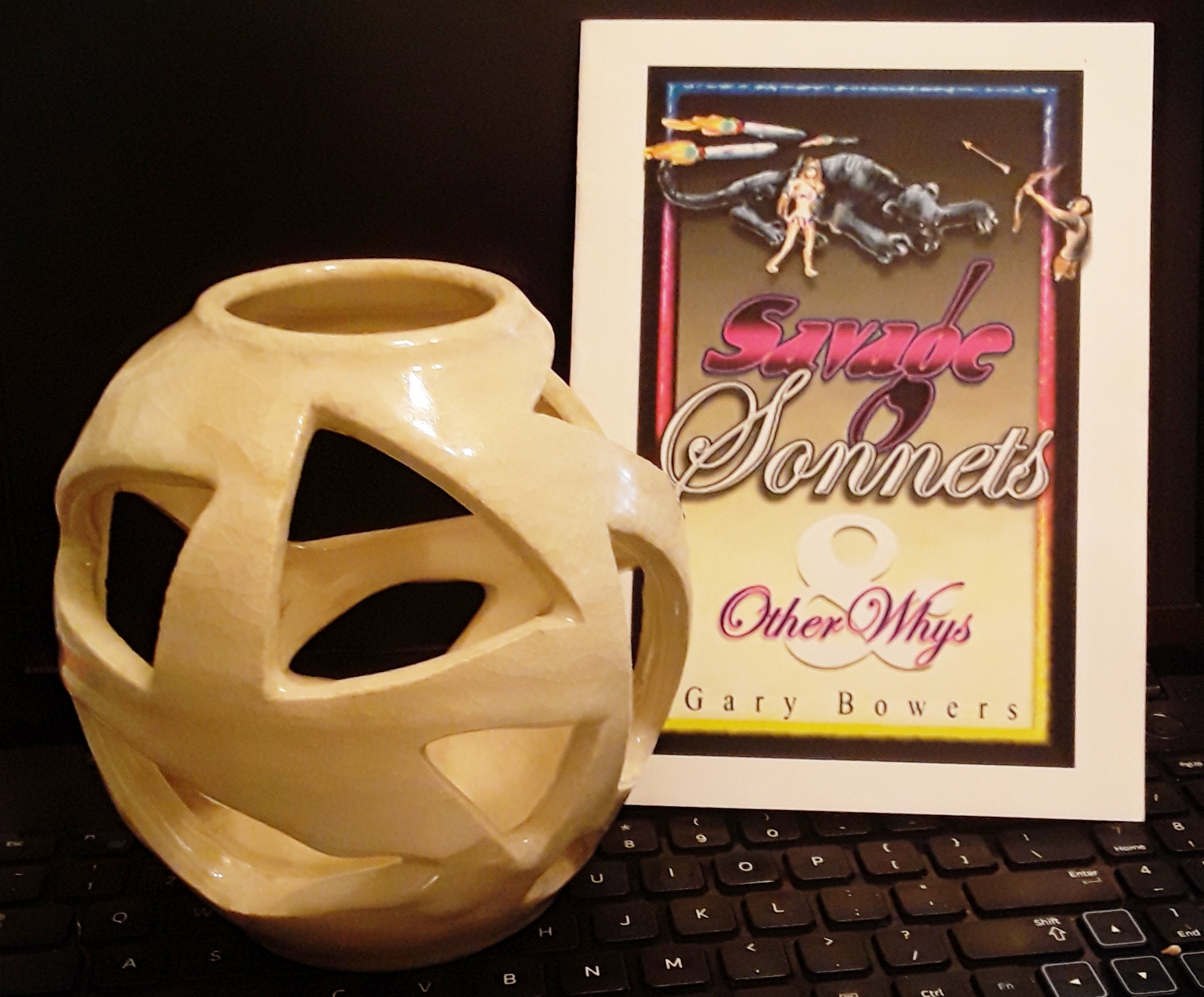
The ceramic piece with the triangle cutouts was made by me in 2007. The chapbook was made by me, with help from my friends Steve Boyle and Genny Edge, in 2008. I gave both of these creations to my mother soon after they were made, but and they were hers till she died on December 11, 2020, and now they are mine again.

I don’t even remember making the vessel, though I do remember that i did a whole series of cutout pieces back in the day. One of them graced my deceased friend Karen Wilkinson’s front-room table for several years. As for the chapbook, it was a labor of love and I remembered it well, and am grateful that this copy yet exists.

Both works now make me feel strange, and strangely hopeful.

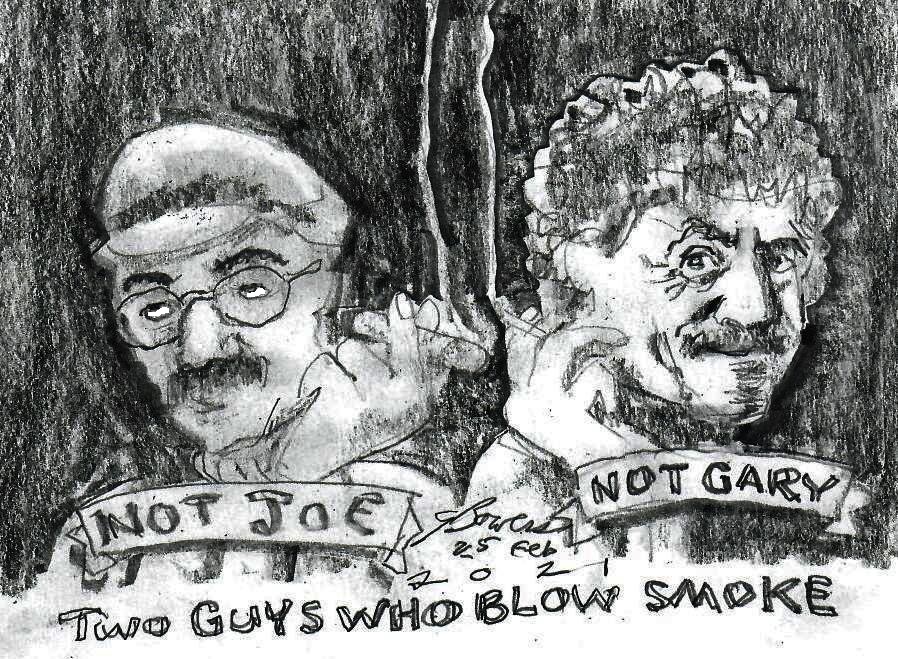
A fellow member of my Poets All Call group, a bright and imaginative man named Joseph Arechavala, wrote a poem and posted it to our group yesterday. I found the poem contained a metaphor for Truth that was apt . . . and I also felt compelled to respond. So I wrote a poem too. I have Joe’s kind permission to post our exchange for all the Blogoverse to see, and that will come soon, but first I want to share a drawing I just made, based on the fact that Joe is using a Groucho Marx headshot for his avatar. I thought it would be cute to draw Groucho and one of my own personal heroes, Kurt Vonnegut, shoulder to shoulder and smoking their tobacco products of choice, thus:
2021 0225 grouch kurt

JOE:

Truth is elusive
Like a woman
Standing in the distance
The sun outlining
Her beauty
A woman who
You know will
Never walk towards you
But will remain
A vaguely fair form
In the far away field
And you will
Walk towards her
But never
Come close to her
And you will weep

****

GARY:

Let me be your wingman Joe
Truth’s elusive this I know
She knows EVERYTHING you’ve done
Stuff for spite and some for fun

She has more than one big sister
I suggest you date one mister
Luscious Evidence will show you
Family pics of Truth–you know you

Could do worse than date Deduce Me
More plot twists than I Love Lucy
You’ll be challenged to decide
If you want Truth by your side
Or for a bride
With Lies denied

One more sister makes things clearer
That is Truth’s twin sister Mirror
Gaze deep DEEP into her glass–
TRUTH–she’s HERE!!!
–to Kick your Ass.

Whoops.
Sorry.

****
Gary: Joe, you have captured an important aspect of Truth in your poem. I am grateful. And I hope you see, for all my clowning, an important bit of Truth in mine, mainly that showing an interest in phenomena related to Truth does bring us closer to Truth Herself.

Joe: Gary Bowers It just feels good to finally be writing again.

Gary: Joe, I would love to do a blog post on this exchange of ours. May I have your permission?

Joe: Sure. Post the link so I can read it.

Gary: Will do, my friend!
****
A couple of things before I go. First, Joe and many others in our group are suffering from writer’s block. I think the pandemic has something to do with it. So his comment about feeling good to be writing again is a hopeful sign to me.

Second, this is not the first instance in poetic history wherein one poem inspires another. Christopher “Kit” Marlowe wrote “The Passionate Shepherd to His Love” in the 16th Century. One year after it was published, none other than Sir Walter Raleigh wrote “The Nymph’s Reply to the Shepherd,” a fitting response (snub) to the Passionate Shepherd’s overtures (lusty). And in subsequent centuries other poets wrote poems inspired by the original, and in the 20th Century those two sly dogs Ogden Nash and Dorothy Parker both took a whack at it. So History is not by any means being made by Joe and me, but what matters to me is that the creative spark was ignited by Joe, and then I got ignited as well, for a pleasant journey to deeper digging.
It being Tuesday, I did my Title Tuesday feature for the Facebook group Poets All Call. This time round my fellow moderator Genevieve Lumbert offered three of her own titles as well:

The Great Falling Away
inertia
hope

My thanks to my lifelong friend. These titles helped me write some poetry that went beyond puzzle-solving and into exploration of matters of the heart.

Here is how I responded.

The Great Falling Away

A clumsy man heard surf
Felt love
Listened to a story about cowhide
Flung over a cliff
And kissed a woman soundly
And kissed a woman softly
And kissed an opportunity
Goodbye.

We don’t always fall down
Like Lucifer.
Sometimes we fall away
Like a vagabond
Or a brisk wind
That shifts direction.

Sometimes a man dies
With a private chamber of sound kisses
And tender sentiments
Still in him.

inertia

the clutter of a litterbug
a scattered realm of shame and love
a stutter step a tale of woe
of habits formed that won’t let go

the butter of another’s lust
unshuttered cluster’d stars unfussed
pull/cull the interstellar dust
and slowly come unwound

the mainspring of eternity
is neither wild nor full unfree
mere cutlery manipulating
flesh of roasts anticipating
guests to sink their teeth
and flee
or saunter through
infinity

hope

we are vertical
and we breathe.

so let us believe
life contains a goodness
our thirst to slake,
the warm embraces
we want to make,
the hikes and climbs and jousts
for whish we roustabouts roust,
the heldhands nightwhispered
plans d’evasions
we wish to conspiratorily make
and then unleash…

hope like a sprig of a sprouting bean
makes a fat man long to lean,
makes two journeys intersect
and lovelorn halves
at last
connect.


[Friends, this is written in haste and may or may not be edited at leisure. Blog Post #2000, scores of posts hence, now has an ETA of December 2, 2022. These last 199 posts should see the conclusion on the n.e.s. series, the Rubáiyát in its entirety, and a dozen reworkings of the best of my drawings in acrylic paint form. Of course “L’homme propose mais Dieu dispose,” but also “Shoot for the moon, and if you miss, you still end up in the stars.” Meanwhile, this State of the Heart message, which I hope to obsolesce…]

to kiss and not to tell. ° “And the girls you offer champagne say Yes, ° And the girls you love say No, ° And your salary isn’t what it was, ° And you feel like the poet Poe.” ° Ogden Nash, “Elegy in a City Shambles” ° most people i know have been kissed ° at least a thousand times ° (less so lately due to pandemickal conditions) ° ° as for me i’m not telling ° but inferences may be drawn from this discussion ° ° the zap factor of some kisses is huge ° and blessed be those pairs who zap over decades ° for they are the fewly unusual zesters ° ° and woe and sympathy to those unwilling loners ° who receive and bestow kisses perfunctorily ° and scavenge memory lane for reminders ° that zappage has happened and might happen again ° ° modern suitors are often like…uh… ° auditioning actors ° who have much to offer but not ° in the eyes of the casting director ° who knows what she wants ° and sees what she doesn’t ° and is quick to thank ° and offer the faintest shred pf hope ° but even quicker to° upper-handedly call “Next!” ° ° the world is not alloronothing ° and scraps may be had while a feast is prepared ° but those kisses ° those electric kisses ° are the sirens of modern love ° and Romance ° is also defined ° as “falsehood” ° ° it is good to love ° but to love and not be loved back ° is an agonizing challenge ° ° hey though ° relax ° have a walk and a read and a workout ° use each day as a step toward true love ° and affirm and expect ° ° and you will be zapped ° and be eager to tell ° but it is more delicious o lover ° to kiss and not to tell

On Facebook I have just finished the third of five takes of a series called “ah, humanness.” This two-word humdinger of a phrase showed up in a comment by my poet friend Susan Vespoli a few days ago. It has been stuck in my head ever since. Some of that is due to Eugene G. O’Neill, an American playwright of the 20th Century.

In Drama class in high school we were required to portray roles from classic plays of our choosing. At home were books of decades past bequeathed to my mother by our unrelated-by-blood Aunt Peg, and there were several plays by Eugene O’Neill among them. So in class I became both Driscoll and Yank for Yank’s death scene in Bound East for Cardiff, and I got a rave review from Miss Ornstein (later Mrs. Frye) for my Eben Cabot in Desire Under the Elms. But one of O’Neill’s Dramatis Personae that would have fit me like my skin was Richard, pretentious and melodramatic schoolboy son of newspaper publisher Nat Miller, in perhaps the only well-known comedy penned by O’Neill, a charming slice of Americana called…Ah, Wilderness!

The title is derived, of course, from the famous Quatrain XII by Hakim Omar Khayyám, as translated by Edward FitzGerald, poet and contemporary of William Makepeace Thackeray and Alfred, Lord Tennyson. It goes something like this:

A Book of Verses underneath the Bough,
A Loaf of Bread, a Jug of Wine, and Thou
Beside me singing in the Wilderness–
Ah, Wilderness were Paradise enow!

I say “something like this” because there were at least five editions of FitzGerald’s translation, and he fiddled with the translations between editions, and the one above seems to be the popular version. But you will find that the Jug is a Flask sometimes, and sometimes it precedes the Loaf of Bread. There’s also the fact that FitzGerald, partly to cleave to the Quatrain form with its rhyme scheme aaba, did a free translation, wandering from a direct translation for the sake of liveliness and pith. Here for comparison is a more literal translation done by Edward Heron-Allen, an English scholar who was born only two years before Edward FitzGerald died:

I desire a little ruby wine and a book of verses,
Just enough to keep me alive, and half a loaf is needful;
And then, that I and thou should sit in a desolate place
Is better than the kingdom of a sultan.

I’m going with FitzGerald, who for my money gives Khayyám more Zing, and yet retains his core content. Of course, it’s a stretch to turn a “desolate place” into a “wilderness.”

Ah, Wilderness. Ah, Desolate Place.

Ah, Humanness. Just a little free-translative twist…

The Poetry that springs from whence we’ve wended,
The Warp, the Woof, the Fabric rent and mended,
The words with friends, the text exchange, a phrase–
Ah, Humanness, this Poet I’ve befriended!

So I have resolved to write a Rubáiyát of my own. FitzGerald’s later editions contained more than 100, but fewer than 200, quatrains, a selection from the more than 1200 attributed to Khayyám. I will do at least 200. It may take a few days, but my confidence that I can do it at all is based on the send-up I did long ago on Algernon Swinburne’s “Garden of Proserpine” and its 112 lines; my “The Compost of Alginate Windburn” had 136 lines, among them these:

We are not sure of value
And zest is not demure
When winning a new pal, you
Must sell and grin and lure;
And lust, grown vaguely cryptic
Ensorcels us in diptych
Then stings our face with styptic
Once shaven shearly sure.

Swinburne’s form, with its penultimate-lines triplet, is more complex by far than Khayyám’s quatrains. I knocked off the “Ah, Humanness” quatrain in less than 10 minutes. I figure a 30-hour workweek will be sufficient for my Rubáiyát, but we’ll see.

As the title of this post indicates, I’ll be assuming the ridiculous nom de plume of Ghary Khayyáhowyadūn [Gary. Hi ya, how ya doin.] for this endeavor. If I stumble into something better than slapstick-whither-thou-goest for this thing–and I earnestly HOPE to, believe me–so much the better. Stay tuned, Friends!


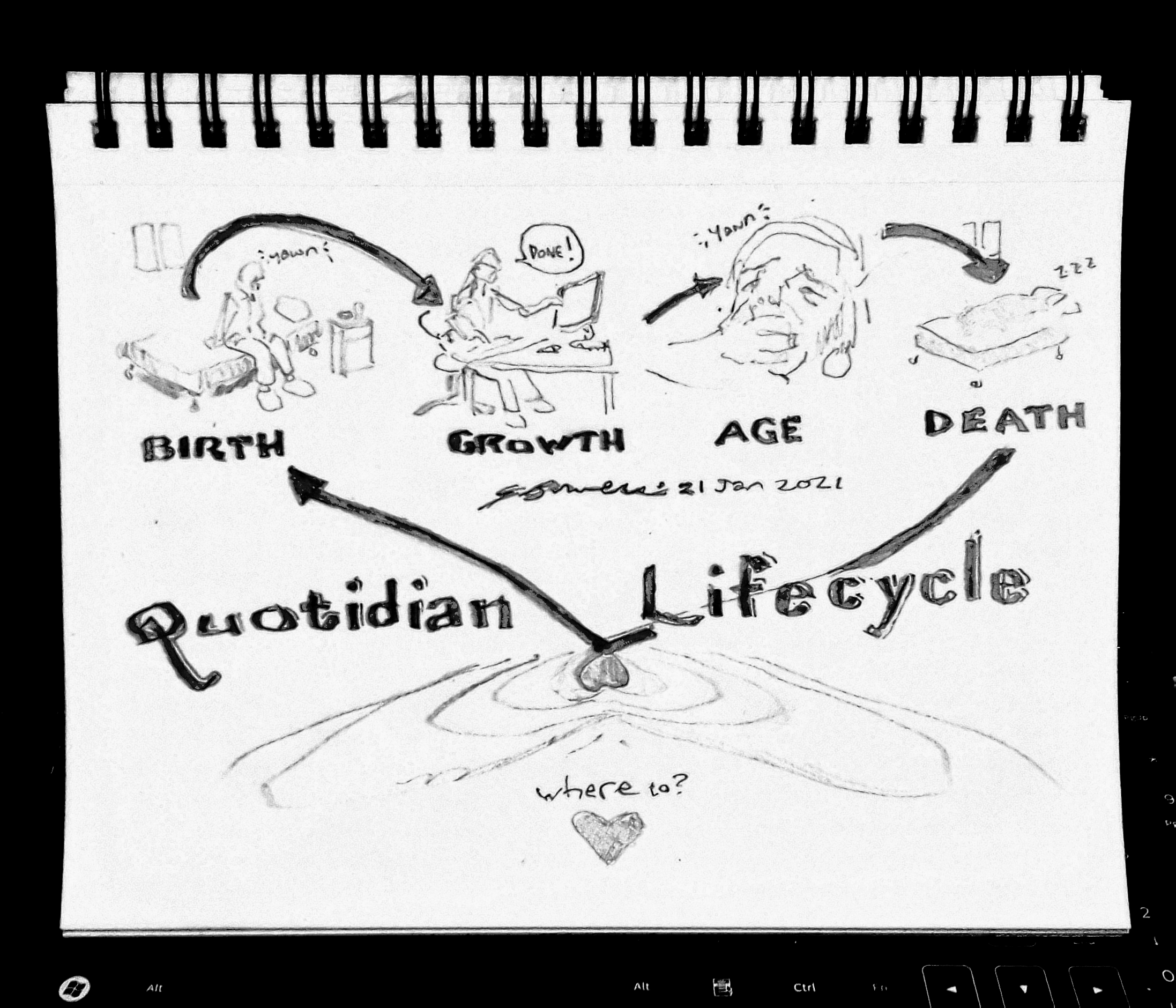
quotidian lifecycle

awakening is a form of birth
taskdoing growth
drowse senescence
death bed

so you were reborn mere hours ago
and into this new life
you may see to it that love is there
and hatred recognized and removed
you may graduate with honors
at scrubbing university
you may keep your troops provisioned
with your grocery requisition
or moldcast and bisquefire
another brick for your cathedral
ste bernardette the hardworker

or you may mope and sit
you may burn out that you not fade
you may build a spectral enemy
and stab and stab at mist

it is your day
it is your microlifetime

where to?

20210121_092459